Nakamichi 582: The Precision Cassette Deck from Nakamichi’s Golden Era
In the early 1980s, Nakamichi stood at the pinnacle of cassette deck engineering, pushing the boundaries of what analog tape could achieve. The Nakamichi 582, introduced in 1982, was a bold statement in high-fidelity audio—a machine that combined meticulous engineering, advanced tape transport mechanics, and audiophile-grade electronics. While not as legendary as the later Nakamichi Dragon, the 582 was a critical stepping stone in the company’s pursuit of perfection in cassette reproduction. It represented the convergence of Japanese precision and analog innovation during a time when the cassette format was being taken seriously as a medium for high-quality music listening.
Historical Context
The early 1980s marked a turning point for consumer audio. Compact cassettes, once seen as portable convenience formats, were rapidly evolving into serious contenders for home and studio use. Companies like Sony, TEAC, and Denon were pushing the envelope, but Nakamichi led the charge with a reputation for uncompromising build quality and sonic excellence. The 582 arrived during this golden era, positioned as a high-end cassette deck for discerning audiophiles and professional users alike.
It followed the success of the Nakamichi 550, a benchmark machine of its time, and refined many of its features. The 582 was not just an incremental upgrade—it was a rethinking of tape alignment, transport stability, and signal path purity. It was aimed at users who demanded studio-level accuracy from their home systems, and it delivered with a level of mechanical sophistication rarely seen outside professional environments.
Technical Specifications
| Feature | Specification |
| Year Introduced | 1982 |
| Format | 4-Track, 2-Channel Stereo (Compact Cassette) |
| Tape Speed | 1⅞ ips (4.76 cm/s) |
| Heads | Three-head system (separate record, playback, erase) |
| Head Material | Ferrite or Permalloy (exact varies by production) |
| Azimuth Adjustment | Manual, user-accessible via front panel |
| Motor System | Dual direct-drive capstan motors |
| Wow and Flutter | < 0.07% (Dolby On, WRMS) |
| Frequency Response | 30Hz – 18kHz (Type I), 30Hz – 19kHz (Type IV) |
| Signal-to-Noise Ratio | > 66dB (Dolby B/C), > 72dB (Dolby C with metal tape) |
| Total Harmonic Distortion | < 1.5% |
| Input/Output | Line In/Out (RCA), Mic In (optional) |
| Recording Equalization | 120μs (Type I), 70μs (Type IV) |
| Power Requirements | 120V AC, 60Hz (region-specific variants) |
| Dimensions | 430mm (W) × 145mm (H) × 380mm (D) |
| Weight | 13.5 kg (approx. 30 lbs) |
Sound Characteristics and Performance
The Nakamichi 582 was engineered for accuracy, transparency, and dynamic range—qualities that defined the Nakamichi philosophy. Its three-head configuration allowed for independent optimization of record, playback, and erase functions, ensuring that each stage of the tape process was handled with precision. This separation meant that users could monitor recordings in real time through the playback head, a feature prized by both musicians and audiophiles.
One of the 582’s most notable features was its manual azimuth adjustment. Unlike most cassette decks of the era, which had fixed head alignment, the 582 allowed users to fine-tune the playback head angle to match the recording. This was particularly useful when playing tapes recorded on other machines, which often suffered from azimuth misalignment leading to high-frequency loss. With the 582, listeners could restore clarity and detail with a simple turn of a knob.
The frequency response was exceptionally flat across the audible spectrum, especially when using Type IV (metal) tapes and Dolby C noise reduction. The deck’s low wow and flutter ensured pitch stability, while its high signal-to-noise ratio minimized tape hiss—critical for quiet passages and acoustic recordings.
Notable Features and Innovations
The 582 was packed with features that set it apart from its contemporaries:
- Dual Direct-Drive Capstan Motors: Eliminated belt slippage and ensured consistent tape speed, improving speed stability and reducing wow and flutter.
- Three-Head Design: Enabled real-time monitoring, precise duplication, and superior head alignment.
- Manual Azimuth Control: A rare feature that gave users unprecedented control over playback fidelity.
- Dolby B and C Compatibility: Provided effective noise reduction for both standard and high-bias tapes.
- Professional Build Quality: Heavy chassis, precision-machined transport, and high-quality components ensured long-term reliability.
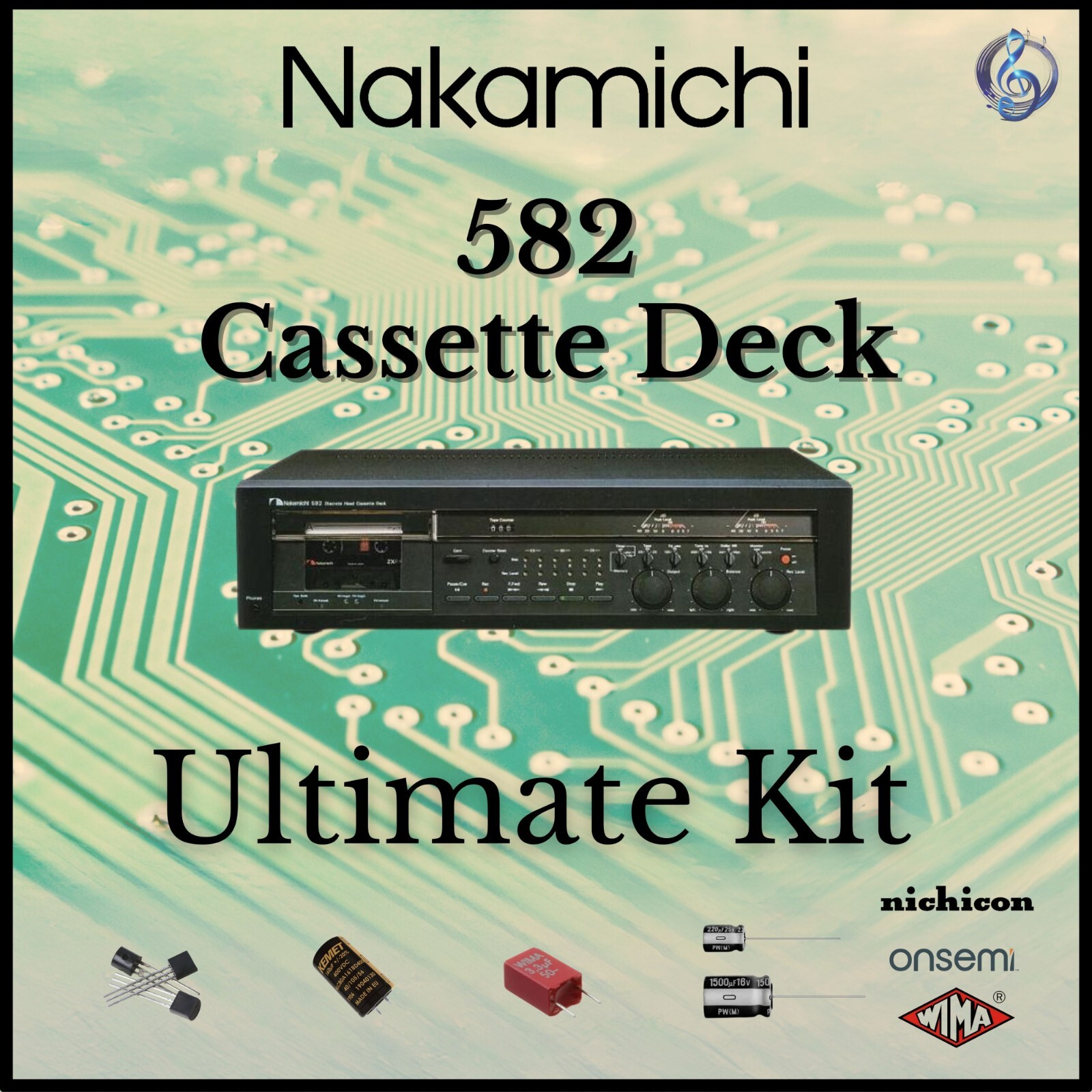
The front panel was clean and functional, with large VU meters for level monitoring, tactile buttons for transport control, and dedicated knobs for bias and equalization settings. It exuded the confidence of a machine built for serious use.
Common Issues and Maintenance
Like all high-precision analog gear, the Nakamichi 582 requires regular maintenance to perform at its best. Over time, the following issues may arise:
- Deterioration of Rubber Components: Although the capstan motors are direct-drive, some rubber parts (such as pinch rollers) can harden or crack. Replacement with modern equivalents is recommended.
- Head Wear and Oxidation: Playback and record heads should be cleaned regularly with isopropyl alcohol. Demagnetization is also essential every few dozen hours of use.
- Capstan Bearing Dryness: The precision capstan shafts may require lubrication to maintain smooth operation.
- Bias Calibration Drift: Over decades, the internal calibration for Type I, II, and IV tapes may shift. A qualified technician can realign the bias for optimal recording performance.
Owners are advised to service the deck every 500–1000 hours of use to maintain peak performance. Finding a technician familiar with vintage Nakamichi gear is key—these machines are complex and not suited for casual DIY repairs.
Current Market Value and Collectibility
Today, the Nakamichi 582 is a sought-after piece among analog enthusiasts and vintage audio collectors. While it doesn’t command the sky-high prices of the Dragon (which can exceed $2,000 in working condition), the 582 typically sells for $400–$700, depending on condition, service history, and completeness (original box, manuals, etc.).
Its value lies in its historical significance, build quality, and sonic performance. It appeals to users who appreciate mechanical excellence and the tactile experience of analog tape. Though overshadowed by later models, the 582 is increasingly recognized as a critical link in Nakamichi’s evolution—a machine that refined the ideas that would culminate in the Dragon.
Conclusion and Legacy
The Nakamichi 582 may not be the most famous cassette deck in history, but it is a masterpiece of engineering from a company that refused to compromise. It embodied the belief that the cassette format could deliver true high-fidelity sound—if engineered with care and precision.
For today’s audiophiles, the 582 offers more than just nostalgia. It provides a window into a time when analog tape was pushed to its limits, and when machines like this were at the forefront of audio innovation. Whether used for archiving vinyl, creating high-quality recordings, or simply enjoying music with warmth and detail, the 582 remains a testament to Nakamichi’s golden era.
If you’re lucky enough to find one in good condition, treat it well, service it properly, and you’ll have a piece of audio history that still outperforms many modern digital solutions in musicality and soul.
eBay Listings


As an eBay Partner, we earn from qualifying purchases. This helps support our independent vintage technology research.
Related Models
- Nakamichi 1000ZXL (1985)
- Nakamichi BX-150 (1983)
- Nakamichi CR-4 (1969)
- Nakamichi 1000-II (1974)
- Nakamichi 1000ZXL-LIMITED (1985)
- Sony TC-2050SD (1978)
- Aiwa AD-F990 (1993)
- Kenwood KX-3060 (1982)
- Sony TC-2130A (1974)
- Sony TC-2220 (1972)