Nakamichi 581Z (1981)
It doesn’t play music like a deck, but it makes every other deck play better—this is the tuning fork of the cassette world.
Overview
The Nakamichi 581Z isn’t a calibration tape, and it’s not a forgotten footnote—it’s a full-blooded, no-compromise cassette deck that just happened to be built fast and sold cheap. Released in 1981, it was Nakamichi’s answer to one question: how do we get Dolby C and metal tape capability into a real three-head machine without charging Dragon money? The answer was simple: strip off the off-tape monitoring, keep everything else, and call it a budget model. And while “budget” might sound like a downgrade, this was Nakamichi budgeting—meaning you still got discrete three heads, a frequency-distributed dual-capstan transport, manual bias and level calibration, and the same core engineering that defined their high-end line.
It wasn’t trying to be flashy. No auto-reverse, no digital counter, no frills. Just a front-loading, belt-driven, full-logic transport with a mechanical three-digit counter, a damped eject, and an illuminated well that made loading tapes feel like opening a vault. The 581Z was built for people who knew what they wanted: precision, flexibility, and the ability to record on metal tape with confidence. It handled normal (EX), chrome (SX), and metal (ZX) tapes with manual selection for both type and equalization, and it came with 15 kHz (-20 dB) and 400 Hz (0 dB) test tones so you could tweak bias and sensitivity before hitting record. Owners report that calibration isn’t as fast as on the 582Z—you’ve got to record, rewind, and play back to check levels—but once it’s set, it stays put. This was a machine for those who didn’t need real-time monitoring, as Nakamichi put it, and were happy to save on production cost without sacrificing the guts.
Specifications
| Manufacturer | Nakamichi |
| Product type | Cassette deck |
| Production years | 1981 |
| Track/Channel | 4 Track / 2 Channel |
| Heads | 3 discrete heads |
| Head system | Discrete three head system |
| Playback head | P-8L-type, laminated core, gap of 0.6 microns |
| Recording head | R-8L catalogue sound head, laminated core, 3.5 micron gap |
| Erase head | E-8L-type, double-gap type using a ferrite core and a Sendust core |
| Head life | Over 10,000 hours for playback and recording heads |
| Off-tape monitoring | No off-tape monitoring |
| Tape speed | 4.76 cm/s |
| Transport | Belt driven dual-capstan transport |
| Transport feature | Frequency distributed double capstan system |
| Transport feature | Asymmetrical Dual Capstans |
| Transport feature | Diffused-Resonance Transport |
| Mechanism control | C-MOS logic control and a silent mechanism driven by a motor |
| Transport controls | Full-logic transport controls |
| Drive types | Idler Drive (Reel), Belt Drive (Capstan), Belt Drive (Mechanism) |
| Transport motors | 3x Motor Mechanism |
| Motor (Capstan) | PLL servo motor |
| Cue/Review | Cue and review can be used at two speeds |
| Tape counter | Mechanical 3 digit tape counter |
| Level meters | Digital LED peak reading meters; 50-dB full-scale wide-range peak level meter that displays -40dB to +10 dB in 16 segments |
| Noise reduction | Dolby B and C noise reduction |
| Dolby C noise reduction | Provides 20 dB of noise reduction above about 1,000 Hz |
| MPX filter | Switchable MPX filter |
| Record calibration | Adjustment of bias and sensitivity can be performed prior to recording |
| Calibration test tones | 15 kHz (-20dB) and 400 Hz (0 dB) from built-in oscillator |
| Tape type handling | Capable of handling normal, chrome and metal tapes |
| Tape type selection | Manual tape type selection |
| Equalization selection | Manual equalization selection |
| Controls | Master Record Level Control, Record Level Balance Control |
| Features | Auto Shutoff, Slack-Tape Takeup, Record Mute, Memory Stop, Removable Well Cover, Easy Queuing function, Rec Mute function, built-in MPX filter, timer recording and playback mechanism, high-output headphone port, Pressure pad lifter |
| Cassette compartment | Illuminated Cassette Compartment |
| Eject mechanism | Damped Eject |
| Power | Alternating Current |
| Audio connections | RCA cable for playback and recording |
| Headphone output | Jack connector for a pair of stereo headphones; high-output headphone port |
| Remote control | All main transport commands can be issued remotely with a wired remote control; Compatible with optional Remote Control Unit RM-200 |
| Dimensions | 7"W x 2-1/4"H x 6-1/2"D |
| Loading |
Key Features
Discrete Three-Head System
The 581Z doesn’t pretend. It’s got three real, separate heads—erase, record, and play—each isolated, each optimized. The playback head is a P-8L-type with a 0.6-micron gap and a laminated crystalline core, built for high-frequency extension and low wear. The record head, an R-8L, uses a 3.5-micron gap and a crystalloid laminated core for strong flux transfer, especially on metal tapes. And the erase head? An E-8L double-gap design combining ferrite and Sendust cores, ensuring clean erasure across all tape types. Nakamichi rated both playback and record heads for over 10,000 hours—this wasn’t a deck meant to be replaced, but maintained.
Frequency-Distributed Dual Capstan Transport
This is where the 581Z earns its keep. It uses a frequency-distributed dual-capstan system with asymmetrical capstans and a diffused-resonance transport design. By varying the diameters of the capstan and flywheel, Nakamichi scattered flutter cycles instead of letting them pile up. The capstan is driven by a PLL servo motor, ensuring rock-solid speed control, while the reels are powered via idler drive from a DC motor. The entire mechanism runs on C-MOS logic and is driven by a motor-operated cam—no solenoid plungers, which means quieter, smoother operation. It’s a system built not just for accuracy, but for longevity.
Double-NF Circuit Design
The electronics aren’t an afterthought. The 581Z uses double-NF (negative feedback) circuits in the recording equalizer, playback equalizer, and output line amplifier—feedback applied directly to the electrolytic capacitor to reduce distortion and stabilize response. Even more telling: the recording equalizer amplifier is directly connected to the record head, eliminating the coupling capacitor entirely. That’s a big deal. Coupling caps degrade over time, muddying the signal. By cutting them out, Nakamichi preserved transient sharpness and ensured the signal path stayed clean for decades—assuming the rest of the machine is serviced.
Dolby C with Sliding Band Method
Dolby C here isn’t a checkbox—it’s engineered. The 581Z uses a sliding band method with a spectral skewing circuit and an anti-frequency network to improve noise reduction accuracy, especially above 1,000 Hz where cassette hiss lives. It delivers up to 20 dB of reduction in that range, making it a serious tool for clean recordings. Combined with manual bias calibration and the built-in 15 kHz and 400 Hz test tones, this deck gives users full control. Want to record FM? Flip on the switchable MPX filter. Want to queue up fast? Use the two-speed cue function. It’s all there, just not flashy.
Historical Context
The Nakamichi 581Z was built for one reason: to deliver high-end cassette performance without the high-end price. Marketed as a budget model, it dropped the off-tape monitoring feature of the 582Z to save production cost, as Nakamichi explicitly stated. But everything else—the three-head system, the dual-capstan transport, the metal tape support, the Dolby C implementation—remained intact. It was, in Nakamichi’s own words, “ideal for those who do not feel the need for real time monitoring.” This wasn’t a stripped-down compromise; it was a focused tool. It arrived in 1981, right as metal tapes were gaining traction, and offered a way to use them seriously without spending flagship money. It shared the same specifications and features as the 582Z, just without the monitor function—proof that Nakamichi could democratize their engineering without diluting it.
Collectibility & Value
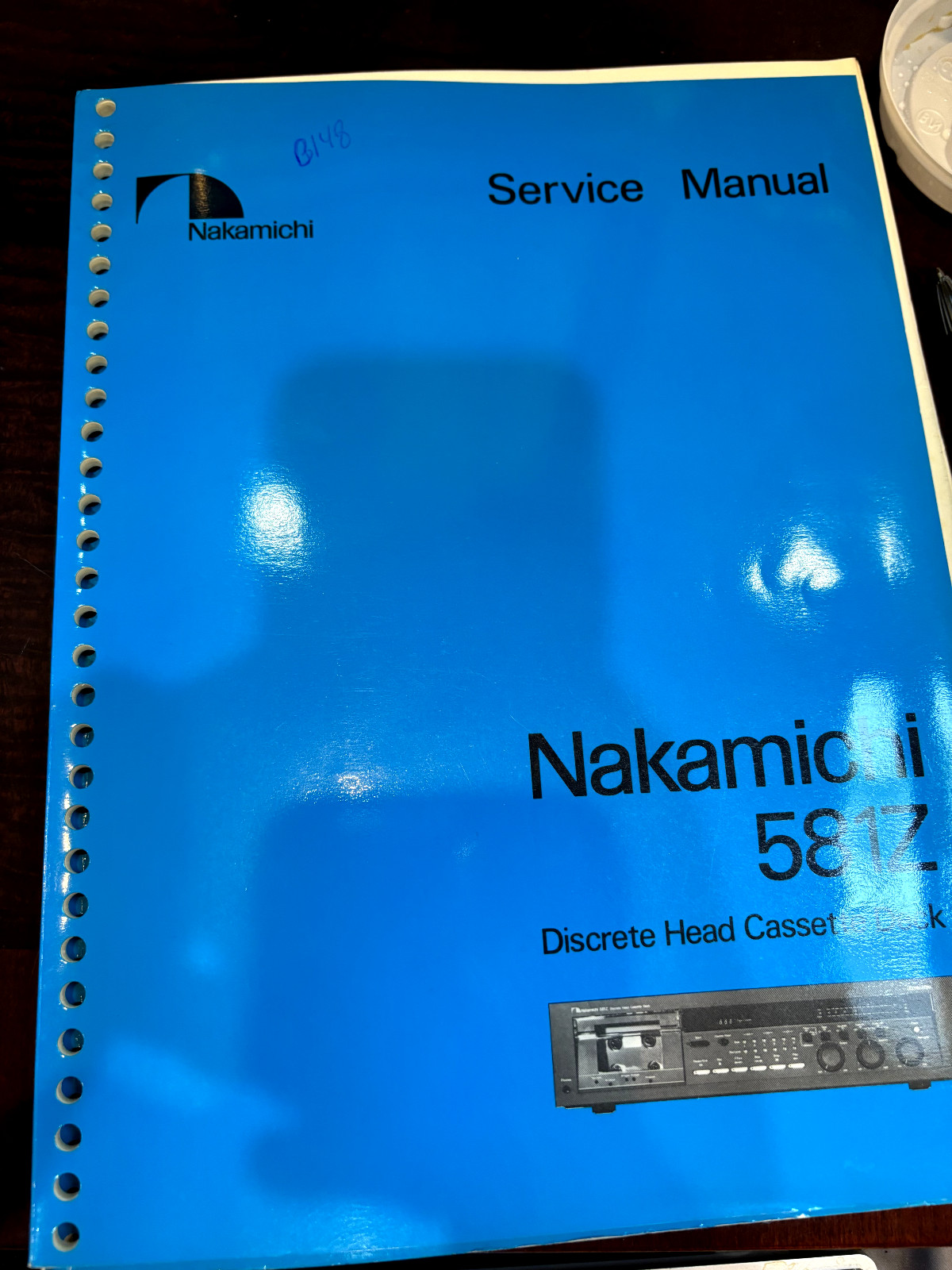
Today, the 581Z flies under the radar. It’s not as famous as the Dragon, not as common as a Tandberg, but it’s respected by those who’ve used one. A recent eBay listing showed a unit priced at $49.99, sold “as parts” due to an eject button issue and a suspected play solenoid problem—typical of untested vintage gear. Another listing noted the deck powers on but the transport doesn’t engage, even though the motor spins. These are red flags, not verdicts. The real concern? Mildew. One owner on Tapeheads.net flagged “mildewiness” inside the unit as a known issue, even if not visible from the outside. And good luck finding a service manual—another user said they’ve never seen one. Original price was ¥168,000 in Japan around 1981, but no current market value is documented beyond isolated eBay examples. If you find one that’s been stored dry and serviced, it’s a steal. If not, budget for a full clinic.
eBay Listings


As an eBay Partner, we earn from qualifying purchases. This helps support our independent vintage technology research.
Related Models
- Nakamichi 1000ZXL (1985)
- Nakamichi BX-150 (1983)
- Nakamichi CR-4 (1969)
- Nakamichi 1000-II (1974)
- Nakamichi 1000ZXL-LIMITED (1985)
- Sony TC-2050SD (1978)
- Aiwa AD-F990 (1993)
- Kenwood KX-3060 (1982)
- Sony TC-2130A (1974)
- Sony TC-2220 (1972)