Nakamichi 580M (1978–1982)
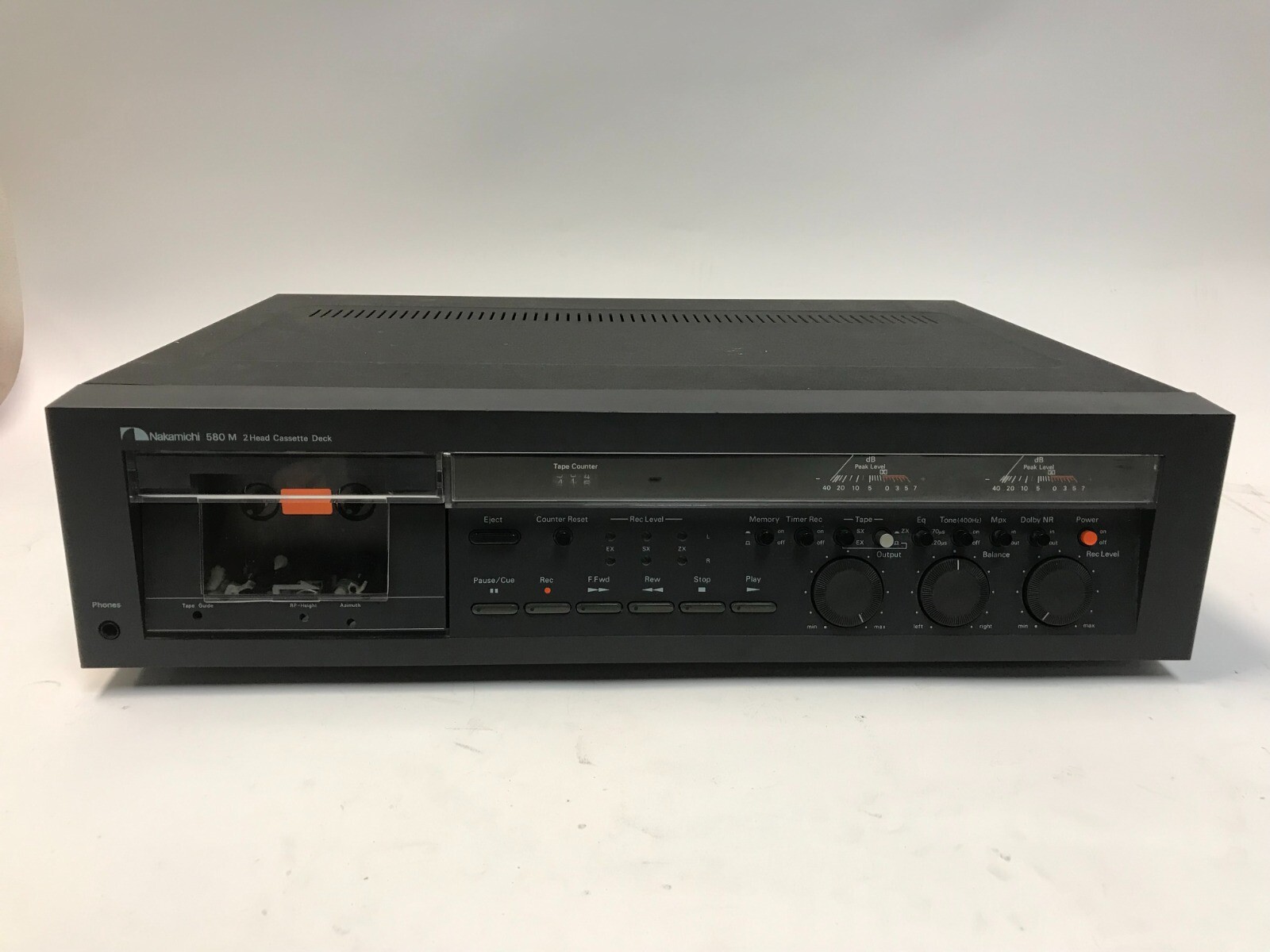
Not just another cassette deck—this was Nakamichi’s no-compromise statement in the middle of their lineup, built like a tank and engineered to extract every last drop of fidelity from metal tape.
Overview
You don’t buy a Nakamichi 580M because it’s flashy or even particularly convenient. You buy it because you care about what’s etched into the oxide: accuracy, dynamics, and a refusal to compromise. Released between 1978 and 1982, the 580M was part of Nakamichi’s pivotal 500-series—a family of decks that sat squarely in the middle of their second-generation lineup, flanked by the junior 400 and senior 600 series. But don’t let “midrange” fool you. This is a 2-head stereo cassette deck that punches way above its class, especially when you consider it was built during the dawn of metal tape compatibility.
Priced at ¥115,000 around 1980, the 580M wasn’t cheap, but it wasn’t meant for casual listeners. It was for those who wanted near-flagship performance without stepping all the way up to the 600s. And while it shared its chassis design with other 500-series models—complete with that distinctive wide slanted front panel and service-friendly adjustment holes under the cassette door—its internals were anything but generic. From the newly developed RP-9E recording/playback head to the E-8L double-gap erase head, every component was chosen to maximize performance, especially on IEC Type IV (metal) tapes. It even added the “ZX” metal bias position absent on earlier models, making it one of the early metal-capable decks that didn’t require external tweaks or mods.
Owners report units sitting in storage for over 20 years firing up and working beautifully—no small feat for a machine this complex. And when it runs, it sings: one user on StereoNET simply put it, “The sound quality is phenomenal.” That’s not just nostalgia talking. This is a deck engineered with obsessive attention to detail, from its PLL servo motor to its resonance-damping chassis made of aluminum and resin molded parts. It’s heavy at 8.3 kg, sure, but that weight is earned—every gram feels like it’s there to keep the tape steady, the heads aligned, and the noise floor buried.
Specifications
| Manufacturer | Nakamichi |
| Type | 2-head cassette deck |
| Tape speed | 4.8cm/s |
| Wow and flutter | 0.04% or less Wrms, 0.08% or less Wpeak |
| Frequency characteristic | 20 Hz to 20 kHz ± 3 dB (-20dB) |
| Overall S/N ratio (400 Hz) | 60 dB or greater (0 dB, WTD rms) |
| Overall S/N ratio (Dolby NR, 70 μs, ZX Tape, 3% THD, WTD rms) | 64 dB or greater |
| Overall strain rate (400 Hz, 0 dB, ZX Tape) | 1.0% or Less |
| Overall strain rate (400 Hz, 0 dB, SX Tape) | 1.2% or Less |
| Overall strain rate (400 Hz, 0 dB, EXII Tape) | 1.0% or Less |
| Erasure rate (1 kHz, Saturation Level, ZX Tape) | 60 dB or More |
| Channel separation (1 kHz, 0 dB) | 37 dB or More |
| Crosstalk (1 kHz, 0 dB, Rch → Rch) | 60 dB or More |
| Bias frequency | 105kHz |
| Input Sensitivity / Impedance Line | 50mV/50k Ω |
| Output Level / Impedance Line | 1V/3.9k Ω (400 Hz, 0 dB, maximum output level) |
| Headphone output | 45mW/8 ohm (400 hz, 0 db, maximum output level) |
| Power | 100 VAC, 50/60Hz |
| Power consumption | Up to 23W |
| External dimensions | Width 500x Height 130x Depth 350 mm |
| Weight | Approx. 8.3 kg |
| Noise reduction | Dolby B |
| Tape compatibility | metal |
| Tape bias capability | metal bias (IEC TYPE IV) |
| Tape settings | EX (normal bias), SX (high bias), and ZX (metal bias) |
Key Features
The RP-9E Head and Double-Capstan Drive
At the heart of the 580M’s performance is the newly developed RP-9E recording/playback head. Paired with a frequency-distributed double capstan system—what Nakamichi called a “closed-loop double capstan”—this setup ensures exceptional tape-to-head contact and ultra-stable speed control. The drive motor is a PLL servo type, meaning it actively corrects speed deviations in real time, which is why wow and flutter are spec’d at an astonishing 0.04% Wrms. The flywheels themselves are machined from solid iron bars, dynamically and statically balanced to eliminate vibration. This isn’t overkill—it’s the kind of engineering that makes a C-90 sound like it was cut in a studio yesterday.
Double-NF Equalizers and DC Recording Amp
The 580M doesn’t just rely on mechanical precision. Its signal path is equally refined. The recording and playback equalizers use Double-NF (Negative Feedback) circuits, which help maintain flat frequency response across all tape types. Even more interesting is the DC recording amplifier, which eliminates coupling capacitors between the circuit and the head. Why does that matter? Capacitors can color the sound, especially at low frequencies. Removing them means cleaner, more direct control over the magnetic flux—critical when you’re pushing metal tape to its limits.
Logic Control and User Features
Operation is handled by C-MOS IC logic control with soft-touch buttons—no clunky solenoids here. It’s smooth, precise, and built to last. The deck includes a 47 dB full-range peak level meter, so you’re never guessing at levels. There’s a built-in 400 Hz test tone for quick calibration of the 0 dB reference, an easy queuing function for seamless track transitions, and a high-speed auto-shutoff mechanism that stops the tape in just 0.4 seconds. It also supports timer recording and playback, a rarity in mid-tier decks at the time. And yes, there’s a headphone jack—45mW into 8 ohms means you can drive most cans without issue.
Historical Context
The Nakamichi 580M arrived in 1978–1979 as part of a coordinated launch that included the junior 400 series and the senior 600 series. It was a statement that Nakamichi wasn’t just chasing high-end glory—they were building a complete ecosystem. The 500-series sat in the middle, but with features like metal tape support, PLL servo drive, and double-capstan transport, the 580M blurred the line between midrange and high-end. It was one of the first in its class to include a dedicated ZX (metal) bias setting, making it a forward-looking machine at a time when Type IV tapes were still emerging. The original lineup included four models: the 580, 580M, 581, and 582, with the 581 later described as a budget model and the 582 as a popular 3-head variant. The 580M stood out as the 2-head workhorse with flagship DNA.
Collectibility & Value
While comprehensive repair data and common failure modes aren’t documented in the sources, the availability of a service manual suggests that maintenance is feasible for the technically inclined. As for value, recent listings show the 580M selling for €180 (as of June 29, 2025) and BGN 590 (as of July 2, 2025). These figures suggest it’s not yet a stratospheric collector’s item like the Dragon, but it’s far from forgotten. Given its solid build, excellent performance on metal tape, and reputation for durability—even after decades in storage—it’s a smart buy for anyone building a serious analog setup. Just remember: this isn’t a deck to tinker with lightly. Its precision demands respect, and ideally, a good cleaning and alignment before heavy use.
eBay Listings


As an eBay Partner, we earn from qualifying purchases. This helps support our independent vintage technology research.
Service Manuals & Schematics
- Service Manual — archive.org
Related Models
- Nakamichi 1000ZXL (1985)
- Nakamichi BX-150 (1983)
- Nakamichi CR-4 (1969)
- Nakamichi 1000-II (1974)
- Nakamichi 1000ZXL-LIMITED (1985)
- Sony TC-2050SD (1978)
- Aiwa AD-F990 (1993)
- Kenwood KX-3060 (1982)
- Sony TC-2130A (1974)
- Sony TC-2220 (1972)