Nakamichi 581: The Precision Pioneer of Cassette Fidelity
In the mid-1970s the compact cassette was moving up from dictation to serious hi-fi, and Nakamichi took that job more seriously than most. The Nakamichi 581, introduced in 1975, was a cassette deck that laid the groundwork for the company's reputation in analog tape technology.
Later flagships like the Dragon get more attention, but the 581 introduced several innovations that became hallmarks of the brand. It made the case that cassette decks could rival reel-to-reel recorders, using mechanical precision, advanced electronics and careful calibration.
Technical Specifications
The Nakamichi 581 was engineered for audiophiles and professionals who demanded the utmost accuracy in tape playback and recording. It featured a full three-head configuration, a rare and expensive design at the time, allowing independent optimize heads for record, playback, and erase functions.
| Specification | Detail |
| Year Introduced | 1975 |
| Format | 1/4" Stereo Compact Cassette |
| Head Configuration | 3-head (Record, Playback, Erase) |
| Tape Speed | 1⅞ ips (4.76 cm/s) |
| Heads | Discrete permalloy heads |
| Motor System | Dual direct-drive capstan motors |
| Wow & Flutter | < 0.07% (measured) |
| Frequency Response | 30 Hz – 18 kHz (with CrO₂ tape) |
| Signal-to-Noise Ratio | 66 dB (Dolby B), 72 dB (Dolby C) |
| Total Harmonic Distortion | < 1.5% at 3% output |
| Input/Output Levels | Line In: 150 mV, Line Out: 1 V |
| Inputs | RCA (x2), Mic (¼") |
| Outputs | RCA (x2) |
| Recording Equalization | 120 µs (IEC standard) |
| Power Consumption | 28 W |
| Dimensions | 440 mm × 145 mm × 335 mm (W×H×D) |
| Weight | 13.5 kg (29.7 lbs) |
Built with a rigid, non-resonant chassis and precision-machined transport components, the 581 was designed to minimize mechanical noise and tape path instability. Its dual capstan system—using separate motors for supply and take-up reels—was a significant engineering feat, ensuring near-perfect tape tension and alignment. This attention to mechanical detail was central to Nakamichi’s philosophy: if the tape doesn’t track perfectly, even the best electronics can’t compensate.
Sound Characteristics and Performance
The Nakamichi 581 sounded transparent and dynamic for its era. Its three-head design allowed precise head alignment and real-time monitoring during recording. Studio engineers and serious home recordists prized that.
Its frequency response was exceptionally flat across the audible spectrum, especially when using chromium dioxide (CrO₂) tapes, which the 581 supported via dedicated calibration settings. The deck’s low wow and flutter figures (<0.07%) ensured pitch stability and a sense of rhythmic precision uncommon in cassette machines of the time.
Listeners noted the 581's ability to preserve fine detail and spatial cues. That made it a good match for classical and jazz recordings, where imaging and tonal accuracy count. The signal-to-noise ratio, particularly with Dolby C noise reduction (introduced shortly after the 581's release), approached that of early digital formats, so pre-recorded tapes and home dubs sounded very clean.
Notable Features and Innovations
The 581 was a high-end deck, and it was also a proving ground for technologies that would define Nakamichi's future:
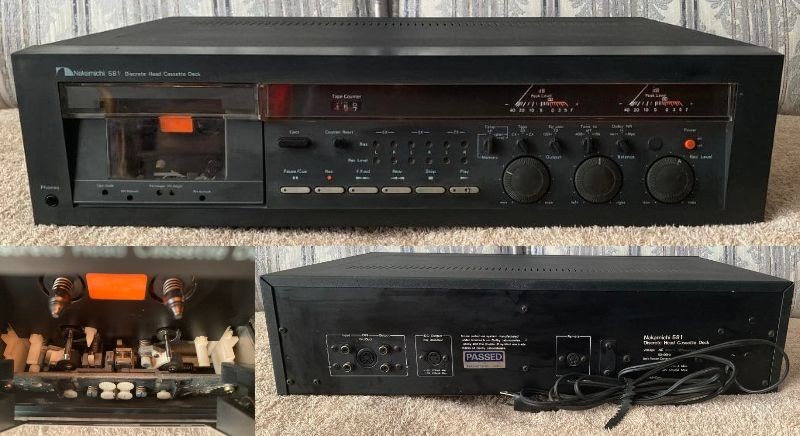
- Three-Head System: Enabled separate optimization of record and playback heads, improving fidelity and allowing real-time monitoring without generational loss.
- Dual Direct-Drive Capstans: A rare feature that eliminated rubber drive belts and ensured consistent tape speed and tension.
- Manual Azimuth Adjustment: Allowed users to fine-tune head alignment for optimal high-frequency response—critical for maintaining compatibility across different tapes and machines.
- Dolby B and C Compatibility: Though Dolby C was introduced later, the 581 was often upgraded or modified to support it, reflecting its modular design.
- Professional-Grade Metering: Large VU meters provided accurate level monitoring, essential for avoiding distortion during recording.
The front panel was clean and functional, with tactile knobs and switches that felt durable. The tape window was large and anti-reflective, and the build quality suggested a machine made to last.
Common Issues and Maintenance
Like all high-precision analog equipment from the 1970s, the Nakamichi 581 needs careful maintenance to perform at its best. Common issues include:
- Deterioration of Rubber Components: While the capstans are direct-drive, idler tires and pressure pads may degrade over time, leading to tape slippage or uneven tension.
- Head Alignment Drift: Due to mechanical stress or age, the playback and record heads may require realignment—best done with a calibration tape and oscilloscope.
- Capacitor Aging: Electrolytic capacitors in the power supply and audio circuits can dry out, leading to noise, hum, or channel imbalance.
- Dirty or Worn Heads: Regular cleaning with isopropyl alcohol and demagnetization are essential for maintaining clarity and preventing tape damage.
A well-preserved 581 is rare today. Many were used heavily in professional or semi-pro settings, so wear and tear are common. When restored by a qualified technician, though, the 581 can still perform at a level that rivals modern digital portable recorders in terms of analog character and warmth.
Current Market Value and Collectibility
The Nakamichi 581 is not as widely collected as the Dragon or CR-7, but vintage audio enthusiasts and tape preservationists hold it in regard. In working condition, a fully serviced 581 typically sells for $400 - $700, depending on cosmetic condition and included accessories.
Its value comes more from historical significance and technical merit than from mainstream nostalgia. Collectors see it as a "stepping stone" model, bridging Nakamichi's early professional decks and the consumer-focused high-end models of the 1980s.
Units with original manuals, calibration tapes, or factory service records command premium prices. Because of its modular design and repairability, many analog enthusiasts consider the 581 a "keeper."
Conclusion and Legacy
The Nakamichi 581 may not have the fame of its successors, but it helped establish Nakamichi as a leader in high-fidelity cassette technology. The company's core belief was that analog tape, engineered with precision and care, could deliver a listening experience on par with any format.
Its influence can be heard in every Nakamichi deck that followed—from the 700 series to the Dragon’s auto-azimuth system. The 581 was more than a cassette deck; it was a statement of intent. In an era when many dismissed cassettes as low-fi, Nakamichi proved that with the right engineering, the format could sing.
Today, the 581 remains a quiet legend—a machine for those who appreciate the craftsmanship of analog audio at its most serious. For collectors, restorers, and analog purists, the Nakamichi 581 is not just a relic of the past, but a working masterpiece of magnetic tape engineering.
eBay Listings



As an eBay Partner, we earn from qualifying purchases. This helps support our independent vintage technology research.
Related Models
- Nakamichi 1000ZXL (1985)
- Nakamichi 482Z (1982)
- Nakamichi 580 (1975)
- Nakamichi 580M (1978–1982)
- Nakamichi 582Z (1982)
- Infinity RS-IIA (1977)
- Infinity RS-4.5 (1978)
- Sony TC-K333ESG (1989)
- Sony TC-K333ESJ (1991)
- Sony TC-K333ESX (1991)