Nakamichi 482: The Precision Pioneer of Cassette Fidelity
In the early 1970s, as audiophiles debated whether cassette tapes could ever rival reel-to-reel or vinyl for high-fidelity sound, Nakamichi quietly began redefining the conversation. The Nakamichi 482, introduced in 1974, was not just another cassette deck—it was a bold declaration that compact cassette technology, when engineered without compromise, could deliver truly exceptional audio performance. Though overshadowed in later years by the legendary Nakamichi Dragon, the 482 was a foundational model in the company’s ascent to the pinnacle of tape deck engineering.
Positioned as a high-end, semi-professional cassette transport, the 482 targeted serious listeners, recording enthusiasts, and broadcast professionals who demanded reliability, precision, and sonic transparency. At a time when most cassette decks used fixed-head designs and basic azimuth alignment, Nakamichi’s approach was revolutionary: meticulous mechanical engineering, advanced head design, and a commitment to measurable performance.
Technical Specifications
The Nakamichi 482 was engineered with a focus on precision mechanics and signal integrity. While not as automated or feature-rich as later models, it laid the groundwork for Nakamichi’s reputation for technical excellence.
| Specification | Detail |
| Year Introduced | 1974 |
| Format | 1/4" Two-Track Stereo Compact Cassette |
| Tape Speed | 1⅞ ips (4.76 cm/s) |
| Heads | Three-head system (Record, Playback, Erase) |
| Head Manufacturer | TDK (custom-designed) |
| Motor System | Dual direct-drive capstan motors |
| Wow and Flutter | < 0.07% (WRMS) |
| Frequency Response | 30 Hz – 18 kHz (with CrO₂ tape) |
| Signal-to-Noise Ratio | 66 dB (Dolby B) |
| Total Harmonic Distortion | < 1.5% |
| Input/Output | Line In/Out (RCA), Mic In (¼") |
| Recording Equalization | 120 µs / 70 µs (switchable) |
| Power Requirements | 120V AC, 60 Hz (or 220-240V variants) |
| Dimensions | 440 mm × 140 mm × 335 mm (W×H×D) |
| Weight | 12.5 kg (27.5 lbs) |
One of the most notable aspects of the 482 was its three-head configuration, which allowed for independent optimization of recording, playback, and erasing functions. This was rare in consumer decks at the time and more commonly found in professional reel-to-reel machines. The playback head was fixed and precisely aligned, while the record head was adjustable, allowing for fine-tuning of azimuth to match specific tape formulations.
Sound Characteristics and Performance
The Nakamichi 482 was engineered for accuracy and neutrality, avoiding the coloration common in many cassette decks of the era. Its frequency response was impressively flat across the audible spectrum, with extended highs that captured cymbal shimmer and vocal sibilance without harshness. The low end was tight and well-controlled, a significant achievement given the limitations of the cassette format.
Thanks to its high-quality TDK-designed heads and precision tape path, the 482 delivered excellent channel separation (over 40 dB) and minimal crosstalk. When paired with CrO₂ (chrome) tapes—a relatively new technology at the time—the deck could achieve a dynamic range and clarity that rivaled many open-reel systems.
Users reported that recordings made on the 482 had a remarkable sense of presence and detail, making it a favorite among musicians and field recordists. Its ability to maintain consistent tape tension and speed stability contributed to its low wow and flutter, ensuring pitch accuracy even during long recordings.
Notable Features and Innovations
While the 482 lacked the auto-reverse or digital displays of later Nakamichi models, it introduced several innovations that became hallmarks of the brand:
- Dual Direct-Drive Capstan System: Unlike belt-driven transports, the 482 used two direct-drive motors—one for each capstan—to ensure precise tape speed control and eliminate belt stretch or slippage.
- Three-Head Design with Manual Azimuth Adjustment: This allowed users to optimize playback fidelity for different tape brands and types, a feature almost unheard of in consumer decks.
- Full Manual Operation with Professional Layout: Transport controls were mechanical and tactile, appealing to users who valued direct control over automation.
- High-Quality Internal Wiring and Shielding: Nakamichi used silver-plated OFC (oxygen-free copper) wiring and extensive shielding to minimize noise and crosstalk.
- Modular Head Assembly: The head block could be removed and serviced or replaced without disassembling the entire deck—a boon for maintenance and calibration.
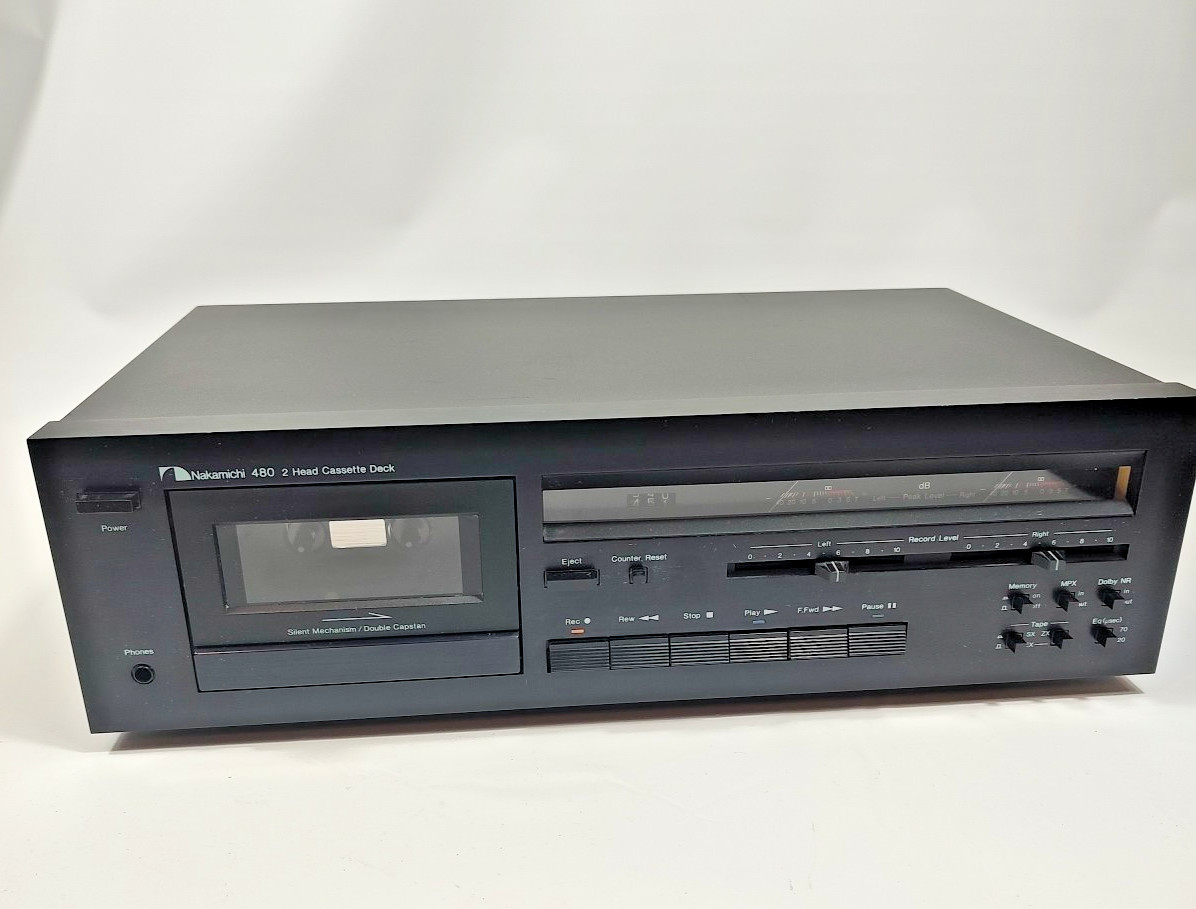
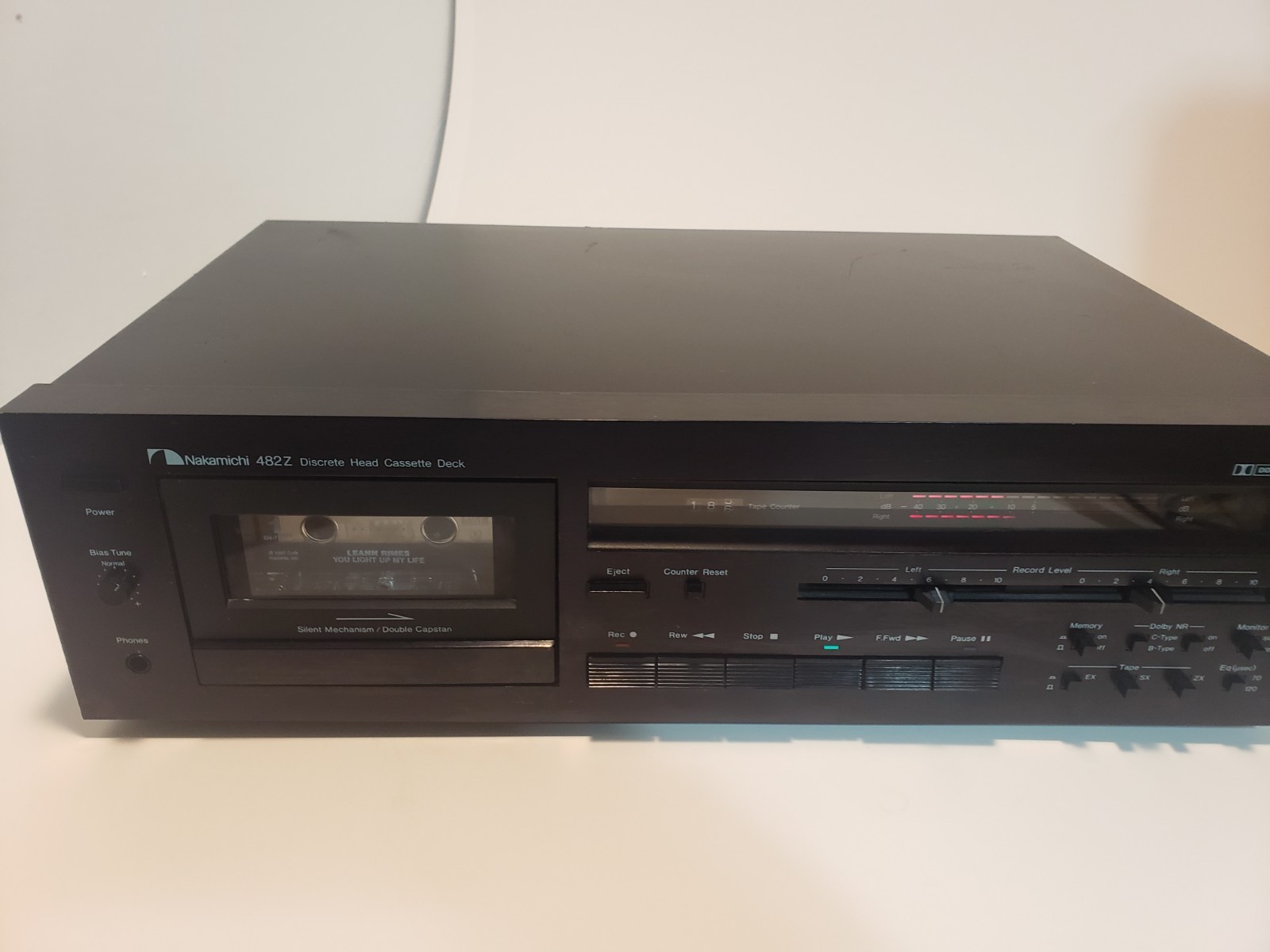
The front panel featured large VU meters for level monitoring, precision VFO (variable frequency oscillator) tuning for bias and equalization adjustments, and a robust aluminum chassis that reduced resonance and improved durability.
Common Issues and Maintenance
Like all high-precision tape decks from the 1970s, the Nakamichi 482 requires regular maintenance to perform at its best. Common issues include:
- Deterioration of Rubber Components: The pinch roller and any internal idler tires can harden or crack over time. Replacement with modern silicone or urethane equivalents is essential.
- Head Wear and Alignment: While durable, the heads can wear or become misaligned after heavy use. Professional demagnetization and azimuth calibration are recommended every 100–200 hours of play.
- Capstan Bearing Dryness: The direct-drive capstan motors rely on precision bearings that may dry out, leading to speed instability. Lubrication with appropriate synthetic oil is necessary.
- Capacitor Aging: Electrolytic capacitors in the power supply and audio circuits may leak or lose capacitance. A full recapping is advisable for units that have been dormant for decades.
Despite these age-related concerns, the 482 is known for its robust build quality. Many units still function reliably today, a testament to Nakamichi’s engineering standards.
Current Market Value and Collectibility
The Nakamichi 482 is a rare and sought-after machine among vintage audio collectors, particularly those focused on the evolution of tape technology. While not as famous as the Dragon or CR-7, it holds a special place as one of Nakamichi’s earliest high-end cassette decks.
In today’s market, a fully serviced and calibrated Nakamichi 482 typically sells for $600 to $1,000, depending on condition, included accessories, and provenance. Units with original packaging, manuals, and calibration tools command premium prices. Because of its semi-professional status and limited production run, original examples in good working order are increasingly scarce.
Collectors value the 482 not only for its performance but as a historical milestone—a machine that helped prove the cassette format’s potential for high fidelity. It’s especially prized by enthusiasts restoring vintage recording setups or exploring analog tape’s sonic character.
Conclusion and Legacy
The Nakamichi 482 may not have the name recognition of its successors, but it was a pioneer in the pursuit of cassette perfection. It embodied Nakamichi’s philosophy: that audio equipment should be engineered first for performance, not cost or convenience. With its three-head design, direct-drive transport, and meticulous attention to detail, the 482 set a new benchmark for what a cassette deck could achieve.
It paved the way for later innovations like the Nakamichi 580, 700, and ultimately the Dragon, which would dominate audiophile discussions in the 1980s. But the 482 was where it began—a quiet revolution in a heavy aluminum chassis.
Today, the 482 stands as a testament to Japanese engineering excellence in the 1970s. For collectors, restorers, and analog enthusiasts, it’s more than a vintage deck—it’s a piece of audio history that still delivers a listening experience few modern digital formats can match. If you’re lucky enough to find one in good condition, it’s worth every effort to restore and preserve.
eBay Listings

As an eBay Partner, we earn from qualifying purchases. This helps support our independent vintage technology research.
Related Models
- Nakamichi 1000ZXL (1985)
- Nakamichi BX-150 (1983)
- Nakamichi CR-4 (1969)
- Nakamichi 1000-II (1974)
- Nakamichi 1000ZXL-LIMITED (1985)
- Sony TC-2050SD (1978)
- Aiwa AD-F990 (1993)
- Kenwood KX-3060 (1982)
- Sony TC-2130A (1974)
- Sony TC-2220 (1972)