Nakamichi 1000MB
A seven-disc carousel that stocks CDs on an internal elevator instead of magazines — and the reviewers couldn't stop arguing about which converter to feed it through.
Overview
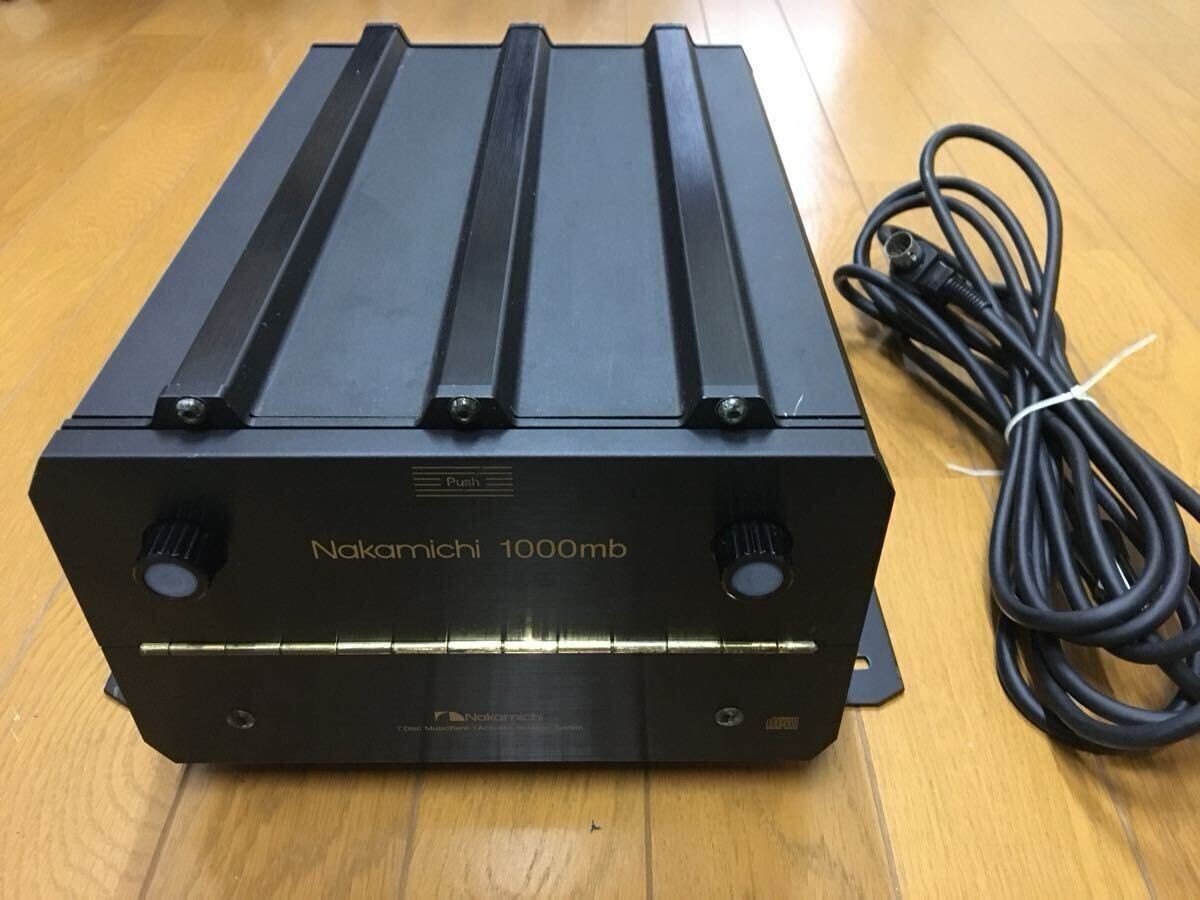
The 1000mb is the changer half of Nakamichi's 1000 car system, a three-box stack that also included the 1000td tuner/cassette head unit and the optional 1000dac outboard converter. It is a seven-disc CD changer built around Nakamichi's MusicBank mechanism, which stores discs on an internal elevator rather than in removable cartridges — the sort of contrarian engineering the company was known for. The unit can be suspended from overhead or mounted on the floor, but it must sit horizontally; brackets for both installations came in the box. It is sealed with an "air shield" held by two screws, a nod to isolating the transport from airborne vibration. Release the screws, the shield folds down, and you press the button for the slot you want to change; a tray emerges to deliver or receive the disc. It handles 3-inch discs only with Nakamichi adaptors, seven of which were supplied.
Inside, the 1000mb carries 18-bit dual DACs with eight-times-oversampling digital filters, enough to feed the 1000td's CD input directly in a simple installation — analog outputs to the head unit's CD inputs, the supplied DIN cable between the changer's control jack and the 1000td's control cable. Power arrives through that same control cable, so there is no separate battery hookup. For buyers chasing better numbers, Nakamichi offered the 1000dac, a separate converter using four "Enhanced Linearity" 20-bit DACs with eight-times-oversampling filters that switches automatically between 44.1- and 48-kHz sampling for CD and DAT. Audio (June 1995, p.46) laid out the hierarchy plainly: the 1000dac connects to the 1000mb's digital output by coaxial cable and feeds analog audio onward to the 1000td.
The measurements told a story the marketing department probably didn't love. Audio (June 1995, p.46) found the external 1000dac's performance significantly better than the changer's internal converters on everything except crosstalk, and recommended using the outboard box in the system — "when you've shelled out this much, what's a few more bucks?" The same review measured the 1000mb's converter at an A-weighted S/N of 86.5 dB against the 1000dac's 104.5 dB, a gap of nearly 20 dB. Dynamic range came in at 87.2 dB A-weighted and 79.5 dB unweighted on the internal converter, versus 98.9 and 95.5 dB on the 1000dac. Quantization noise measured −83.5 dB on the 1000mb and −91.9 dB on the 1000dac. THD + N versus level was the ugliest plot of the lot: the internal converter bottomed out around −77 dB at −10 dB and below, which the reviewer called "substantially worse than average" and had to rescale his graph to capture.
Frequency response through the 1000mb's own DACs ran +0.03, −1.17 dB left and +0.01, −1.33 dB right from 20 Hz to 17.6 kHz — noticeably short of the 1000dac's +0.02, −0.58 dB and +0.04, −0.71 dB across 20 Hz to 20 kHz. THD + N stayed below 0.022% to 12.5 kHz on the internal converter but climbed to 0.21% left and 0.32% right at 20 kHz, while the 1000dac held to 0.0075% and 0.0084% across the band. Linearity was the one place the 1000mb nearly kept up: off by 0.13 dB left and 0.36 dB right at −70 dB without dither, and by 2.62 dB on the −100 dB track. The 1000dac's linearity error at −100 dB was a minuscule 0.27 and 0.25 dB, which the reviewer called arguably the best he'd ever measured. Channel separation between 2 and 16 kHz ran 56 to 68 dB and was essentially independent of which converter was in use — suggesting the limit sat in the 1000td, not the changer. At lower frequencies the internal DAC actually did better, reaching 96 to 106 dB at 125 Hz where the 1000dac dropped to about 56 dB.
The verdict on the system as a whole was warm even where the changer's converter wasn't. Audio (June 1995, p.46) called the 1000 system "impeccably High End: expensive, a bit impractical — and sings with the tongues of angels," and handed the 1000dac an A++ while giving the 1000td tuner/cassette deck merely good grades. The impracticality the reviewer flagged was the head unit's lack of real theft protection, not the changer's. The 1000mb itself got a kind word for its loading: in a world of cartridge-loading changers, it loads CDs one at a time "but so handily it might start its own trend."
Pricing put the system firmly in statement territory. The 1000mb carried a list of $2,200, and the 1000dac — the box the review effectively told you to buy — added $1,400 on top. The changer measures 8¼ inches wide, 5⅜ inches high, and 11¼ inches deep (22.1 x 14.3 x 29.9 cm) and weighs about 14.3 lbs. (6.5 kg). Its published specs include frequency response of 10 Hz to 20 kHz ±0.5 dB, S/N greater than 92 dB IHF A-weighted, dynamic range greater than 90 dB, THD less than 0.008% at 1 kHz, channel separation greater than 88 dB, and analog output of 1.5 V at 0 dB into a 600-ohm impedance, with a 75-ohm coaxial digital output. Operating voltage is 14.4 V d.c. negative ground, with 10.8 to 15.6 V allowable, and maximum current consumption is 1 ampere. Wow and flutter was below the measurement limit.
Collectors chasing a 1000mb today should know what they're buying: a changer whose own converter was the weak link in a system the contemporary press loved anyway, and one that only makes full sense paired with the 1000td head unit and, ideally, the 1000dac. The 1000mb is not the Nakamichi cassette deck most people picture when they hear the name, and that's precisely the point.
eBay Listings
As an eBay Partner, we earn from qualifying purchases. This helps support our independent vintage technology research.