NAD 7020: The Integrated Legacy of the 3020 Sound
Introduction
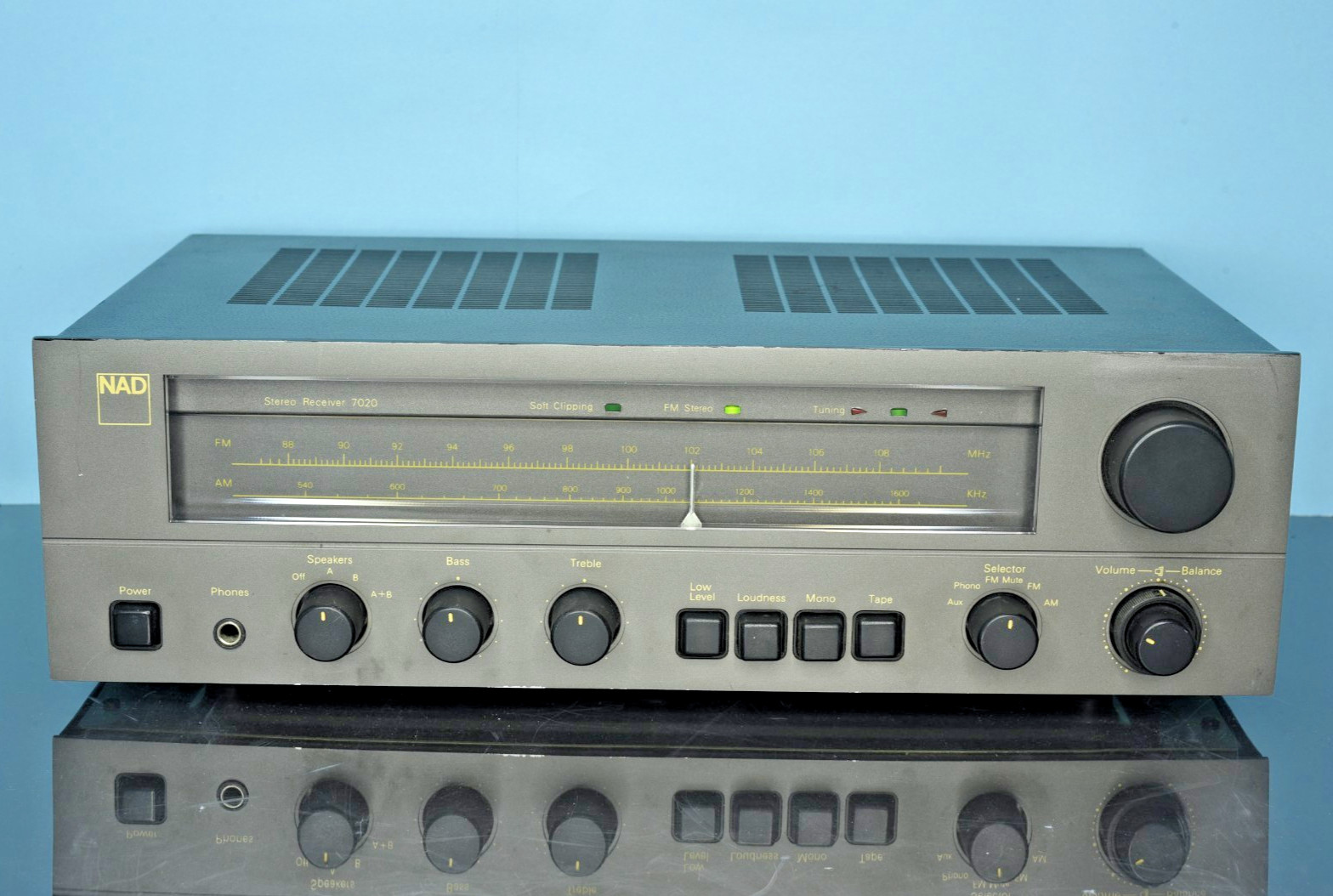
The NAD 7020 receiver, produced from 1979 to 1983, stands as a quintessential example of NAD’s (New Acoustic Dimension) philosophy during the golden era of high-fidelity audio: delivering exceptional sound quality and solid engineering at an accessible price point. As the receiver counterpart to the legendary NAD 3020 integrated amplifier, the 7020 combined the same revered amplifier circuitry with the AM/FM tuner section derived from the NAD 4020, creating a compact yet powerful all-in-one solution for audiophiles and casual listeners alike. Positioned as a premium receiver in NAD’s lineup during the early 1980s, the 7020 offered a rare balance of performance, simplicity, and value that helped define the brand’s reputation for honest, musical audio reproduction. Its production run from 1979 to 1983 coincided with a period of rapid innovation in consumer audio, and the 7020 emerged as a favorite among those seeking a no-nonsense, high-performance receiver without the complexity or cost of separates.
Technical Specifications
| Specification | Value |
| Model | 7020 |
| Category | Receivers |
| Years Produced | 1979-1983 |
| Power Output | 35W per channel @ 8Ω |
| Impedance | 8 ohms |
| Frequency Response | 20Hz - 20kHz |
| Total Harmonic Distortion | < 0.03% |
| Signal-to-Noise Ratio | 86dB |
| Dimensions | 430x130x310 mm |
| Weight | 9.5 kg |
Design & Engineering
The NAD 7020 was engineered with a focus on sonic integrity and reliability, borrowing heavily from the award-winning design of the NAD 3020 amplifier. At its heart is a robust dual-mono power supply with a high-quality toroidal transformer, ensuring stable power delivery and excellent dynamic headroom—critical for handling complex musical passages with ease. The amplifier section features discrete transistor circuitry, avoiding the integrated circuits common in budget receivers of the era, which contributed to its clean, low-distortion performance. The 7020’s front panel is a study in minimalist functionality: a large central volume knob, source selector, balance control, and dual VU meters that provide visual feedback on output levels. These meters, while partly aesthetic, also serve as a useful indicator of channel balance and signal strength.
The tuner section, adapted from the NAD 4020, was considered one of the best in its class at the time. It offered excellent sensitivity and selectivity, with smooth tuning and stable reception across both AM and FM bands. The 7020 includes standard inputs for phono (MM), tape, auxiliary, and tuner, along with a tape monitor function that allows users to switch between live and recorded sources seamlessly. The rear panel is cleanly laid out with gold-plated speaker terminals and RCA jacks, reflecting NAD’s attention to detail in signal integrity. The chassis is constructed from heavy-gauge steel with a matte black finish, providing both durability and effective shielding against electromagnetic interference.
Sound Characteristics
The NAD 7020 is renowned for its warm, engaging, and surprisingly spacious sound—qualities that made it a favorite for vinyl playback and acoustic music. Its 35 watts per channel may seem modest by modern standards, but the amplifier’s ability to deliver current into difficult speaker loads ensures it can drive a wide range of 8-ohm speakers with authority. The harmonic richness and midrange clarity are particularly notable, giving vocals and instruments a lifelike presence. Bass response is tight and well-controlled, while the high frequencies remain smooth and non-fatiguing, even during extended listening sessions.
This receiver excels with genres like jazz, classical, and singer-songwriter recordings, where tonal accuracy and musicality are paramount. Compared to other receivers of its era—many of which prioritized flashy features over sound quality—the 7020 stands out for its transparency and lack of coloration. It doesn’t attempt to impress with artificial brightness or exaggerated bass; instead, it reveals the essence of the recording with honesty and grace. Audiophiles often compare its sound to that of the 3020, noting only minor differences due to the shared amplifier topology.
Market & Collectibility
Today, the NAD 7020 is a sought-after piece among vintage audio enthusiasts and collectors. Its reputation as a “giant killer” in the amplifier world extends to this receiver variant, and well-maintained units typically command prices between $250 and $450, depending on condition, functionality, and originality. Units with working tuners, responsive meters, and clean casings are especially prized. Given its age, potential buyers should inspect for common issues such as dried-up electrolytic capacitors, worn potentiometers, or degraded rubber belts in the tuner mechanism. Many owners opt for a full recapping and servicing to restore the unit to optimal performance.
Originality is highly valued in the vintage market, so receivers with unmodified circuitry and original NAD branding tend to hold more value. Some enthusiasts have modified their 7020s with upgraded power cords or external DACs for modern source integration, though purists prefer stock configurations. The 7020’s compact size and timeless design also make it a favorite for retro audio setups, desktop systems, or secondary listening environments.
eBay Listings


As an eBay Partner, we earn from qualifying purchases. This helps support our independent vintage technology research.
Service Manuals & Schematics
- Owner's Manual — archive.org
- Owner's Manual — archive.org
Related Models
- Pioneer QX-949A (1978)
- Pioneer SX-2000 (1978)
- Pioneer SX-2500 (1978)
- Marantz SR-2000 (1999–2001)
- Onkyo TX-1500MKII (1975)
- Pioneer QX-646 (1978)
- Pioneer SX-1900 (1978)
- Pioneer SX-201 (1978)
- Pioneer SX-251R (1976)
- Realistic STA-2250 (1975)