McIntosh MR80 (1980–1986)
That first burst of FM static clearing into a live orchestral broadcast—rich, wide, and startlingly present—like the room just filled with musicians.
Overview
There’s a moment when tuning in a station on the McIntosh MR80 that feels like magic: the signal column LEDs climbing as the frequency locks in, the LOCK light glowing steady, and then—silence, not of absence, but of readiness. Then the music hits, and it’s not just clear, it’s dimensional. This isn’t background listening gear; the MR80 was built for audiophiles who treated FM radio as high art, and it delivers with a presence that still startles today. Despite being over four decades old, its combination of surgical selectivity, rock-solid build, and that unmistakable McIntosh aesthetic—black glass front, blue VU-style signal meter, glowing indicators—makes it more than a relic. It’s a statement.
Positioned between the legendary MR78 and the later MR88, the MR80 was McIntosh’s digital-display flagship during the early '80s, a time when FM was peaking as a high-fidelity medium. While it lacked the MR78’s “Wide” IF bandwidth mode, it compensated with a quartz crystal “Super Narrow” filter that could pull in weak, distant stations buried under adjacent-channel interference—a godsend in crowded urban markets. The design philosophy was clear: maximum flexibility, maximum reliability. Instead of mechanical tuning capacitors that degrade over time, the MR80 used electronic varactor tuning, which not only eliminated wear but allowed for precise tracking across RF stages. It offered four preset stations (plus a fifth “touch-to-tune” feature via the main knob), remote scanning capability, dual antenna inputs (for outdoor FM and cable), and a headphone amp built in—luxuries in its day.
Owners report that the MR80 doesn’t just play FM well—it reveals what FM *can* be. In strong signal areas, it’s dead quiet between stations, with a noise floor so low that weak signals emerge from silence rather than hiss. The stereo image is wide but stable, never collapsing or phasing, thanks to a third-generation phase-locked loop (PLL) stereo decoder that was cutting-edge at the time. And while some modern tuners may offer wider frequency response on paper, the MR80’s 20Hz–15kHz range is delivered with a coherence and midrange richness that many find more musically satisfying than clinical precision. It’s not bright or analytical; it’s warm, full, and confident—classic McIntosh.
Specifications
| Manufacturer | McIntosh Laboratory, Inc. |
| Production Years | 1980–1986 |
| Original Price | $1,000 (approx. $3,300 in 2024 USD) |
| Type | Mono/Stereo Tuner |
| Tuning Bands | FM |
| Tuning Scale | Digital |
| FM Tuning Range | 88 to 108 MHz |
| Sensitivity | 1.6 µV (FM) |
| Signal to Noise Ratio | 75 dB (FM) |
| Distortion | 0.2% (FM) |
| Selectivity | 60 dB (FM) |
| Frequency Response | 20 Hz to 15 kHz (FM) |
| Output | 2500 mV |
| Inputs/Outputs | FM Antenna In (75Ω), Cable In (75Ω), 2x RCA Line Out, Headphone Jack (1/4") |
| Weight | 28 lbs (12.7 kg) |
| Dimensions | 16 x 5.5 x 13 inches (W x H x D) |
| Power Requirements | 120V AC, 60 Hz |
| Presets | 4 Touch-Sensitive, 1 Touch-to-Tune |
| Display | Digital Frequency Readout (100 kHz resolution) |
| Special Features | Super Narrow Quartz Filter, PLL Stereo Decoder, Remote Scanning, Internal Headphone Amplifier |
Key Features
The Lock Circuit That Changed Tuning
Before the MR80, many high-end tuners relied on a center-zero meter to indicate proper tuning—finicky and prone to drift. McIntosh engineered a new lock circuit using dual operational amplifiers that automatically detected when the tuner was centered on a station, eliminating the need for manual fine-tuning. This wasn’t just convenient; it was revolutionary. The circuit could track a station even if it drifted up to 1 MHz off-frequency—critical for cable FM inputs or unstable broadcast signals. Once locked, the tuner stayed put, and the LOCK indicator gave instant visual confirmation. No guessing, no tweaking. Just press scan, wait for the light, and enjoy.
Super Narrow Selectivity with Quartz Precision
The MR80’s standout feature is its Super Narrow IF mode, which engages a 4-pole, 4-zero quartz crystal filter. This wasn’t just another notch filter—it was a surgical tool for FM DXers. In dense markets where strong local stations bleed into adjacent channels, the Super Narrow mode could isolate a distant signal that would be obliterated on lesser tuners. The result? Stations from 100+ miles away, previously lost in noise, suddenly became listenable. Even today, few vintage tuners match its ability to dig deep into the band without cross-modulation. Owners note that while it sacrifices a bit of high-frequency extension in this mode, the trade-off is worth it for clean, intelligible reception.
Analog Soul, Digital Clarity
Despite its digital display and electronic tuning, the MR80 is fundamentally an analog tuner—its RF and IF stages are all-analog, with discrete transistors and precision filters. The digital readout was a usability upgrade, not a sound compromise. The PLL stereo decoder, while integrated, was designed to minimize harmonic distortion and eliminate interference from SCA (Subsidiary Communications Authority) signals, which plagued many tuners of the era. The variable separation control automatically adjusted stereo decoding based on signal strength, ensuring a smooth transition from stereo to mono as reception weakened—no abrupt dropouts, just a graceful fade to clarity.
Historical Context
The MR80 arrived in 1980, at the tail end of FM’s golden age, when classical, jazz, and public radio stations were broadcasting in stereo with high modulation and wide bandwidth. Competitors like Sony, Denon, and Kenwood were pushing digital tuning, but few matched McIntosh’s commitment to RF performance. The MR80 competed directly with the Sony ST-SEV3, the Kenwood KR-8100, and the Yamaha T-800, but it stood apart with its build quality and real-world selectivity. While some brands focused on flashy features or sleek styling, McIntosh doubled down on engineering—overbuilt power supplies, military-grade components, and a chassis designed to reject interference. It wasn’t the most affordable—its $1,000 price tag in 1980 was equivalent to a decent used car—but for serious listeners, it was worth every penny. It shared DNA with the MR78, but with modernized ergonomics and improved preset functionality, making it a natural successor for McIntosh loyalists.
Collectibility & Value
Today, the MR80 is a sought-after vintage tuner, especially among collectors who appreciate its blend of performance and aesthetics. Units in excellent working condition with all functions intact typically sell for $600–$900, while fully restored examples with replaced capacitors and cleaned controls can fetch $1,000 or more. The biggest red flag for buyers? The touch-sensitive preset buttons. Over time, the conductive pads degrade, and one or more presets may stop responding—this is common, not a dealbreaker, but it should factor into the price. The internal electrolytic capacitors are another concern; after 40+ years, they’re likely dried out, leading to hum, low output, or power supply instability. A full recap by a qualified tech runs $150–$250, but it’s often necessary for reliable operation.
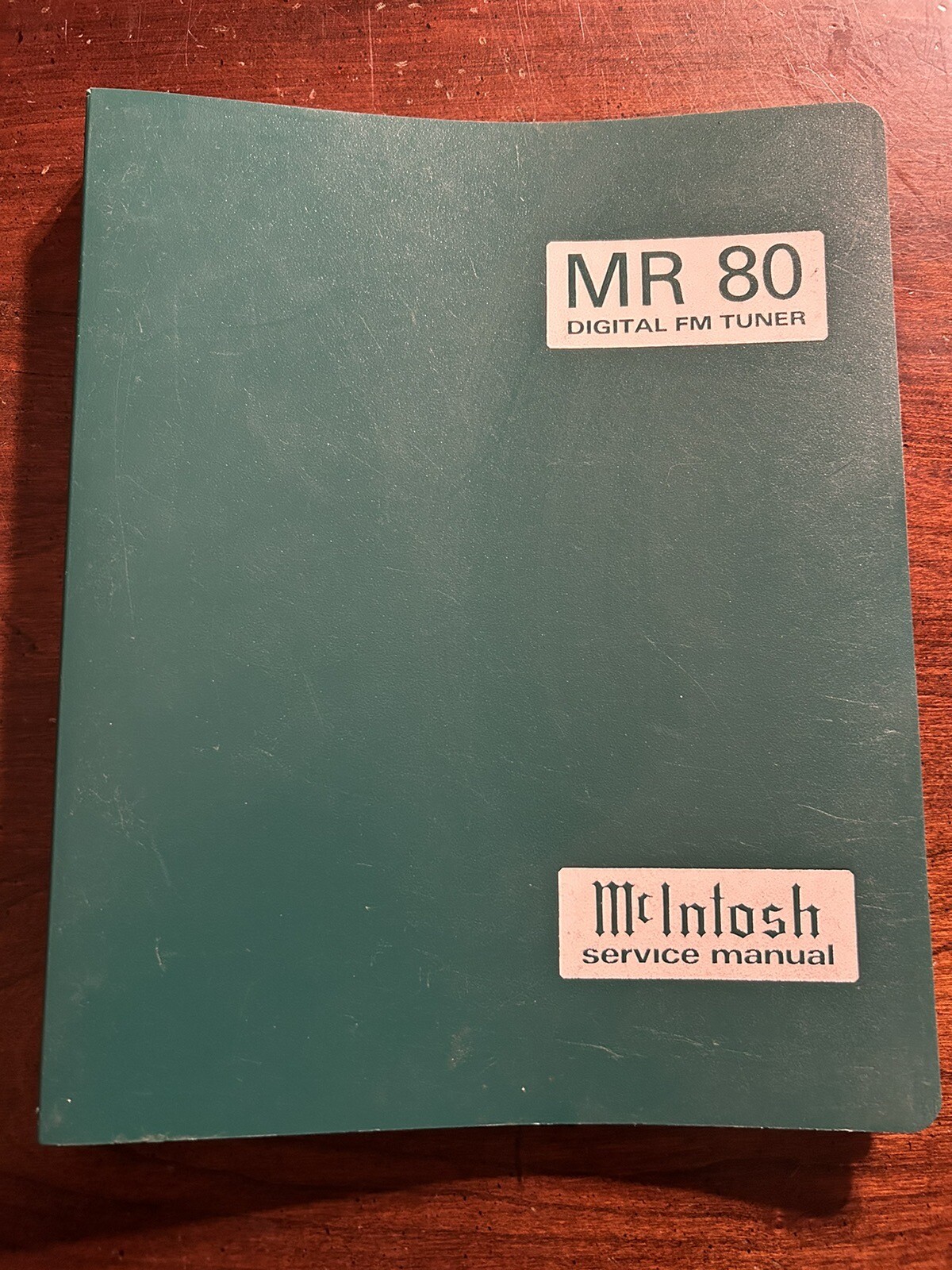
Other failure points include the varactor tuning diodes (rare, but possible), the headphone amplifier (if heavily used), and the front panel display, which can dim or flicker due to aging LEDs or driver circuits. When buying, insist on a unit that powers on, locks onto stations, and produces full output on both channels. Test all presets and the scan function. Look for the original box and manual—rare, but a nice bonus. For those building a vintage McIntosh stack, the MR80 pairs perfectly with the C26 preamp and MC225 amp, creating a system that looks and sounds like a museum piece—except it’s still better than most modern tuners.
eBay Listings



As an eBay Partner, we earn from qualifying purchases. This helps support our independent vintage technology research.
Related Models
- McIntosh mr75 (1971-1977)
- McIntosh ml-1 (1969-1975)
- McIntosh mr7083 (1993-1995)
- McIntosh mr74 (1972-1977)
- McIntosh mr78 (1972-1977)
- Sony ps-5550 (1978-1980)
- Sony ps-lx5r (1983-1985)
- Sony ss-7220a (1970s)
- Sony ss-97 (Late 1970s (approximately 1977-1979))
- Sony ss-999 (Late 1970s (approximately 1977-1979))