McIntosh mr75 (1980-1985)
FM done right—sleek, serious, and smooth as silk.
Overview
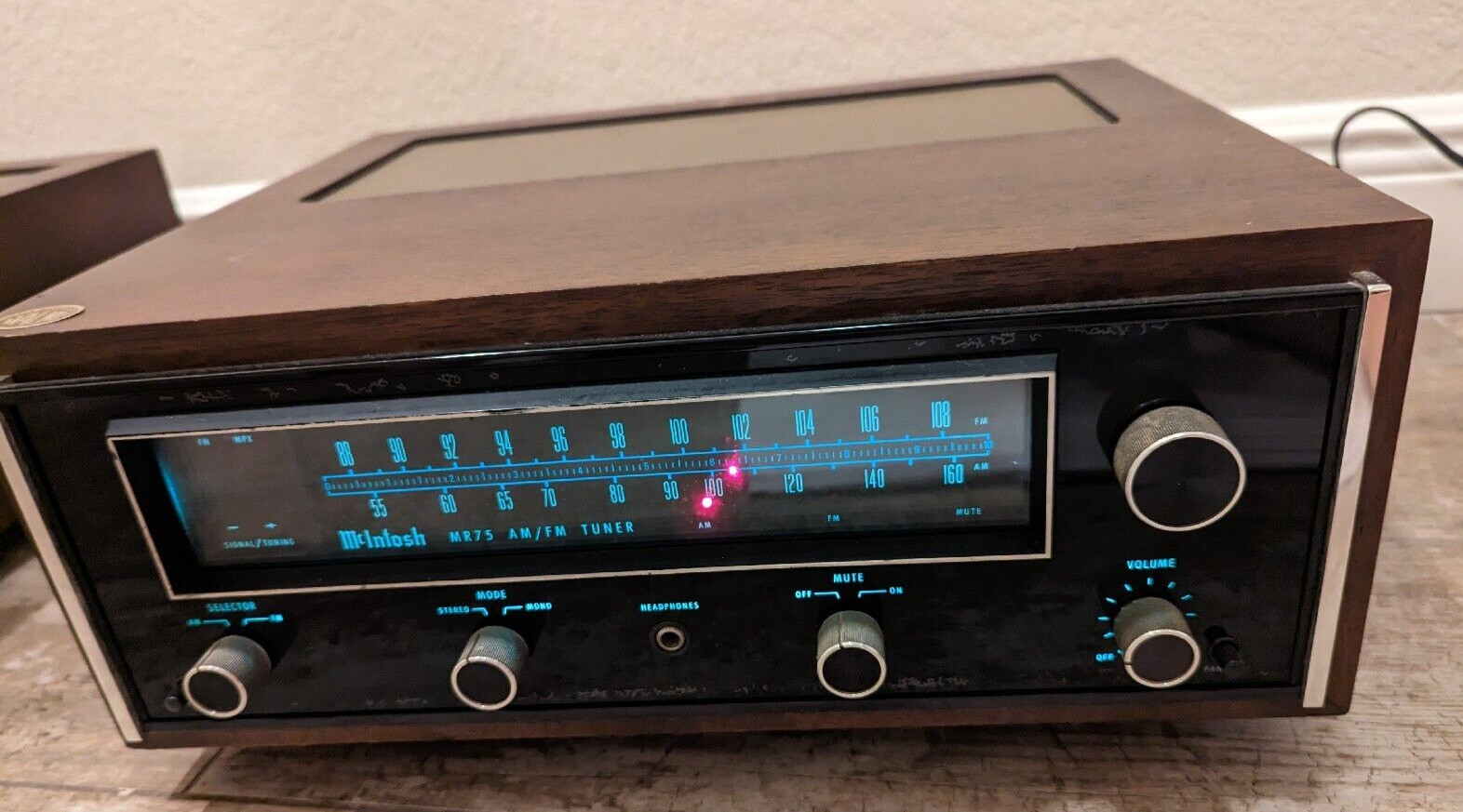
When you fire up the McIntosh MR75, it doesn’t just tune in a station—it locks on like it owns the frequency. This is FM done with authority, the kind of tuner that makes you forget you’re listening to broadcast radio at all. Built like a vault and finished with that unmistakable McIntosh glow, the MR75 isn’t just a piece of gear; it’s a statement. Produced from 1980 to 1985, it arrived when solid-state refinement had matured into something close to perfection, and McIntosh wasn’t messing around. Priced at $1,349 when new—a serious investment—it was engineered to deliver broadcast audio with the same precision and poise as their legendary amplifiers.
Owners report that the MR75 pulls in weak stations with eerie precision, thanks to its exceptional sensitivity and selectivity. It’s not just about raw specs, though those are impressive—it’s about how it feels. There’s a warmth, a smoothness, a lack of edge that makes late-night listening feel like a ritual. The tuning meter sweeps with confidence, the signal strength meter dances with every flutter, and the whole unit hums with the kind of analog presence that modern digital tuners can’t replicate. It’s been called “the last of the true analog tuners,” and if you’ve spent time with one, you understand why.
Specifications
| Manufacturer | McIntosh Laboratory, Inc. (McIntosh Labs) |
| Product type | Solid-State AM/FM Stereo Tuner |
| Production years | 1980 - 1985 |
| Original price | $1,349.00 |
| Tuning | 88 to 108 MHz |
| Antenna Inputs | One 300Ω balanced and one 75Ω unbalanced. |
| Intermediate Frequency | 10.7 MHz |
| Usable Sensitivity | 2.0 µV (11.2 dBf) IHF |
| Quieting Sensitivity | 5mV (19.1 dBf) IHF -50 dB (Mono) / 50mV (39.5 dBf) IHF -50 dB (Stereo) |
| Signal To Noise Ratio | 70 dB IHF minimum both Mono and Stereo |
| Harmonic Distortion | 0.18% (Mono) IHF maximum / 0.38% (Stereo) IHF maximum |
| Alternate Channel Selectivity | 75 dB IHF minimum |
| Image Rejection | 100 dB IHF minimum |
| Stereo Separation | 45 dB minimum at 1 kHz |
| Audio Frequency Response | 20 Hz to 15 kHz +0, -1 dB |
| Capture Ratio | 1.8 dB |
| Selectivity | 75 dB IHF minimum |
| Spurious Rejection | 100 dB IHF minimum |
| SCA Rejection | 60 dB minimum |
| AM Sensitivity | 75mV IHF with external antenna |
| AM Signal To Noise Ratio | 45 dB minimum IHF or 55 dB at 100% modulation |
| AM Frequency Response | + 0 -6 dB from 20 Hz to 3500 Hz |
| AM Harmonic Distortion | 0.8% maximum at 30% modulation |
| AM Adjacent Channel Selectivity | 30 dB minimum IHF |
| AM Image Rejection | 65 dB minimum from 550 kHz to 1600 kHz |
| Audio Output | 2.5V into 47kΩ (Variable) / 1V into 47kΩ (Fixed) |
| Audio Hum | 75 dB down from 100% modulation |
| Power Requirement | 120 Volts 50/60 Hz, 20 Watts |
| Semi Conductor Complement | 22 Bipolar Transistors, 4 Field Effect Transistors, 23 Silicon Diodes, 15 Integrated Circuits, 19 LEDs, 2 Bridge Rectifiers |
| Dimensions | 16"W x 5-7/16"H x 14.25"D |
| Weight | 23 lbs. |
| Cabinet Dimensions | 16 inches wide, 5-7/16 inches high, 10-3/4 inches deep |
| Cabinet Weight | 10 lbs |
| IF Stages | 3 |
| Output Impedance | 1000 Ohms |
| AM Suppression | 70 dB |
| IF Rejection | 120 dB |
Key Features
Automatic Frequency Lock and Precision Tuning
The MR75 features Automatic Frequency Lock (AFL), a patented McIntosh circuit that eliminates drift and keeps the station locked in place—no hunting, no wavering. Combined with a 4-gang tuning capacitor and a 6-pole crystal filter, this gives the tuner exceptional stability and selectivity. The result? Stations come in cleanly, even in weak signal areas, and stay put. Owners note that it “locks onto stations with eerie precision,” and that’s no exaggeration. The tuning meter and signal strength meter provide real-time feedback, making manual tuning a satisfying, almost tactile experience.
Solid-State Circuitry with FET Front End
As a fully solid-state design, the MR75 avoids the maintenance hassles of tubes while delivering the kind of reliability McIntosh is known for. The FET front end ensures high input impedance and low noise, critical for pulling in weak FM signals without adding hiss. This, paired with a third-generation phase-locked loop (PLL) stereo decoder, ensures accurate stereo separation and stable demodulation. The PLL MPX decoder is known for being reliable, but if it does fail, repair can be challenging due to the complexity of the circuit.
Build Quality and User Interface
The chassis is built from heavy-gauge steel and capped with a glass front panel that’s both elegant and functional. Gold-plated input and output jacks ensure long-term connectivity without corrosion. The front-panel headphone jack with level control is a thoughtful touch—rare on tuners of this era—allowing private listening without needing an external amp. The 19 LEDs provide clear status indication, and the overall layout is clean, intuitive, and unmistakably McIntosh. It’s a design that ages well, looking as at home on a modern rack as it did in 1982.
Collectibility & Value
Today, the McIntosh MR75 trades in the $1,000 to $1,300 range for units in good, serviced condition. Listings on Reverb and Audiogon show prices at $1,299 and $1,000 respectively, with some professionally serviced examples holding firm at $999. European markets show variability—€690 on Subito, €1,390 on SpringAir—suggesting condition and service history heavily influence value. Units advertised as “Recapped (CR1300)” or with “New Glass” command premiums, and professional servicing often includes a full capacitor replacement, tuning capacitor cleaning, and control contact maintenance.
Common issues include failing power supplies and tuning capacitors, both of which are serviceable but require expertise. The front glass is prone to bubbling behind the panel, especially near the headphone jack and upper right corner—a cosmetic flaw that doesn’t affect function but detracts from appearance. Fortunately, replacement glass is available directly from McIntosh, a rare perk for vintage gear. While the PLL decoder is robust, its alignment is critical for optimal stereo performance, and misalignment can dull the soundstage. If you're buying, prioritize units that have been comprehensively tested and recapped, with verified lamp operation and clean controls.
eBay Listings


As an eBay Partner, we earn from qualifying purchases. This helps support our independent vintage technology research.
Related Models
- McIntosh ml-1 (1969-1975)
- McIntosh mr7083 (1993-1995)
- McIntosh mr74 (1972-1977)
- McIntosh mr78 (1972-1977)
- McIntosh xr-16 (1989-1991)
- Sony ps-5550 (1978-1980)
- Sony ps-lx5r (1983-1985)
- Sony ss-7220a (1970s)
- Sony ss-97 (Late 1970s (approximately 1977-1979))
- Sony ss-999 (Late 1970s (approximately 1977-1979))