The quiet pioneer in a wooden box—the first preamp McIntosh ever made, and the seed of a legend.
Overview
You don’t hear about the AE-2 in the same breath as the C22 or the MC275, but if you care about where that hallowed McIntosh sound began, this is ground zero. The McIntosh AE-2 wasn’t just another early tube preamp—it was the first. , it marked the company’s official entry into the preamplifier game, a modest but pivotal step for a brand that would go on to define high-fidelity for decades. It’s easy to overlook because it doesn’t have the polished front panels or the massive transformers of later models, but that’s part of its charm. This is McIntosh before the world was watching.
It’s a mono unit, which tells you everything about the era it was born into—stereo was still a dream in an engineer’s notebook. Tube-driven, of course, and built around four 12AX7s, the workhorse of preamp tubes even today. It wasn’t flashy; in fact, it was described as having a “very understated design,” which feels like an understatement in itself. Housed in a wooden chassis, it looks more like a piece of mid-century furniture than a piece of audio gear. No glowing meters, no blue pilot light, no shiny knobs—just a simple, honest box that did its job and stayed out of the way.
And what a job it did. Owners report a very flat frequency response when the tone controls are set to zero, which was no small feat in 1950. With separate volume, treble, and bass controls, it gave listeners actual tonal shaping power at a time when many systems still relied on crude resistive networks or nothing at all. Gain reaches up to 75 dB, which means it could handle the low-output magnetic cartridges just starting to gain traction, though later modifications (like resistor swaps on inputs 3 and 4) were reportedly recommended in the manual to better match modern cartridges—a hint that even early McIntosh owners were tinkering to keep up with evolving tech.
Specifications
| Manufacturer | McIntosh Laboratory |
| Product type | Preamplifier |
| Technology type | Tube (T) |
| Channel configuration | Mono |
| Uses | 4 12ax7 tubes |
| Gain | up to 75 dB |
| Controls | Separate volume, treble, and bass controls |
Key Features
The Original Integrated Design
The AE-2 is consistently described as the “real original one” and the “original integrated unit,” distinguishing it sharply from the later AE-2A, which required an external power supply. That integration was no small thing—having the power supply built in meant fewer boxes, fewer cables, and a cleaner setup at a time when high-fidelity systems were rapidly multiplying components. The AE-2A, which plugged into the McIntosh MC-30 via an octal connector, represented a shift toward modularity, but the AE-2 was the prototype of the concept: a self-contained, ready-to-run preamp that didn’t need hand-holding from another chassis.
Wooden Chassis, Minimalist Aesthetic
Enclosed in a wood chassis, the AE-2 looks more like a radio from a 1950s living room than a piece of serious audio gear. But that wooden enclosure wasn’t just for looks—it reflected the design language of the time, when hi-fi components were meant to blend into the home, not dominate it. The understated design extends to the front panel: simple knobs, minimal labeling, no frills. It’s the anti-spectacle, which makes it all the more striking when you realize you’re looking at the genesis of one of the most recognizable brands in audio.
Flat Response, Tonal Control
Despite its simplicity, the AE-2 delivered a very flat frequency response when the tone controls were set to neutral—a hallmark of McIntosh’s engineering philosophy even in its infancy. That flatness meant it didn’t color the sound unless you wanted it to, and with independent treble and bass controls, you had real shaping power. This wasn’t just a volume knob with a hint of tone tweak; it was a proper equalizer-amplifier, as some sources describe it, built to adapt to the variable quality of records and cartridges of the era.
Historical Context
Launched in 1950, the AE-2 was more than just a product—it was a statement. It was the first preamplifier ever made by McIntosh, a company still finding its footing in the postwar audio market. At a time when many manufacturers were cobbling together kits or repurposing military surplus, McIntosh was designing purpose-built, high-performance gear from the ground up. The AE-2 may have been basic by today’s standards, but it set the template: clean gain, precise control, and a commitment to transparency.
It didn’t stay alone for long. The original AE-2 was followed by a “second version”—understood to be the AE-2A—that required an external power supply, marking an early divergence in design philosophy. Where the AE-2 was self-contained, the AE-2A leaned into modularity, possibly to share power resources with other McIntosh components like the MC-30. This evolution, even in its earliest stages, shows McIntosh already experimenting with system integration, a theme that would define their future.
eBay Listings

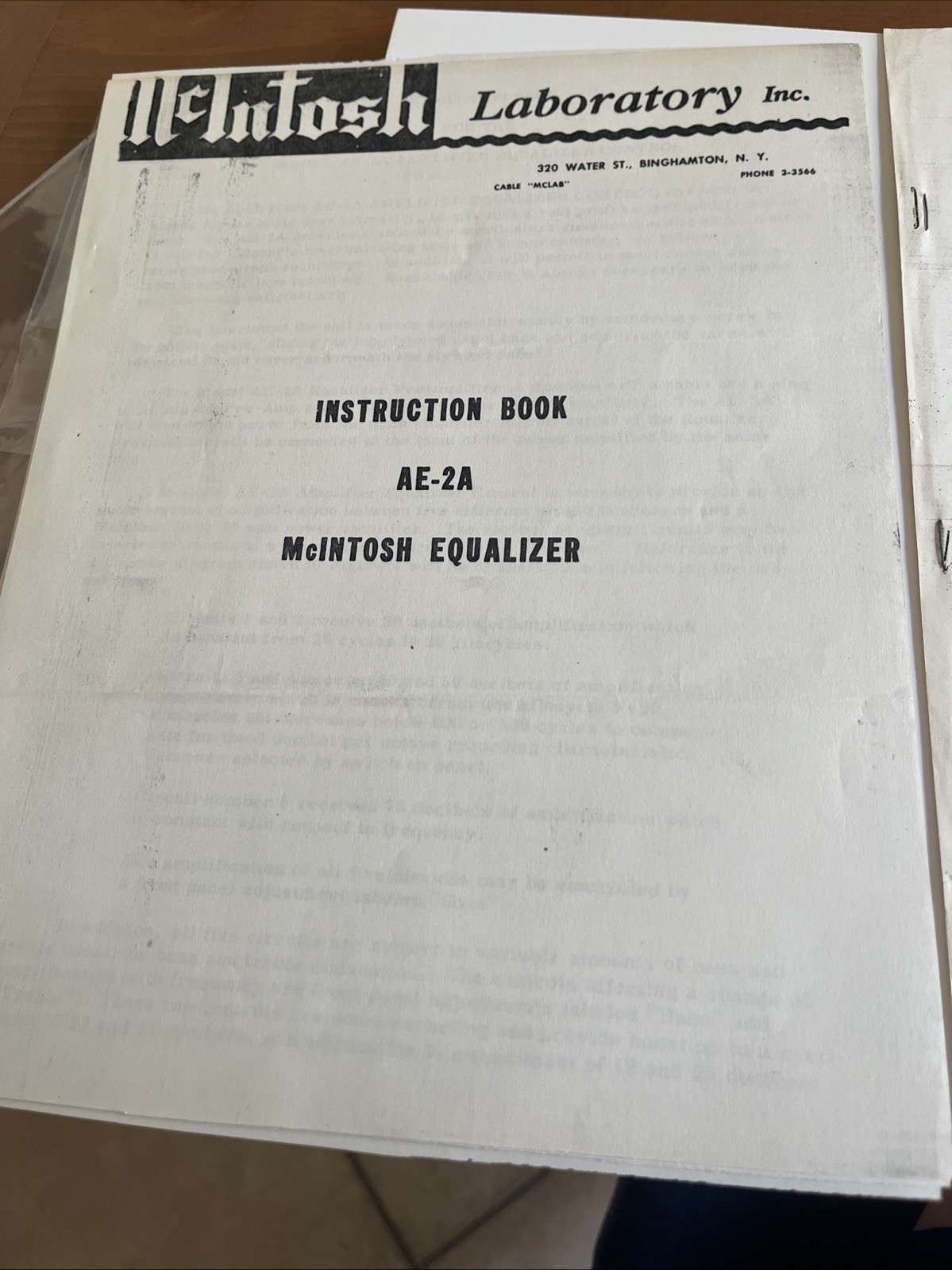


As an eBay Partner, we earn from qualifying purchases. This helps support our independent vintage technology research.
Related Models
- McIntosh mr75 (1971-1977)
- McIntosh ml-1 (1969-1975)
- McIntosh mr7083 (1993-1995)
- McIntosh mr74 (1972-1977)
- McIntosh mr78 (1972-1977)
- Sony ps-5550 (1978-1980)
- Sony ps-lx5r (1983-1985)
- Sony ss-7220a (1970s)
- Sony ss-97 (Late 1970s (approximately 1977-1979))
- Sony ss-999 (Late 1970s (approximately 1977-1979))