Marantz MODEL 22 (1969)
The first solid-state Marantz receiver—and the one that quietly redefined what an integrated amp could be
Overview
Turn the volume knob on a Marantz MODEL 22 and you’re not just adjusting loudness—you’re engaging with a pivot point in audio history. This is the receiver that marked Marantz’s full departure from tubes, the first all-solid-state model the company ever released, and it arrived in 1969 with a quiet confidence that belied its importance. It didn’t scream for attention like some of the flashier Japanese competitors, nor did it carry the romantic glow of its tube-powered predecessors. But in its understated gold-and-black front panel, with that iconic horizontal tuning wheel and piano-key speaker terminals, it laid the foundation for the Marantz sound in the transistor era: smooth, musical, and remarkably neutral when properly maintained.
Rated at 40 watts per channel into 8 ohms, the MODEL 22 wasn’t the most powerful receiver of its time—Marantz’s own Model 19 topped it with 50 watts—but it was positioned as a serious alternative for audiophiles who wanted integrated convenience without sacrificing fidelity. It shared design DNA with the higher-end models, borrowing from the same engineering philosophy that would later define the legendary 22xx series. But unlike those, the MODEL 22 was built during the transitional phase when Marantz was shifting manufacturing overseas, likely to Standard Radio of Japan, though heavily modified to meet Marantz’s exacting standards. The result is a receiver that feels both hand-crafted and forward-thinking, with a dual power supply design that isolates sensitive preamp and tuner circuits from the demands of the amplifier section.
Owners who’ve had one serviced often report performance that exceeds its original specs: distortion figures dipping below 0.1% at normal listening levels, frequency response flat within ±0.1 dB from 20Hz to 20kHz, and a phono stage so accurate it measures within ±0.7 dB of ideal RIAA equalization. The FM tuner, featuring a FET front end and dual ceramic filters, delivers excellent stereo separation and a clever “Antenna Tuning” function that lets you visually minimize multipath distortion—a rare feature even on separates at the time. It’s not just a receiver; it’s a compact system engineered to punch above its weight.
Specifications
| Manufacturer | Marantz |
| Production Years | 1969–1972 |
| Original Price | $449 |
| Power Output | 40W per channel into 8Ω (stereo) |
| Power Output (4Ω) | 50W per channel |
| THD | 0.3% (rated), under 0.1% (measured, 1–50W) |
| Frequency Response | 20Hz – 20kHz (±0.1 dB) |
| Signal-to-Noise Ratio | 80dB (line), 65dB (FM tuner at 50µV) |
| Damping Factor | 35 |
| Input Sensitivity | 2.4µV (IHF, FM tuner) |
| FM Selectivity | 80dB |
| FM Stereo Separation | 40dB at 1kHz |
| AM Tuner | Yes (first Marantz receiver with AM) |
| Inputs | 2 phono, 1 auxiliary, 1 tape |
| Outputs | 1 tape, 2 speaker sets |
| Power Outlets | 1 switched, 1 unswitched |
| Dimensions | 5.5" H × 17" W × 15" D |
| Weight | 37 lbs |
Key Features
Horizontal Tuning Wheel and Analog Elegance
The front panel of the MODEL 22 isn’t just functional—it’s a design statement. The horizontally mounted tuning wheel, flanked by analog meters for signal strength and tuning, gives it a console-like presence that few integrated receivers ever achieved. This wasn’t just about looks; the layout encouraged deliberate, hands-on operation. You didn’t punch buttons and hope for the best—you tuned, you watched the meter, you adjusted the antenna. It made listening feel like a ritual, not a convenience. The push-button controls below handle channel selection, loudness contour, muting, and speaker switching, while the top panel includes dedicated knobs for bass, treble, balance, and volume. It’s a layout that rewards familiarity, with a tactile quality that modern digital interfaces can’t replicate.
Dual Power Supply Architecture
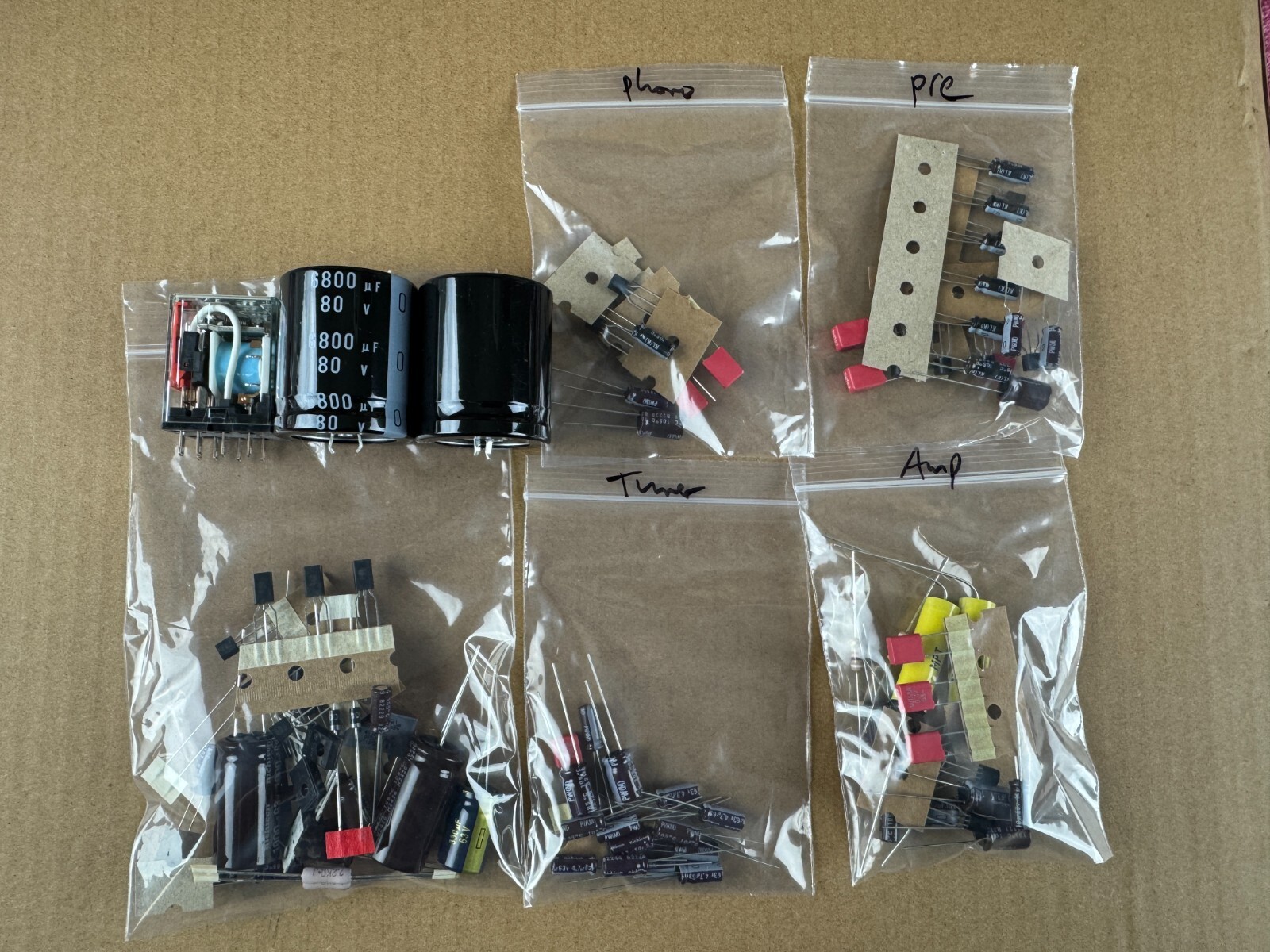
Beneath the chassis lies one of the MODEL 22’s most significant engineering choices: a dual-rail power supply that separates the preamp and tuner sections (27V/35V rails) from the RF and front-end driver stages (12V tap). This isolation minimizes crosstalk and noise, a design approach more commonly found in separates than in integrated receivers of the era. The original power supply used two large metal-can capacitors (1000µF/50V), now routinely replaced during restoration with modern low-impedance, high-temp electrolytics like Nichicon PW or Panasonic FR series. This upgrade not only improves reliability but can enhance dynamic headroom and bass control, bringing the receiver closer to its original performance before component aging took its toll.
Phono Stage Precision and Service Challenges
The RIAA phono stage in the MODEL 22 is consistently praised in restoration circles for its accuracy and musicality. Unlike many solid-state designs of the period that leaned toward brightness or brittleness, this one delivers a balanced, natural midrange with excellent detail retrieval. However, it’s also home to some of the receiver’s most failure-prone components—particularly the 2SC458 transistors used throughout the preamp and driver stages. These early Japanese BJTs are notorious for drifting in gain and introducing noise over time, and service bulletins from the era recommend replacing them with more stable alternatives. A full recap and transistor refresh can transform a sluggish, noisy unit into a reference-level performer, but it’s not a job for the faint of heart or shallow of wallet.
Historical Context
The MODEL 22 arrived at a turning point. In 1969, the hi-fi world was shifting from tubes to transistors, and Marantz—long associated with hand-wired tube amplifiers—was under pressure to modernize. The MODEL 22 was its answer: a bold step into solid-state territory that didn’t abandon the brand’s sonic identity. It was also the first Marantz receiver to include an AM tuner, a practical addition that broadened its appeal beyond the FM-obsessed audiophile niche. Competitors like Sansui, Pioneer, and Sony were pushing higher power ratings and flashier features, but Marantz focused on refinement, building a receiver that prioritized signal purity and build quality over raw specs.
It sat just below the flagship Model 19 in the lineup, offering most of the same engineering rigor at a more accessible price point. While the 22xx series that followed in the mid-70s would become more collectible today, the MODEL 22 was the prototype for that lineage—sharing circuit philosophies, layout conventions, and the same commitment to musicality. It was also one of the last Marantz receivers to exhibit significant hand assembly before production became more automated. For collectors, it represents a bridge between the American-designed tube era and the Japanese-manufactured solid-state age.
Collectibility & Value
The MODEL 22 trades in a quiet corner of the vintage market—respected by those who know it, but often overlooked by casual buyers drawn to the flashier 22xx series. In untested or as-found condition, it typically sells for $200–$300, reflecting the near-certainty of needing a full restoration. A fully serviced unit, with recapped power supply, replaced transistors, cleaned controls, and realigned tuner, can command $400–$600, depending on cosmetic condition and provenance. The optional walnut cabinet (WC-3 or WC-4) adds value, though fitment can be slightly off due to dimensional differences from later models.
Common failure points include degraded electrolytic capacitors (especially the dual can types in the power supply), oxidized potentiometers, and aging transistors in the preamp and driver stages. The speaker protection relay (P980) is another weak spot, with older LY relays prone to contact failure. Owners report that once restored, the MODEL 22 is reliable, but the initial service investment is non-trivial—easily $300–$500 at a qualified technician. It’s not a “plug-and-play” vintage receiver, but for those willing to put in the work, it delivers a listening experience that rivals far more expensive contemporaries.
When buying, insist on a unit that has been tested for channel balance, hum levels, and tuner performance. Avoid units with cracked meter faces or heavily corroded binding posts. Check for service history—some units were modified under factory bulletins, including resistor value changes (e.g., R617/618 updated from 10k to 9.1k) and transistor upgrades. These aren’t flaws; they’re signs of a receiver that was taken seriously in its time.
eBay Listings


As an eBay Partner, we earn from qualifying purchases. This helps support our independent vintage technology research.
Related Models
- Marantz 3600 (1976-1977)
- Marantz MODEL 112 (1971-1973)
- Marantz MODEL 115 (1975-1977)
- Marantz MODEL 260 (1976-1978)
- Marantz MODEL 28 (1971-1973)
- Akai AM-2850 (1975)
- Akai AP-206 (1975)
- Nakamichi BX-1 (1985)
- Acoustic Research research-ar-17 (1978)
- Acoustic Research AR-19 (1994)