Marantz Model 125 (1973)
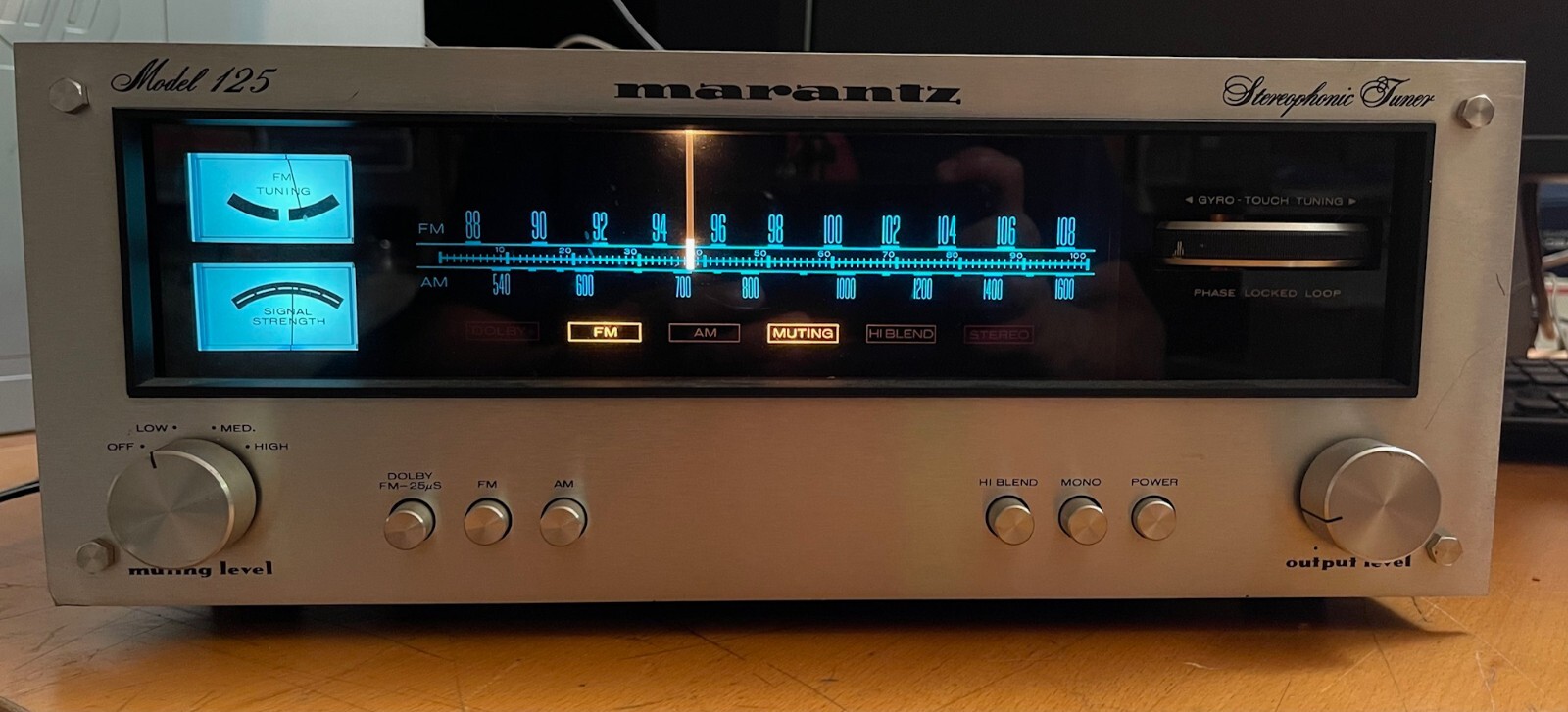
The Marantz Model 125 is a high-fidelity FM/AM tuner introduced in 1973 as part of Marantz’s respected mid-range receiver and tuner series of the 1970s. Though it lacks built-in amplification, the Model 125 was designed to deliver exceptional tuner performance when paired with external amplifiers and preamplifiers. Renowned for its advanced tuning stability, clean signal path, and elegant walnut wood cabinet, the Model 125 remains a sought-after piece among vintage audio enthusiasts who appreciate precise FM reception and classic analog design.
Specifications
| Feature | Specification |
| Year of Production | 1973–1975 |
| Type | FM/AM Tuner (no amplification) |
| Power Output | Not specified |
| Impedance | N/A (no speaker output) |
| FM Sensitivity | 1.9 μV (IHF usable sensitivity) |
| Tuning System | Quartz-locked phase-locked loop (PLL) FM stereo multiplex |
| Front End | FET (Field-Effect Transistor) |
| Tuning Capacitor | 4-gang |
| Display | Analog signal strength and center tuning meters |
| Cabinet | Walnut wood veneer |
| Dimensions (W×H×D) | 440 × 145 × 335 mm |
| Weight | 10.5 kg (approx.) |
Key Features
- Quartz-Locked PLL FM Stereo Decoding: Ensures stable and accurate stereo demodulation, minimizing drift and crosstalk.
- FET Front End: Provides high input impedance and low noise for improved weak-signal reception.
- 4-Gang Tuning Capacitor: Enhances tuning precision and tracking accuracy across the FM band.
- Dual Analog Meters: Monitor both signal strength and stereo center tuning for optimal station alignment.
- AM/FM Band Coverage: Full coverage of FM (87.5–108 MHz) and AM (530–1710 kHz) bands with smooth analog tuning.
- Classic Design: Elegant walnut cabinet with Marantz’s signature brushed aluminum faceplate and large tuning dial.
Historical Context
The Marantz Model 125 was released during a golden era of high-fidelity audio, when tuner performance was a critical differentiator among audiophiles. As part of Marantz’s 1970s lineup, the Model 125 bridged the gap between entry-level and flagship tuners, offering advanced features like quartz-locked PLL technology—rare in mid-tier models at the time. This innovation provided superior tuning stability compared to traditional variable-capacitor or varactor-tuned designs, reducing the need for constant manual adjustment.
While not as powerful or feature-rich as Marantz’s all-in-one receivers, the Model 125 was prized for its clean, low-noise reception and accurate stereo imaging. It reflected Marantz’s commitment to engineering excellence and build quality, with point-to-point wiring, high-grade components, and meticulous shielding to minimize interference.
Though overshadowed by more powerful integrated models, the Model 125 earned a loyal following among listeners who valued pure signal integrity and precise tuning—especially in fringe reception areas.
Sound Signature
The Model 125 delivers a clean, transparent sound with excellent stereo separation and minimal distortion when properly aligned. Its FET input stage ensures low noise and high sensitivity, making it capable of pulling in weak FM stations with clarity. The quartz-locked PLL demodulator contributes to stable stereo decoding, reducing drift-induced flutter and phase errors.
Users often praise its selectivity—the ability to reject adjacent-channel interference—making it effective in crowded urban RF environments. Once aligned, the tuner maintains consistent performance, offering a listening experience that rivals more expensive contemporaries.
Maintenance and Restoration Tips
Like all vintage electronics, the Marantz Model 125 benefits from regular maintenance to ensure optimal performance:
- Capacitor Replacement: Electrolytic and coupling capacitors degrade over time. Replacing them (recapping) is often essential for reliability and sound quality.
- Cleaning Controls and Switches: Use contact cleaner on tuning pots, band switches, and input selectors to prevent crackling and intermittent connections.
- Alignment Check: Over decades, IF and RF stages can drift. A professional alignment using proper test equipment is recommended for peak sensitivity and selectivity.
- Meter and Dial Lighting: The analog meters and tuning dial use small incandescent bulbs that may need replacement. Use exact voltage-rated bulbs to avoid damage.
- Ventilation and Dusting: Keep the unit clean and well-ventilated to prevent overheating and dust buildup, especially around the power transformer and tuning capacitor.
Collectibility and Market Value
The Marantz Model 125 holds moderate collectibility, rated 6/10, due to its solid engineering and brand reputation, though it lacks the rarity or power output of Marantz’s flagship receivers. Well-maintained or restored units typically sell for $100–$250, with higher prices for fully serviced models in excellent cosmetic condition.
It appeals to:
- Vintage tuner collectors
- Audiophiles building period-correct systems
- DIY restorers seeking a project with high-end potential
While not the most iconic Marantz model, the Model 125 represents a smart blend of innovation and craftsmanship from a legendary era in audio history.
eBay Listings



As an eBay Partner, we earn from qualifying purchases. This helps support our independent vintage technology research.
Related Models
- Marantz 2215B (1978-1980)
- Marantz HD 440 (1976-1977)
- Marantz 1515 (1976-1978)
- Marantz 4220 (1974-1976)
- Marantz 4230 (1974-1976)
- Aiwa CS-250 (1978)
- Denon TU-1500RD (1995)
- Denon TU-280 (1976)
- Denon TU-501 (1977)
- Denon TU-550 (1978)