Marantz MODEL 115 (1974-1976)
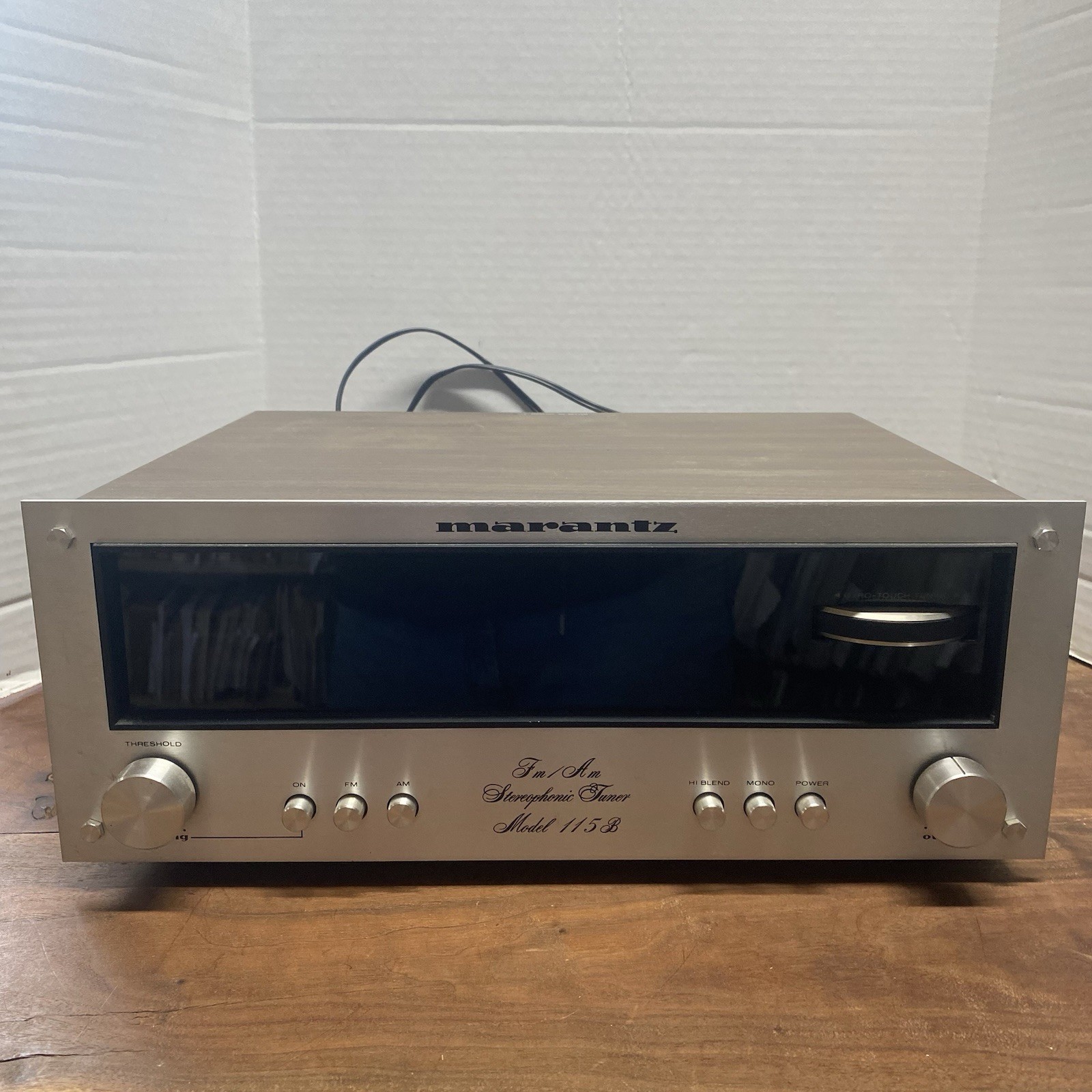
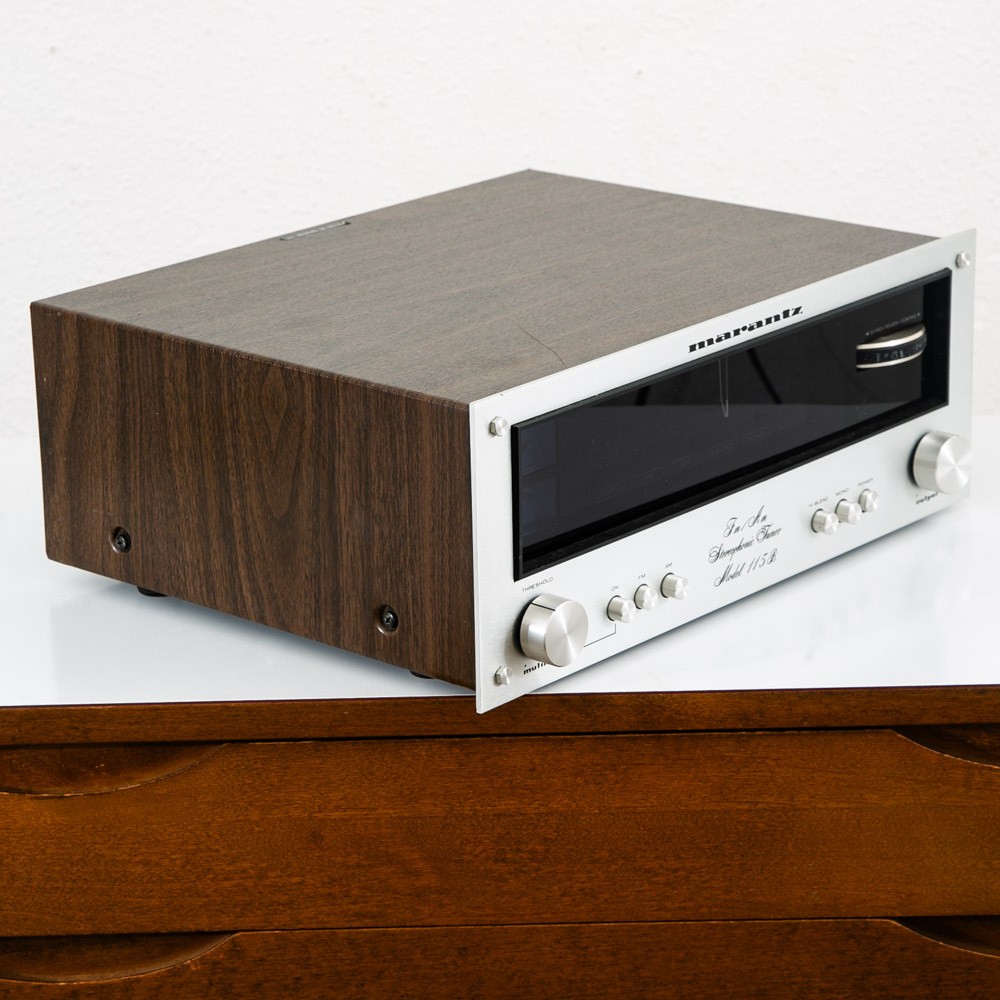
That smooth, heavy glide of the gyro-touch dial—like tuning a radio through molasses—is pure Marantz 115, a tuner built for precision, not speed.
Overview
The Marantz Model 115 isn’t loud, flashy, or fast—it’s deliberate. Built between 1974 and 1976, this FM/AM stereo tuner was part of Marantz’s “Classic Model” lineup, a series that balanced cutting-edge engineering with the brand’s reputation for musicality and build quality. Unlike the power amplifiers some might confuse it with, the 115 is a dedicated tuner, designed to extract every whisper of signal from the airwaves with surgical accuracy. It was developed using Marantz’s 10B tuner technology and designed and checked by Marantz U.S.A., a detail that matters to purists who associate that era with the brand’s golden touch. While some listings reference a “115B” variant, the Model 115 stands as the primary designation in official spec databases, and it’s this version that collectors and restorers most often encounter. It’s not a showstopper in terms of raw power, but in the quiet art of reception, selectivity, and signal purity, it’s a masterclass.
Owners report it as accurate, precise, user-friendly, and versatile—words that don’t scream excitement but speak volumes in the world of vintage tuners, where a stable stereo lock, clean separation, and low distortion are the real prizes. It wasn’t built to be flashy; it was built to disappear into the system, delivering radio broadcasts with a clarity that lets the music breathe. And while it lacks the wattage wars appeal of amplifiers, its 40 dB closed-loop gain was a notable return to form—the first in a Marantz tuner since the legendary Model 7—making it capable of driving higher-output MC cartridges directly, a subtle but meaningful flex in its design.
Specifications
| Product type | FM/AM Stereo Tuner |
| Year of Production | Circa 1974-1976 |
| FM sensitivity (IHF) | 1.9 μV (75 Ω) |
| FM practical sensitivity (IHF) | 2.3 μV |
| FM separation | 42 dB (1kHz) |
| FM capture ratio | 1.6 dB |
| FM distortion factor mono | 0.15% |
| FM distortion factor stereo | 0.3% |
| FM spurious interference ratio | 95 dB or more |
| FM image ratio | 70 dB or more |
| FM AM suppression ratio | 60 dB or more |
| FM IF interference ratio | 90 dB or more |
| FM selectivity | 60 dB or more |
| FM signal-to-noise ratio Mono | 70 dB or more |
| FM signal-to-noise ratio Stereo | 60 dB or more |
| AM sensitivity | 20 μV or more |
| Tuning frequency range (FM) | 76 MHz to 90 MHz |
| Frequency response (50 μsec de-emphasis) | ±1 dB (50 Hz to 15 kHz) |
| Tuning frequency range (AM) | 535 kHz to 1605 kHz |
| Selectivity (AM) | 26 dB |
| Signal-to-noise ratio (AM) | 46 dB |
| Power supply | 100 VAC, 50Hz/60Hz |
| Power consumption | 25W |
| External dimensions | Width 390 x Height 146 x Depth 300 mm |
| Weight | 7.9 kg |
| Features | AM/FM tuning, gyro-touch tuning, muting with threshold control, automatic stereo/mono switching, high-blend switch, attenuator switch (~20 dB), QUADRADIAL OUTPUT for 4-channel, output for 4-channel decoder |
Key Features
Gyro-Touch Tuning: Heavy Metal Precision
The first thing you notice when you lay hands on a Model 115 is the gyro-touch tuning. It’s not a knob—it’s a flywheel. Turn it, and you feel the inertia of a well-balanced, heavy-duty mechanism designed to eliminate overshoot and allow for micro-adjustments. This isn’t just a gimmick; it’s a functional design that lets users tune in weak stations with confidence. The large flywheel smooths out hand tremors and provides a tactile feedback loop that modern digital tuners can’t replicate. It’s satisfying in the way only mechanical precision can be—like shifting a well-oiled manual transmission.
FM Front-End: Double-Tune with FETs
Under the hood, the Model 115’s FM section uses a double-tune system with a four-row varicon and a two-stage FET configuration. The FET mixer stage helps maintain low noise and high input impedance, critical for pulling in weak signals without adding hiss. This front-end design, combined with six ceramic filters in the IF stage, gives the 115 its exceptional selectivity (60 dB or more) and image rejection (70 dB or more), making it resistant to adjacent-channel interference—a real issue in crowded urban bands during the 1970s.
Advanced Muting and Signal Management
The muting circuit is unusually sophisticated, monitoring three inputs: signal strength, detector noise state, and the DC component of the detected output. This means the tuner doesn’t just mute when the signal drops—it anticipates noise and suppresses it before it hits the output. The result is a clean, quiet listening experience even when tuning across the dial. Combined with automatic stereo/mono switching and a high-blend switch (which reduces high-frequency crosstalk in weak signal areas), the 115 adapts to reception conditions rather than forcing the user to compromise.
4-Channel Ready with QUADRADIAL Output
Forward-thinking for its time, the Model 115 includes a QUADRADIAL OUTPUT connector and a dedicated output for a 4-channel decoder. This wasn’t just a nod to quadraphonic audio—it was a full integration, allowing owners to future-proof their systems during the brief but enthusiastic quadraphonic era. The inclusion of this feature, along with the attenuator switch (~20 dB), shows Marantz wasn’t just building a tuner—they were building a control center for the discerning listener.
Shielding and Build Integrity
Inside, the Model 115 takes no shortcuts. The transformer, FM front end, AM tuner section, and power supplies are all covered in black shielding to prevent unwanted radiation and crosstalk. This attention to electromagnetic hygiene ensures that the tuner doesn’t interfere with other components in a stacked rack. The AM section, while simpler, uses an integrated circuit for RF amplification, oscillator, mixer, IF amp, and detector, backed by a discrete transistor audio stage. The RF amp uses two tuning circuits with a 3-row varicon, improving AM selectivity and sensitivity—critical for pulling in distant AM stations with clarity.
MPX and Equalizer Design
The MPX (stereo demodulator) section uses a PLL-type IC, a stable and accurate method for decoding stereo signals, with its coil sealed in epoxy to prevent microphonics and drift. The equalizer amplifier is a 5-transistor, 3-stage direct-coupled differential circuit with a 40 dB closed-loop gain—the first Marantz tuner since the Model 7 to feature such high gain. This allows it to interface directly with higher-output moving coil cartridges, bypassing the need for an additional preamp stage in some setups, a subtle but meaningful advantage for minimalist systems.
Historical Context
Designed and checked by Marantz U.S.A., the Model 115 emerged during a period when high-fidelity radio reception was still a core component of the audiophile experience. Before streaming, before satellite, FM radio was the high-res audio source of choice, and tuners like the 115 were expected to perform at the level of the best preamps and amplifiers. Its 40 dB gain marked a return to a design philosophy last seen in the Model 7, bridging a gap in Marantz’s tuner lineage. Positioned as a “Classic Model,” it wasn’t the flagship, but it carried the brand’s full engineering weight, offering performance that rivaled or exceeded many contemporaries.
Collectibility & Value
The Marantz Model 115 trades today between €379 and €699, with one U.S. listing noted at $500. Condition is everything—cosmetic wear is expected, but functional integrity is paramount. One known unit, upgraded with a C14 power connector, was described as 7/10 cosmetically but excellent functionally, including original manuals and a high-end power cable. Restoration kits are available, including recap sets and replacement button knobs, making it a feasible project for the DIY-inclined.
The most commonly reported failure point is the dial illumination lamps—fusible type, 6.3x31 mm, 8V 250 mA or 6.3V 250 mA—which are prone to burning out and should be replaced in kind. Owners are advised to replace all lamps at once, as aging bulbs can fail unpredictably and may stress the power supply. Beyond that, there’s limited public data on chronic failures, but given the complexity of the analog circuitry, a full recapping and control cleaning are prudent for any unit that’s been dormant for years.
eBay Listings


As an eBay Partner, we earn from qualifying purchases. This helps support our independent vintage technology research.
Related Models
- Marantz 3600 (1976-1977)
- Marantz MODEL 112 (1971-1973)
- Marantz MODEL 260 (1976-1978)
- Marantz MODEL 28 (1971-1973)
- Marantz MODEL 2A (1964-1966)
- Akai AM-2850 (1975)
- Akai AP-206 (1975)
- Nakamichi BX-1 (1985)
- Acoustic Research research-ar-17 (1978)
- Acoustic Research AR-19 (1994)