A statement of intent carved from aluminum, copper, and Class D ambition—this is Marantz at its most uncompromising.
Overview
The Marantz Model 10 isn’t just an amplifier; it’s a declaration. Positioned as the flagship of a new “Best of the Best” series, this Reference Integrated Amplifier represents a clean-sheet design philosophy where cost was clearly not a constraint. At $15,000, it’s not chasing entry-level buyers or casual listeners—it’s aimed squarely at the top tier, where engineering obsession meets audiophile aspiration. And while it carries the revered “10” badge—a lineage that stretches back to the legendary 10B tube tuner—this is no nostalgic rehash. Instead, it’s a modern powerhouse, the most muscular amplifier Marantz has ever made, retiring the 2018 PM-10 with a claim that 84% of its components are entirely new. Even the copper screws survived the purge.
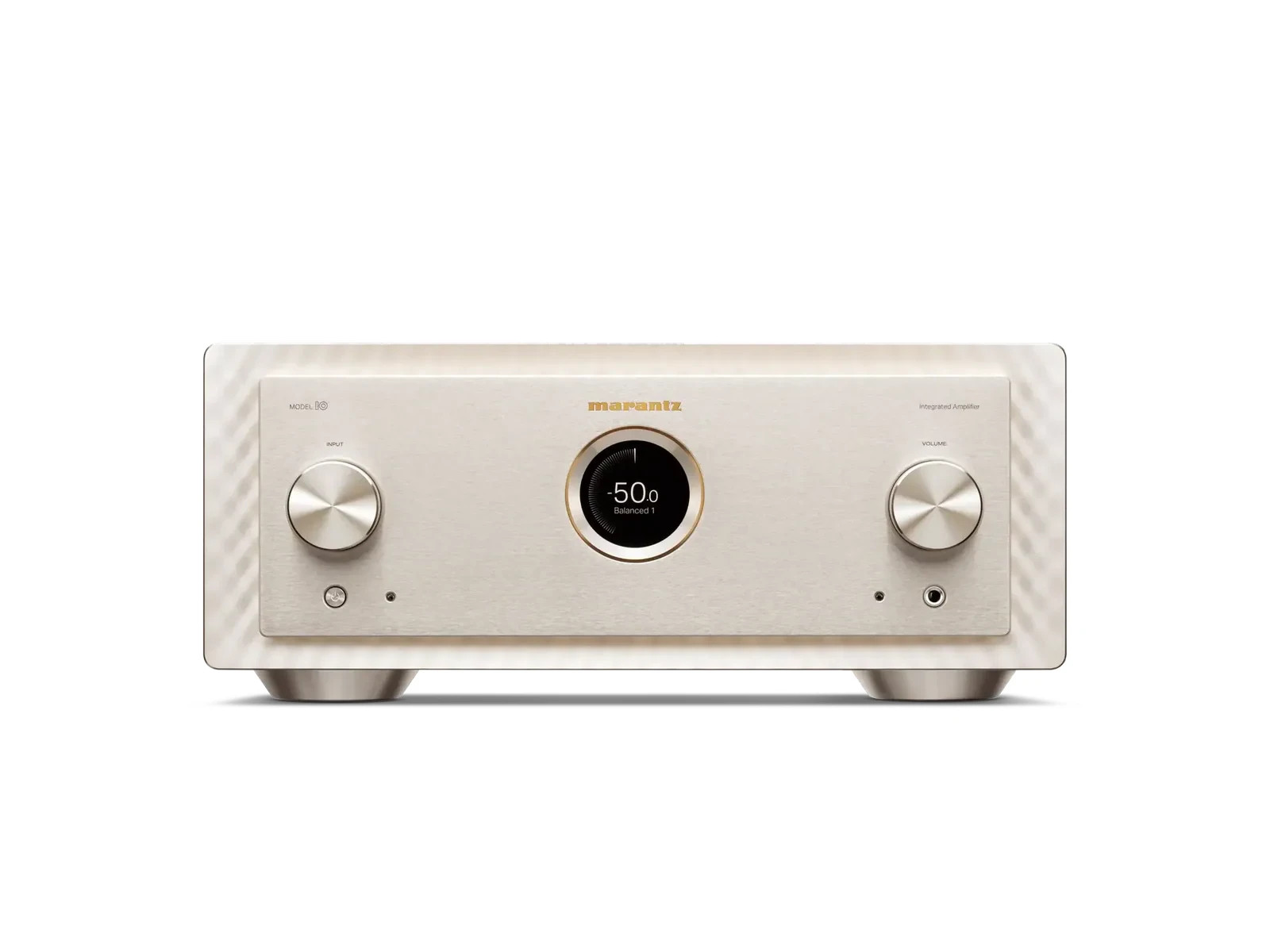
What stands out immediately is the sheer physical presence. Weighing in at 34kg (74.8 lbs), it’s dense with intention. The chassis isn’t just built—it’s sculpted. The front panel is milled from a 3-cm billet of aluminum on a 6-axis CNC machine, giving it a distinctive hammered texture that catches light like brushed steel under moonlight. It’s flanked by thick aluminum side and top panels, while the interior goes full fortress mode: every internal chassis panel is copper-plated, the bottom gets three layers of copper plating, and even the toroidal transformer wears a copper-plated shell. This isn’t just shielding—it’s overkill as a design principle, and in high-end audio, that kind of paranoia often pays off in silence.
Despite its size and heft, the Model 10 doesn’t shout. It whispers authority. The central “porthole” display—a nod to classic Marantz tuners—houses a vibrant HD TFT color screen that doubles as a level meter, glowing with quiet confidence. The volume and input dials ride on bearings, offering a tactile precision that reviewers have called “perfectly balanced.” It’s a machine that feels expensive not because of chrome or flash, but because every surface, every screw, every layer of metal feels like it belongs.
And then there’s the sound. Or rather, the promise of it. With 250 watts per channel into 8 ohms and 500 into 4, this isn’t an amp built for polite listening. It’s designed to drive difficult loads with ease, to dig deeper into bass octaves, to deliver transient incision without flinching. Reviewers report it punches harder below 40Hz than any amplifier they’ve heard, blending the heft of a Hegel with the layer separation of an NAD M23, while ditching the tonal compromises of both. It’s described as “practically perfect,” “exquisitely tactile,” and in one case, “the best-sounding amplifier I’ve heard to date.” That’s not marketing speak—that’s reviewer awe.
But make no mistake: this is not vintage gear in the traditional sense. It’s too new, too current, too much of a technological statement to belong in a museum of obsolete wonders. Yet it earns its place here because it’s a landmark—a moment where Marantz doubled down on craftsmanship, heritage, and cutting-edge tech in one defiant package. It’s a bridge between eras, built in Shirakawa, Japan, the spiritual home of Marantz’s high-end builds, and it carries the weight of 70 years of audio history on its broad, copper-clad shoulders.
Specifications
| Manufacturer | Marantz |
| Product type | Integrated amplifier |
| Power output | 250 watts per channel into 8 ohms |
| Power output | 500 watts per channel into 4 ohms |
| THD | 0.005 % (125 W, 8 ohm, 20 Hz-20 kHz) |
| Frequency response | 5 Hz – 60 kHz (+0 dB/-3 dB) and 20 Hz – 20 kHz (+0 dB/-0.3 dB) |
| Damping factor | 500 (8 ohm, 20 Hz-20 kHz) |
| Phono stage | Included, with settings for MC cartridges (High, Mid, Low output) |
| Moving-coil stage impedance settings | 33 ohms, 100 ohms, and 390 ohms |
| MM input sensitivity | 3.6 mV / 39 kΩ |
| Headphone amplifier | Included |
| Inputs | Two sets each of balanced (XLR) and single-ended (RCA) inputs, tape monitor inputs and outputs |
| Outputs | Preamp outputs and power amp inputs, two sets of binding posts to accommodate biwiring |
| Signal-to-Noise Ratio | CD/Line/Balanced ~122 dB |
| RIAA deviation (Phono MM/MC) | 20 Hz–20 kHz ±0.5 dB |
| Dimensions | 17.32” × 7.56” × 18.62” (440 × 192 × 473 mm) |
| Weight | 34kg (74.8 lbs) |
| Power consumption (typical operation) | 270 watts |
| Power consumption (standby mode) | 0.1 watts |
Key Features
Class D Reimagined
At its core, the Model 10 runs on a custom-tailored variant of Purifi’s Eigentakt Class D modules—a collaboration that signals Marantz’s willingness to embrace modern efficiency without sacrificing sonic purity. This isn’t the Class D of yesteryear, accused of being clinical or lean. Instead, it’s been tuned to deliver over 300 watts (measured) into 8 ohms and nearly 600 into 4, with peak bursts approaching 900 watts. The current delivery capability—30 amperes—means it can slam transients with authority, giving it that “killer bass” reviewers rave about. And because it’s fully balanced from input to output—even converting single-ended signals to balanced internally—it maintains signal integrity across the entire chain.
Hyper-Detailed Signal Path
Marantz didn’t stop at the power stage. The preamp section is its own island of refinement, powered by a dedicated toroidal transformer and shielded from digital noise. Analog and digital sections each have their own power supplies, and the services/controls run on a dual setup: linear when active, switching in standby. Inside, the signal path is guarded by third-generation HDAM (Hyper Dynamic Amplifier Modules), including HDAM-SA3 variants, known for their speed and low distortion. The volume control uses a MUSES72323 chip, and all incoming signals pass through it—no DSP, no room correction, no digital meddling. What you feed it is what it amplifies.
Fortress-Like Construction
The chassis is a layered defense against resonance and interference: aluminum, steel, and copper in a three-tiered structure. Power is transmitted via solid copper bars (L-profiles) fastened with copper screws—yes, those same screws reused from the PM-10. Critical components include red Wima capacitors, MELF resistors, low-tolerance mica SMDs, and high-speed SiC Schottky diodes, all mounted on multi-layer PCBs housed in isolated sub-enclosures. The result is a signal path that’s not just clean, but physically isolated, thermally managed, and electromagnetically shielded to an almost absurd degree.
Design as Statement
Even the lighting is considered: subtle, dimmable illumination glows inside the chassis and around the front panel, more for ambiance than utility. Reviewers admit it makes no audible difference, but leave it on anyway—because it looks that cool. The binding posts are chunky, covered in clear plastic with small slots, and the remote, while functional (and shared with the SACD 10 and Link 10n), has been called “not a pleasant experience” to use. But the dials? They’re flawless. The balance of resistance, precision, and tactile feedback is, in one reviewer’s words, “simply nailed.”
Historical Context
The Model 10 emerged as the first product in Marantz’s new 10 Series, a “blank-page, cost-no-object” line launched to celebrate the brand’s 70th anniversary in 2023. The “10” designation has long been a symbol of Marantz’s highest ambition, dating back to the 10B tuner of the 1960s. The Model 10 continues that legacy, retiring the 2018 PM-10 and marking a decisive break from its predecessor with an 84% component overhaul. Designed and manufactured at Marantz’s Shirakawa facility in Japan, it represents a rare commitment to in-house, high-end production in an era where such practices are increasingly rare.
eBay Listings


As an eBay Partner, we earn from qualifying purchases. This helps support our independent vintage technology research.
Related Models
- Marantz 3600 (1976-1977)
- Marantz MODEL 112 (1971-1973)
- Marantz MODEL 115 (1975-1977)
- Marantz MODEL 260 (1976-1978)
- Marantz MODEL 28 (1971-1973)
- Akai AM-2850 (1975)
- Akai AP-206 (1975)
- Nakamichi BX-1 (1985)
- Acoustic Research research-ar-17 (1978)
- Acoustic Research AR-19 (1994)