Marantz 2250B (1976–1977)
A receiver that doesn’t shout for attention—until you turn it on and realize nothing else in its class hits quite this hard.
Overview
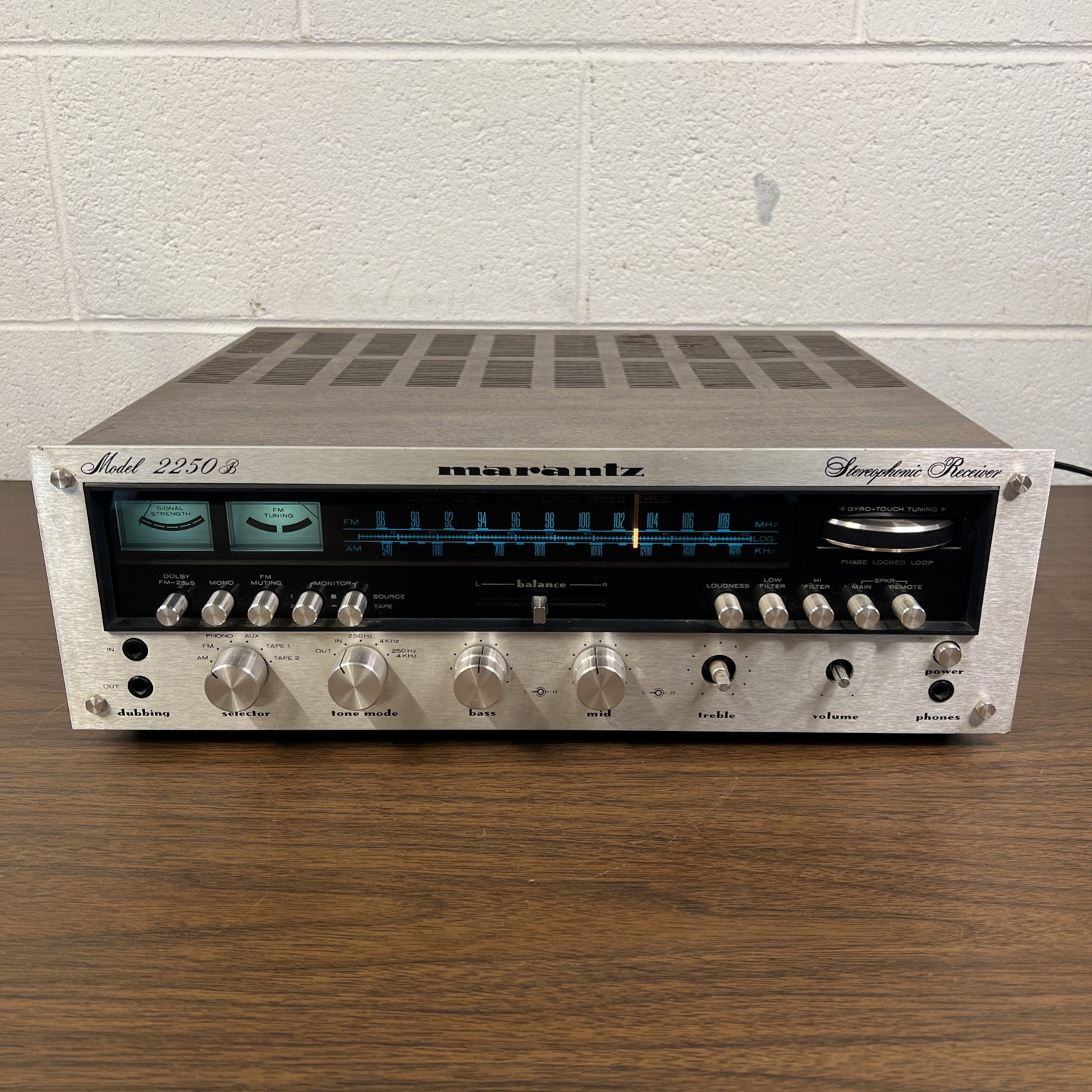
Fire up a Marantz 2250B and you’re not just hearing a vintage receiver—you’re hearing the moment when Marantz got serious about mid-tier performance without cutting corners. Rated at 50 watts per channel into 8 ohms, it’s the kind of unit that feels like it’s understated on paper but punches way above its weight in practice. Many owners swear it delivers closer to 70 watts when fully restored, and after spending time with one that’s been recapped and bias-adjusted, it’s easy to believe. The power isn’t just strong—it’s clean, thanks to a massive dual-balanced power supply and direct-coupled amplifiers that eliminate output capacitors, a design choice that pays off in tighter bass and better transient response.
It’s not the flashiest Marantz of the era, but it’s one of the smartest. Positioned just below the legendary 2270 and 2275, the 2250B was built for people who wanted real engineering, not just prestige. It came at a time when receiver specs were becoming a battlefield—watt wars, distortion claims, tuner sensitivity numbers—and Marantz responded with substance. The 2250B doesn’t just meet the standards of its day; it exceeds them in key areas, especially in the preamp and tuner sections. The FM section, for instance, uses a four-gang tuning capacitor and dual-tuned RF interstage, which means it rejects interference like a champ and locks onto weak stations with confidence. The Phase-Locked Loop (PLL) stereo demodulator, a space-age tech at the time, ensures rock-solid separation and low distortion, even under marginal signal conditions.
Sonically, it’s classic Marantz: warm, full-bodied, and effortlessly composed. But unlike some of its siblings that lean heavily into lushness, the 2250B keeps a tighter grip on the low end. Bass is present and controlled, mids are rich without being thick, and highs have a smoothness that avoids fatigue. It’s not clinical—this is the 1970s, after all—but it’s more neutral than nostalgic. The tone controls are unusually flexible, with a five-position TONE switch that lets you adjust turnover frequencies or bypass the circuit entirely, reducing distortion when you want pure signal path integrity. And yes, you can tweak bass and treble per channel, a rare luxury in a receiver of this class.
Specifications
| Manufacturer | Marantz |
| Production Years | 1976–1977 |
| Original Price | $549.95 (1977) |
| Power Output | 50 watts per channel (8Ω, both channels driven, 20Hz–20kHz) |
| THD | 0.25% (at rated power) |
| IM Distortion | 0.25% (IHF method, 60Hz and 7kHz mixed 4:1) |
| Frequency Response (Power Amp) | 20Hz–20kHz, ±20dB at 1W |
| S/N Ratio (Phono) | 70dB (A-weighted, 1kHz) |
| Input Sensitivity (Phono MM) | 1.8 mV / 47 kΩ |
| Input Sensitivity (Line) | 180 mV / 100 kΩ |
| Load Impedance | 4–16Ω |
| Damping Factor | 55 (at 1kHz) |
| Phono Overload Point | 100 mV |
| Phono Dynamic Range | 96 dB |
| FM Sensitivity (Quieting) | 1.9 μV (30 dB quieting) |
| FM Stereo Separation | 40 dB at 1kHz |
| FM Distortion (Stereo) | 0.4% at 1kHz, 1000 μV |
| AM Sensitivity | 20 μV |
| Inputs | Phono (MM), Aux, Tape 1, Tape 2 (DUBBING front/rear) |
| Outputs | Tape 1, Tape 2, Pre Out, Main In, Headphones, Speaker A/B |
| Weight | 24.2 lbs (11 kg) |
| Dimensions | 17-3/8" W × 5-3/8" H × 14-3/8" D (44.1 × 13.7 × 36.5 cm) |
| Power Supply | 120V (US), switchable 110/120/220/240V (European model) |
Key Features
Direct-Coupled Amplifier Design
Most receivers of the 1970s used coupling capacitors between the output stage and the speakers, a necessary compromise that could dull transient response and limit bass extension. The 2250B ditches those caps entirely, using direct coupling to deliver a cleaner, more dynamic sound. This isn’t just a spec-sheet flex—it changes how the amplifier behaves. There’s no “capacitor sag” in the low end, and the transition from preamp to power amp is seamless. It also means the amp can drive difficult speaker loads with more authority, though it does require careful bias and DC offset calibration to avoid speaker damage. When properly set, the payoff is a level of control and clarity that separates it from contemporaries like the Pioneer SX-1980 or Kenwood KR-8100.
Five-Position Tone Control System
Most receivers offered basic bass and treble adjustments, but the 2250B goes further with a five-position TONE switch that alters the turnover frequencies of the tone controls. You can set bass to affect only the deepest lows or extend further into the midbass, and treble can be focused on air or rolled off gently. There’s even a MID control at 700 Hz, rare in a receiver, and the ability to switch tone controls out of the circuit entirely. This isn’t just for audiophiles tweaking room acoustics—it’s a system that adapts to source material, speaker characteristics, and listening preferences without adding unnecessary coloration. And because the tone amp is separate per channel, you can correct imbalances between speakers on the fly.
Phase-Locked Loop (PLL) FM Tuner
In the mid-70s, most tuners used ratio detectors or Foster-Seeley discriminators for stereo decoding. Marantz went a different route with PLL technology, borrowed from aerospace comms, to lock precisely onto the 19 kHz pilot tone. The result? Exceptional stereo separation, lower distortion, and resistance to multipath interference. In real-world use, this means the 2250B pulls in weak stations more cleanly than most receivers of its era, and stereo imaging stays stable even when the signal wavers. The tuner also features a four-gang capacitor and dual-tuned RF stage, giving it superior selectivity and image rejection—critical for urban listeners plagued by adjacent-channel interference.
Historical Context
The 2250B arrived in 1976, a year when the receiver market was exploding with competition. Sansui, Pioneer, Yamaha, and Sony were all pushing high-power, high-spec models, and Marantz needed to prove it could compete without sacrificing its reputation for refinement. The 2250B was part of that strategy—a mid-tier model that packed flagship-level engineering into a more accessible price. It followed the original 2250, which had earned a reputation for reliability issues, particularly with the power switch and relays. The “B” revision wasn’t just a cosmetic update; it addressed those flaws with a redesigned switch, improved relays, and better capacitors. It also came at a time when Marantz was transitioning from its classic “chrome strip” faceplate to the flatter, more modern “silver face” design, though the 2250B keeps the older look, making it a bridge between eras.
It wasn’t the most powerful receiver on the block—models like the Sansui AU-9900 or Harman Kardon HK-9900 offered 100+ watts—but it didn’t need to. At 50 watts, it was plenty for most rooms, especially when paired with efficient speakers. And unlike some high-wattage receivers that sacrificed sound quality for power, the 2250B delivered both. It was also part of a broader trend toward integrated features: Dolby FM noise reduction, dual speaker outputs, tape dubbing, and preamp/power amp separation via jacks on the back. These weren’t gimmicks—they were thoughtful additions that made the 2250B a genuinely flexible centerpiece for a system.
Collectibility & Value
Today, the 2250B trades below the radar compared to Marantz’s more famous models, but that’s starting to change. Clean, fully restored units sell for $400–$700, with original WC-22 walnut cabinets adding $100–$150 if intact. Cosmetics matter—chassis corrosion, cloudy meters, or cracked knobs can knock $100 off the price, especially if the front panel has been scratched or relabeled by a previous owner. The European voltage-switchable models are more desirable internationally and often command a premium on eBay.
Common failures include failing electrolytic capacitors (especially in the power supply and preamp boards), dried-up potentiometers, and worn relay contacts. The original 2SC1344 and 2SC458 transistors in the phono stage are known to drift or fail, introducing noise or channel dropouts. The power switch, while improved over the 2250, can still develop resistance over time, leading to intermittent operation. A full recap, relay cleaning, and transistor replacement are standard for any unit that hasn’t been serviced in decades. DC offset and bias should be checked—misadjustment here can damage speakers.
When buying, look for a unit with both tuning meters working, especially the STEREO indicator. A dead bulb is an easy fix, but a dead decoder IC is not. Check all inputs and outputs, and verify that speaker switching and tape monitoring work. If the sound cuts out at low volume, it’s likely a bad connection in the signal path—common at the PRE OUT/MAIN IN jacks or between circuit boards. A full restoration by a qualified tech typically costs $250–$400, but it’s money well spent. Once dialed in, the 2250B is a receiver that can last another 40 years.
eBay Listings



As an eBay Partner, we earn from qualifying purchases. This helps support our independent vintage technology research.
Service Manuals & Schematics
- Service Manual — archive.org
Related Models
- Marantz 3600 (1976-1977)
- Marantz MODEL 112 (1971-1973)
- Marantz MODEL 115 (1975-1977)
- Marantz MODEL 260 (1976-1978)
- Marantz MODEL 28 (1971-1973)
- Akai AM-2850 (1975)
- Akai AP-206 (1975)
- Nakamichi BX-1 (1985)
- Acoustic Research research-ar-17 (1978)
- Acoustic Research AR-19 (1994)