Marantz 2240B (1978–1980)
It powers up with a soft relay click and a slow glow of green tuning meters—this isn’t just a receiver, it’s a ritual.
Overview
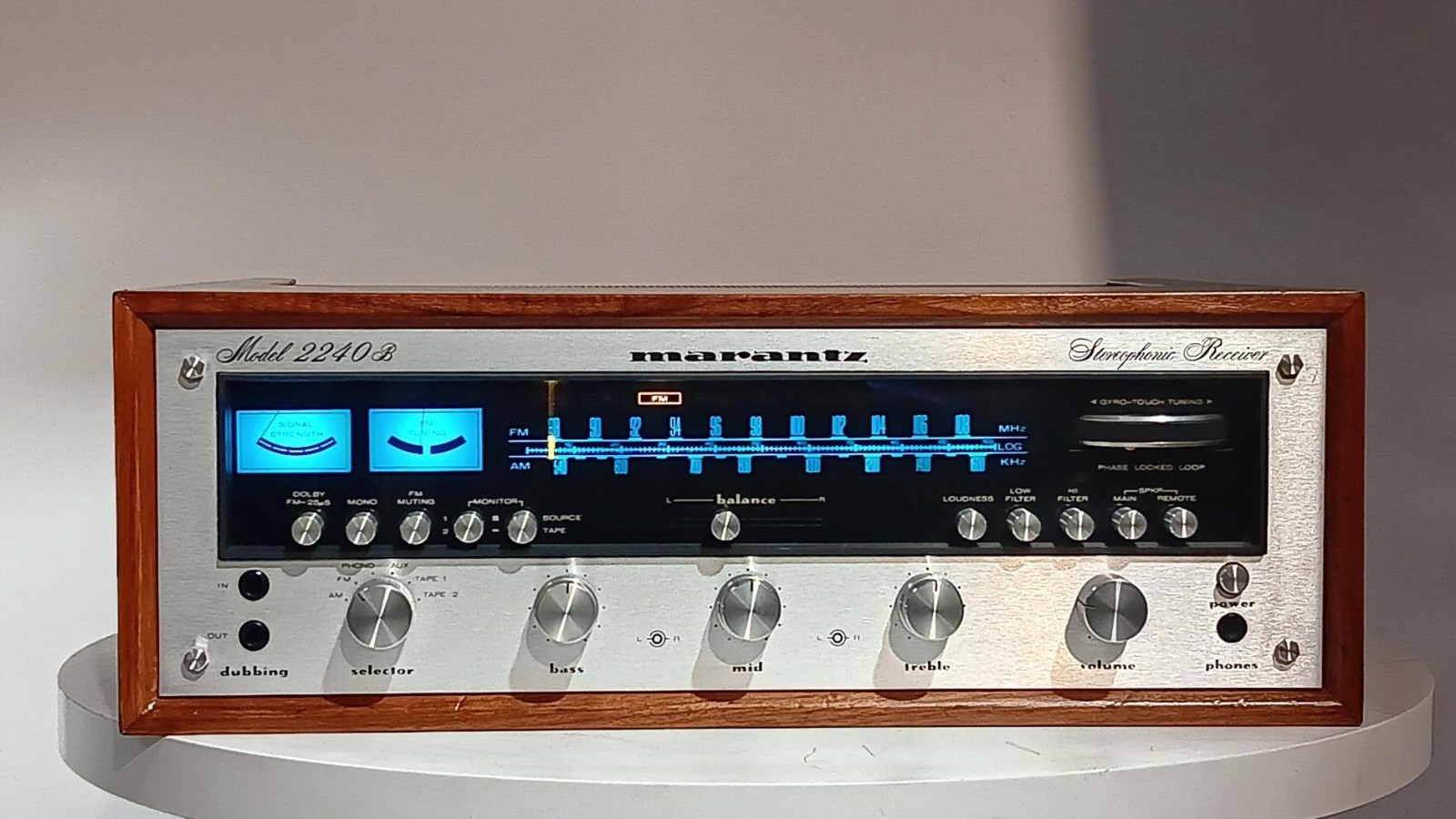
When you slide the power switch on a Marantz 2240B, the front panel doesn’t just light up—it wakes up. The tuning meter sweeps with a deliberate grace, the signal strength needle creeping to life like something alive, and the heavy chassis settles into place with the quiet authority of gear built to outlive its owners. This is mid-tier Marantz from the golden age of solid-state receivers: not the flagship 2270, not the stripped-down 2230, but the 2240B—the sweet spot where performance, features, and price met in 1978 without pretension. It delivers 40 watts per channel into 8 ohms, a number that sounds modest today but was more than enough to drive the era’s efficient speakers with authority and control. What it lacks in brute power it makes up for in finesse—its phono stage is quiet and detailed, the FM tuner section is a thing of beauty with dual analog meters, and the overall sound signature leans warm without smearing detail, a hallmark of Marantz’s house voicing.
Compared to its predecessor, the original 2240, the “B” revision brought subtle but meaningful improvements: a redesigned power supply, updated relay logic for speaker protection (eliminating the dreaded turn-on “pop”), and slightly refined circuit layout to reduce crosstalk. It wasn’t a ground-up redesign, but enough of a tweak to make the 2240B the preferred version among collectors and restorers. It shares the same elegant, minimalist faceplate as other 22xx-series receivers—brushed aluminum, large rotary knobs with crisp detents, and a clean layout that puts function first. No digital displays, no microprocessor gimmicks—just direct analog control over bass, treble, and a surprisingly effective midrange control that lets you dial out nasally vocals or boost presence on acoustic instruments. It has two tape loops, AM/FM tuning with a smooth-performing analog dial, and a muting switch that actually works, making it easy to flip between stations without blasting your ears.
While not as powerful as contemporaries like the Pioneer SX-1980 or as luxurious as a McIntosh, the 2240B holds its own in both build and sound. It was built during a time when Marantz was still engineering their own circuitry in-house, before the era of cost-cutting and shared platforms. The chassis is steel, the circuit boards are point-to-point wired in critical sections, and the power transformer is substantial—enough to deliver current when the music demands it. It’s not a brute force amplifier, but it’s dynamic, with a damping factor of 30 that gives it respectable control over 8-ohm speakers. If you’re pairing it with vintage AR, KLH, or Advents, it’ll drive them with clarity and composure. Even with 4-ohm loads, it holds up reasonably well, though sustained low-frequency passages will make it work harder than a higher-powered receiver.
Specifications
| Manufacturer | Marantz |
| Production Years | 1978–1980 |
| Original Price | $449.95 (1978) |
| Power Output | 40 watts per channel into 8Ω (stereo, both channels driven) |
| Frequency Response | 20Hz – 20kHz (±0.5dB) |
| Total Harmonic Distortion | 0.25% at rated power |
| Intermodulation Distortion | 0.3% at rated power |
| Signal-to-Noise Ratio | 86dB (A-weighted, IEC-A) |
| Input Sensitivity | 1.8mV (MM phono), 180mV (line level) |
| Input Impedance | 47kΩ (line), 1MΩ (MM) |
| Output Impedance | 4–16Ω speaker load |
| Damping Factor | 30 (8Ω, 1kHz) |
| Tuning Range | FM: 88–108 MHz, AM: 530–1620 kHz |
| Tuner Sensitivity | FM: 1.8µV for 26dB SNR, AM: 25µV for 20dB SNR |
| Inputs | 2 line, 1 phono (MM), tape 1 |
| Outputs | Tape 2, preamp out, FM/AM antenna |
| Headphone Output | 1/4" jack with level control |
| Dimensions | 17" W × 6" H × 15" D |
| Weight | 31 lbs (14.1 kg) |
| Power Consumption | 280 watts (max) |
Key Features
Discreet, Musical Circuitry Without the Hype
The 2240B doesn’t rely on exotic parts or over-engineering to impress—it earns its reputation through thoughtful, no-nonsense design. Its amplifier section uses discrete transistors (no IC op-amps in the signal path), with a complementary symmetry output stage that delivers smooth clipping and low distortion. The preamp section includes a dedicated, low-noise phono stage with RIAA equalization that’s well-regarded for its ability to extract detail from vinyl without adding harshness. Unlike some receivers of the era that used cheap switching circuits for input selection, the 2240B uses high-quality rotary switches that maintain signal integrity. The midrange control—often a gimmick on lesser receivers—is actually useful here, with a ±12dB range centered at 1kHz, allowing real tonal shaping without muddying the overall sound.
Tuner Section That Still Outperforms Modern Radios
FM reception on the 2240B is where it truly shines. The dual analog meters—one for tuning, one for signal strength—make dialing in a station a tactile, almost meditative experience. The tuner’s selectivity and sensitivity were competitive with standalone units at the time, and even today, with a decent outdoor antenna, it pulls in weak stations with clarity that most modern digital tuners can’t match. The AM section is also surprisingly capable, with good image rejection and minimal background hash. If you still listen to broadcast radio—or want to archive old FM jazz or classical recordings—this tuner section is a legitimate reason to own the 2240B.
Build Quality That Invites Hands-On Use
Every control on the 2240B feels like it was made to be used. The volume knob has a smooth, damped rotation. The source selector clicks positively into place. The sliding balance and tone controls glide without wobble. Even the power switch has a satisfying, slightly heavy action. The front panel is thick aluminum, the knobs are knurled metal, and the rear panel uses robust, screw-terminal speaker connections—no flimsy spring clips here. The internal layout is clean, with generous spacing between components and clearly labeled test points for technicians. It’s the kind of receiver you don’t just listen to—you interact with.
Historical Context
The Marantz 2240B arrived in 1978, a time when the integrated receiver was the centerpiece of the average high-fidelity system. Home audio was booming, and manufacturers like Pioneer, Sansui, Sony, and Kenwood were locked in a wattage war, pushing power ratings higher every year. Marantz, meanwhile, took a different path—focusing on refinement over raw specs. While competitors touted 100+ watt monsters, Marantz stuck to a philosophy of balanced, musical design. The 2240B sat in the middle of the lineup, above the 2230 and below the 2250B and 2270. It wasn’t the most powerful, nor the most feature-laden, but it offered the full Marantz experience—excellent tuner, solid phono stage, and a warm, engaging sound—at a price that didn’t require a second mortgage.
Its main competitors included the Pioneer SX-2550 (45WPC), the Kenwood KR-5090 (40WPC), and the Sansui AU-D307 (42WPC). All were competent, but the Marantz stood out for its superior tuner and more refined aesthetics. While Pioneer leaned into aggressive styling and high power, and Sansui offered deep bass and flashy meters, Marantz focused on coherence—everything working together in harmony. The 2240B also benefited from being part of a modular ecosystem: it paired perfectly with Marantz’s own CD players, turntables, and speakers, and many came with the optional WC-22 wood cabinet, turning the receiver into a piece of furniture.
Collectibility & Value
Today, the Marantz 2240B trades in a sweet spot between affordability and desirability. It’s not as rare or coveted as a 2270 or 2250B, but it’s far more common than those flagships, making it a practical entry point into vintage Marantz ownership. In excellent working condition, with clean meters and no chassis corrosion, it typically sells for $400–$600. Units with the original wood cabinet can command an extra $100–$150. Non-working or cosmetically damaged examples go for $200–$300, often as donor units for restoration.
Common failure points are predictable for a 45-year-old receiver. The most critical issue is electrolytic capacitor degradation—especially in the power supply and audio coupling stages. If a 2240B has never been recapped, it should be assumed that it needs it. Old capacitors can cause hum, low output, or even damage to output transistors. The relay that protects the speakers can also stick or fail, leading to no sound or delayed turn-on. The tuning meters are delicate and can become sluggish or stuck if the unit was stored improperly. The rear panel’s phenolic terminal blocks—holding the speaker and antenna connections—are brittle and prone to cracking, especially if the speaker wires were overtightened. Replacements are available, but care must be taken during removal.
For buyers, the rule is simple: never buy a 2240B “as-is” without testing. Look for units described as “recapped” or “serviced by a technician.” If it powers on and the meters respond, that’s a good sign—but full testing under load is ideal. Cleaning the controls and switches with DeoxIT is recommended, as decades of oxidation can cause scratchy pots or intermittent muting. Belt-driven tuners aren’t an issue here—the 2240B uses direct-drive tuning—so no rubber parts to worry about in the front end.
Restoration is straightforward for a skilled technician. A full recap, relay cleaning, and control pot cleaning will run $150–$250, but it’s money well spent. Unlike some receivers that require rare or obsolete parts, the 2240B uses standard transistors and op-amps that are still available or easily substituted. Service manuals are readily found online, and the circuit layout is logical and well-documented. Once restored, it’s reliable for daily use—many owners report running theirs for years without issue.
eBay Listings


As an eBay Partner, we earn from qualifying purchases. This helps support our independent vintage technology research.
Related Models
- Marantz 3600 (1976-1977)
- Marantz MODEL 112 (1971-1973)
- Marantz MODEL 115 (1975-1977)
- Marantz MODEL 260 (1976-1978)
- Marantz MODEL 28 (1971-1973)
- Akai AM-2850 (1975)
- Akai AP-206 (1975)
- Nakamichi BX-1 (1985)
- Acoustic Research research-ar-17 (1978)
- Acoustic Research AR-19 (1994)