Marantz 1530L (1978–1980)
That warm, musical Marantz glow—still alive in this understated mid-tier receiver with a longwave twist.
Overview
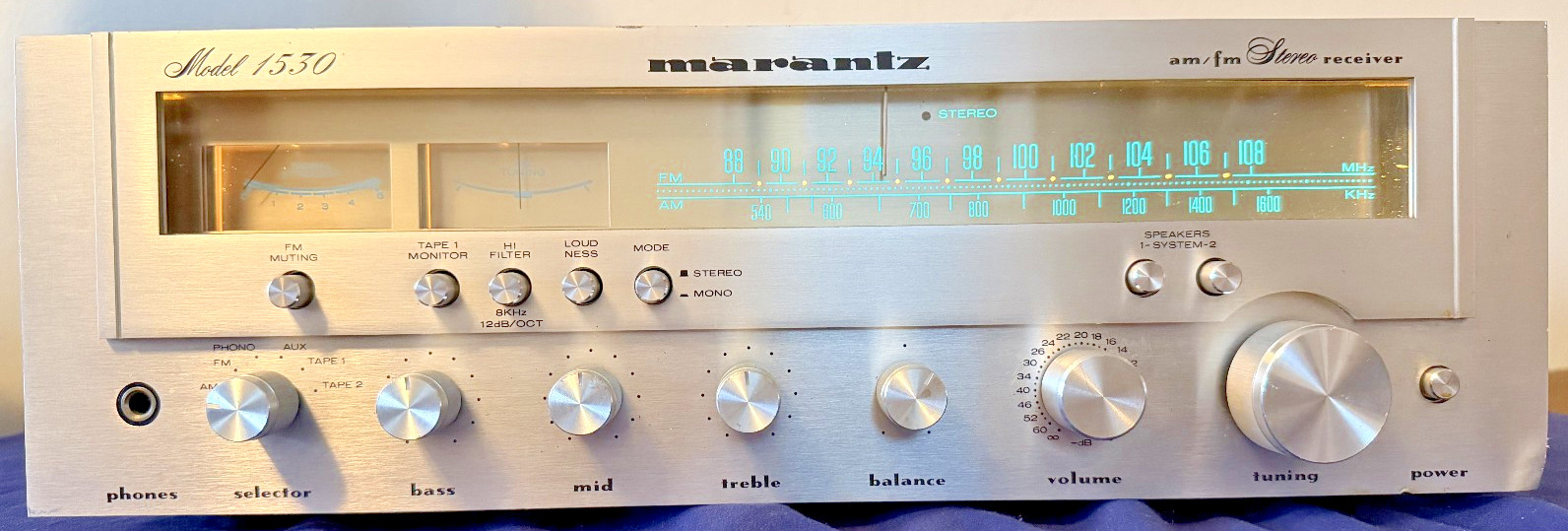
Turn on a Marantz 1530L and you’re not just flipping a switch—you’re stepping into a moment when high fidelity was still dressed in brushed aluminum and soft blue plexiglass, when tuning FM stations felt like navigating the airwaves with precision, not scrolling through presets. This isn’t the king of the Marantz lineup, but it’s the kind of receiver that wins hearts: solid, musical, and just a little more thoughtful than its price tag suggests. Built between 1978 and 1980, the 1530L sits in the middle of a three-model series that includes the 1515L and 1550L, offering a balanced blend of power, features, and build quality just before Marantz’s design language began shifting under new ownership. It puts out 30 watts per channel into 8 ohms—modest by today’s standards, but enough to drive efficient speakers with authority in a medium-sized room.
What sets the 1530L apart from the standard 1530 isn’t in the amplifier section or the tone controls—it’s in the tuner. The “L” stands for *Langwelle*, German for longwave, and this model includes reception from 150 to 350 kHz, a feature aimed at European buyers and international broadcasters. While longwave may seem like a niche today, back then it was a legitimate way to catch distant stations, weather broadcasts, or time signals, especially in parts of Europe and the Middle East. For the collector or enthusiast, that extra band isn’t just a curiosity—it’s a time capsule of global radio culture, and it makes the 1530L a slightly rarer bird than its sibling.
Sonically, the 1530L delivers the smooth, midrange-rich Marantz signature that fans expect, though it doesn’t quite reach the depth or authority of the vaunted 22xx series from the 1960s and early 70s. The bass is present but not overwhelming—some owners report it lacks punch compared to higher-end contemporaries, especially when driving low-efficiency speakers. But the mids and highs? Crisp, detailed, and never fatiguing. It’s the kind of receiver that makes a well-recorded vocal track feel intimate, like the singer is in the room. The stepped attenuator volume control ensures precise level adjustments, and the inclusion of bass, mid, and treble controls—plus loudness compensation and a high-pass filter—gives users real tonal flexibility without veering into audiophile excess.
Specifications
| Manufacturer | Marantz |
| Production Years | 1978–1980 |
| Original Price | $340 (1978), discounted to $299 by 1980 |
| Power Output | 30 W per channel (8 Ω, stereo, FTC 20–20,000 Hz) |
| Power Output (DIN) | 48 W per channel (8 Ω, 1,000 Hz) |
| Total Harmonic Distortion | 0.15% |
| Damping Factor | 53 |
| Frequency Response | 18 Hz – 30,000 Hz ±1 dB |
| Input Sensitivity | 2.8 mV (MM), 180 mV (line) |
| Signal-to-Noise Ratio | 72 dB (MM), 80 dB (line) |
| Output | 500 mV (line) |
| Speaker Load Impedance | 4 Ω (minimum) |
| Tuning Bands | FM, MW (AM), LW (150–350 kHz) |
| Inputs | Phono (MM), Tape, Aux, Tuner |
| Outputs | Tape, Headphones |
| Dimensions (W×H×D) | 440 × 137 × 357 mm (17.3 × 5.4 × 14.1 in) |
| Weight | 10 kg (22 lb) |
| Power Consumption | 150 W |
Key Features
The Longwave Edge
The most obvious differentiator of the 1530L is its longwave reception—a feature absent on the base 1530. While not essential for most North American users, longwave was widely used in Europe for national broadcasters, maritime communications, and time signal stations like WWVB. The 1530L’s LW band runs from 150 to 350 kHz, and the tuning dial includes clear markings for this range. For vintage radio enthusiasts, this opens up a whole other dimension of listening, especially when paired with an external longwire antenna. It’s a subtle but meaningful upgrade that adds both functionality and collectibility.
Classic Marantz Tuning and Display
By 1978, Marantz had moved on from the iconic gyro-tuned dials of the 1960s, replacing them with a more conventional tuning knob and analog meter. The 1530L retains a clean, functional aesthetic: a brushed aluminum faceplate, machined aluminum knobs with beveled edges, and a blue-tinted plexiglass frequency display that glows softly when lit. Unlike earlier models that used five bulbs to illuminate the dial, the 1530L uses just two—another cost-saving measure, but one that actually simplifies maintenance. Many owners have since upgraded to LED replacements, which not only last longer but can add a modern blue or white glow that enhances readability without altering the vintage look.
Build and Serviceability
Inside, the 1530L shows signs of the cost-cutting trends of the late 1970s—fewer circuit board layers, simpler power supply design, and less massive internal construction than the 22xx series. But it’s far from flimsy. The heat sink is substantial, the power transformer is decently sized, and the overall layout remains service-friendly. Technicians note that the point-to-point wiring is still relatively accessible, and the use of standard components makes repairs more straightforward than with later integrated designs. It’s not a museum piece in terms of build, but it’s built to last—and many units still function reliably today with basic maintenance.
Historical Context
The Marantz 1530L arrived at a transitional moment for the brand. Saul Marantz had long since stepped away, and the company was now under Superscope, a firm more focused on profitability than the hand-built craftsmanship of the early years. The late 1970s saw intense competition from Japanese brands like Pioneer, Sony, and Kenwood, all offering high-performance receivers at aggressive prices. Marantz responded with a streamlined lineup that balanced performance and cost, and the 1530 series was squarely in that sweet spot: not entry-level, not flagship, but a solid mid-tier performer for the serious listener who didn’t want to spend top dollar.
The 1530L competed directly with models like the Pioneer SX-1980 (a powerhouse), the Kenwood KR-8080 (a tuner-focused rival), and the Yamaha CR-840R. While it didn’t match their raw power or feature sets, it offered something they didn’t: that unmistakable Marantz sound—smooth, refined, and musically coherent. The inclusion of longwave also gave it a niche appeal in international markets, particularly in Germany and Scandinavia, where LW broadcasting remained relevant well into the 1980s.
This era also marked the beginning of the end for the classic Marantz front-panel design language. The 1530L was among the last to feature the arched cutout above the tuning knob—a nod to the missing gyro wheel—and the brushed aluminum finish that defined the brand’s aesthetic. By the mid-1980s, Marantz would shift to more modern, minimalist styling, making the 1530L a kind of closing chapter in the brand’s golden age of analog design.
Collectibility & Value
Today, the Marantz 1530L trades in a quiet but steady market. It’s not a headline-grabbing collector’s item like a 2270 or 2600, but it’s respected for its sound, build, and the slight rarity conferred by the longwave tuner. Units in working condition typically sell for $250–$350, with fully restored examples—especially those with upgraded LEDs, recapped power supplies, and cleaned pots—fetching up to $400. Non-working or cosmetically damaged units can be found for $150 or less, making them attractive restoration projects.
The most common failures are predictable for a 45-year-old receiver: dried-up electrolytic capacitors in the power supply, oxidized potentiometers and switches, and burned-out dial lamps. The tuner belt can degrade, affecting tracking, and the rubber feet often crumble. But none of these are fatal. Service technicians observe that the 1530L is relatively straightforward to repair, with most capacitors easily accessible and standard in value. A full recap and cleaning can cost $150–$200 if outsourced, but DIYers with basic soldering skills can handle it in a weekend.
When buying, check that the FM and AM tuners lock onto stations cleanly, that the speakers switch correctly between A/B, and that the tape monitor and mute functions work. Listen for hum or distortion at moderate volumes, which could indicate failing power supply caps or output transistors. Also verify that the longwave band actually functions—if it doesn’t, the issue may lie in a disconnected coil or damaged section of the tuner module, which is harder to source.
For the budget-conscious vintage audio fan, the 1530L is a smart entry point. It delivers real Marantz character without the premium price of the classics. And if you happen to catch a distant longwave signal from a European broadcaster late at night, you’ll understand why some collectors keep these not just for the sound—but for the connection to a quieter, more analog world.
eBay Listings



As an eBay Partner, we earn from qualifying purchases. This helps support our independent vintage technology research.
Service Manuals & Schematics
- Manual — archive.org
Related Models
- Marantz 3600 (1976-1977)
- Marantz MODEL 112 (1971-1973)
- Marantz MODEL 115 (1975-1977)
- Marantz MODEL 260 (1976-1978)
- Marantz MODEL 28 (1971-1973)
- Akai AM-2850 (1975)
- Akai AP-206 (1975)
- Nakamichi BX-1 (1985)
- Acoustic Research research-ar-17 (1978)
- Acoustic Research AR-19 (1994)