Marantz 1040 Integrated Amplifier (1973–1975)
The amplifier that taught you 20 watts could be enough — if it was Marantz.
Overview
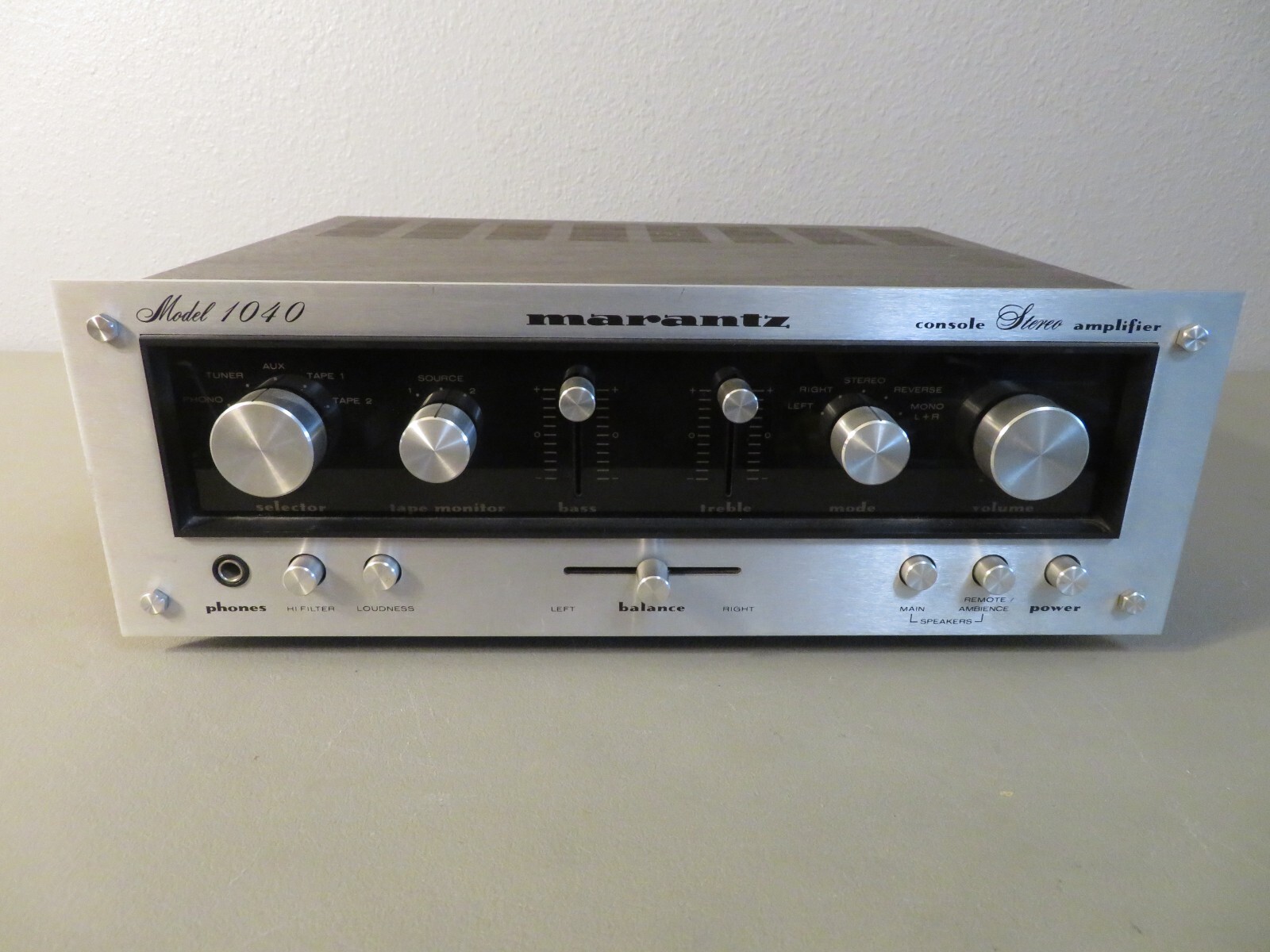
There is a particular kind of confidence that comes from switching on a Marantz 1040 — the quiet certainty that the tool in your hands will not let you down, even though it's modest on paper. This is not the receiver that made grown audiophiles weep; that was the 2270, and it cost four times as much. The 1040 is the amplifier that sat on the desk of the college student who knew he'd be listening to music seriously for the next fifty years. It's the unit that lived in the bedroom, the office, the second system that somehow became the primary system because it never asked to be replaced.
Produced from 1973 through approximately 1975 at Marantz's Kanagawa, Japan manufacturing facility, the 1040 delivered 20 watts per channel RMS into 8 ohms at a time when the receiver wars were just beginning to escalate into absurdity. It occupied the entry tier of Marantz's legendary "10xx" integrated amplifier lineup — below the 1060 (30 WPC) and 1090 (45 WPC), above nothing, because Marantz didn't make a cheaper integrated amp in this era — but it hit a sweet spot of musicality, build quality, and headphone capability that those more powerful siblings never quite replicated in quite the same way. It was, to borrow a phrase that Marantz owners have been using since approximately 1974, just enough.
The 1040 originally retailed for approximately $200–$250 USD — roughly $1,500–$1,900 in 2024 dollars — which tells you everything you need to know about how seriously Marantz took the entry-level audiophile market, and how seriously that market took Marantz in return. This was not budget equipment pretending to be premium; this was premium equipment that happened to be affordable.
Physically, the 1040 is compact — approximately 14 inches wide, 12 inches deep, and 4.75 inches tall without its optional walnut veneer cabinet (the WC-10, which adds another inch of height and transforms the unit from component to furniture). It weighs 22 pounds, which is substantial for its footprint and signals that Marantz didn't skimp on transformers or chassis thickness. The faceplate is silver anodized aluminum, clean and unadorned, with dual power meters flanking the central volume knob — a visual signature that Marantz reserved for its serious equipment, even at this power level.
Specifications
| Manufacturer | Marantz Company (Standard Radio Corp. / Superscope, Inc.), Kanagawa, Japan |
| Production Years | 1973–1975 |
| Original Retail Price | ~$200–$250 USD (1973) |
| Power Output | 20 watts per channel RMS, 8 ohms, 20Hz–20kHz |
| Load Impedance | 4–16 ohms compatible |
| Total Harmonic Distortion (THD) | 0.3% at rated power output |
| Frequency Response (amplifier) | 20Hz–20kHz |
| Input Sensitivity (Phono MM) | 2.1 mV |
| Inputs | Phono (MM), Aux, Tape Monitor |
| Outputs | Speaker terminals (A); Pre-Out, Main-In jacks; Headphone (¼" front panel) |
| Tone Controls | Bass, Treble; Loudness contour |
| Semiconductors | Fully solid-state integrated amplifier |
| Dimensions (W × H × D, without cabinet) | 14 × 4.75 × 12 inches (356 × 121 × 305 mm) |
| Weight | 22 lbs (10 kg) |
| Faceplate Finish | Silver anodized aluminum |
| Optional Cabinet | WC-10 walnut veneer case |
Key Features
Dual Power Meters
Ask any 1040 owner what they look at first when the unit is running, and they will describe the dual power meters with the nostalgic reverence normally reserved for a first car or a first kiss. Two small needle meters flank the central volume knob, displaying output power in real time — not VU, not voltage, but actual wattage delivery. This is not a gimmick. The meters provide tactile feedback that makes amplification feel like a precision instrument operation, because it is a precision instrument operation. Marantz reserved this feature for its serious equipment, and including it on the 20-watt entry model signaled that the 1040 was not a toy. Forty-plus years later, watching those needles dance while listening to vinyl is still a mild religious experience. The lamps are replaceable — standard incandescent, and yes, you can upgrade them to warm-white LEDs, though doing so will earn you a lengthy lecture from the purists on every audio forum.
The Headphone Jack
The 1040's front-panel headphone jack is not incidental; it is a core reason the unit has survived in working form in numbers that should embarrass manufacturers of disposable modern electronics. Forum threads from Steve Hoffman Music Forums, AudioKarma, and Vinyl Engine consistently report that the 1040 drives high-impedance headphones — 600Ω AKG K240s, Sennheiser HD600s, Grado SR80s — with authority that modern integrated amps at this price point rarely replicate. The headphone amp section is derived from the main amplifier circuit, not a cheap add-on, and it delivers the warm, smooth, musical character that Marantz engineered into the main output stage. If you're using the 1040 as a headphone amp in a bedroom or office system, you're not compromising; you're exploiting a design virtue that Marantz intended.
Discrete Solid-State Design
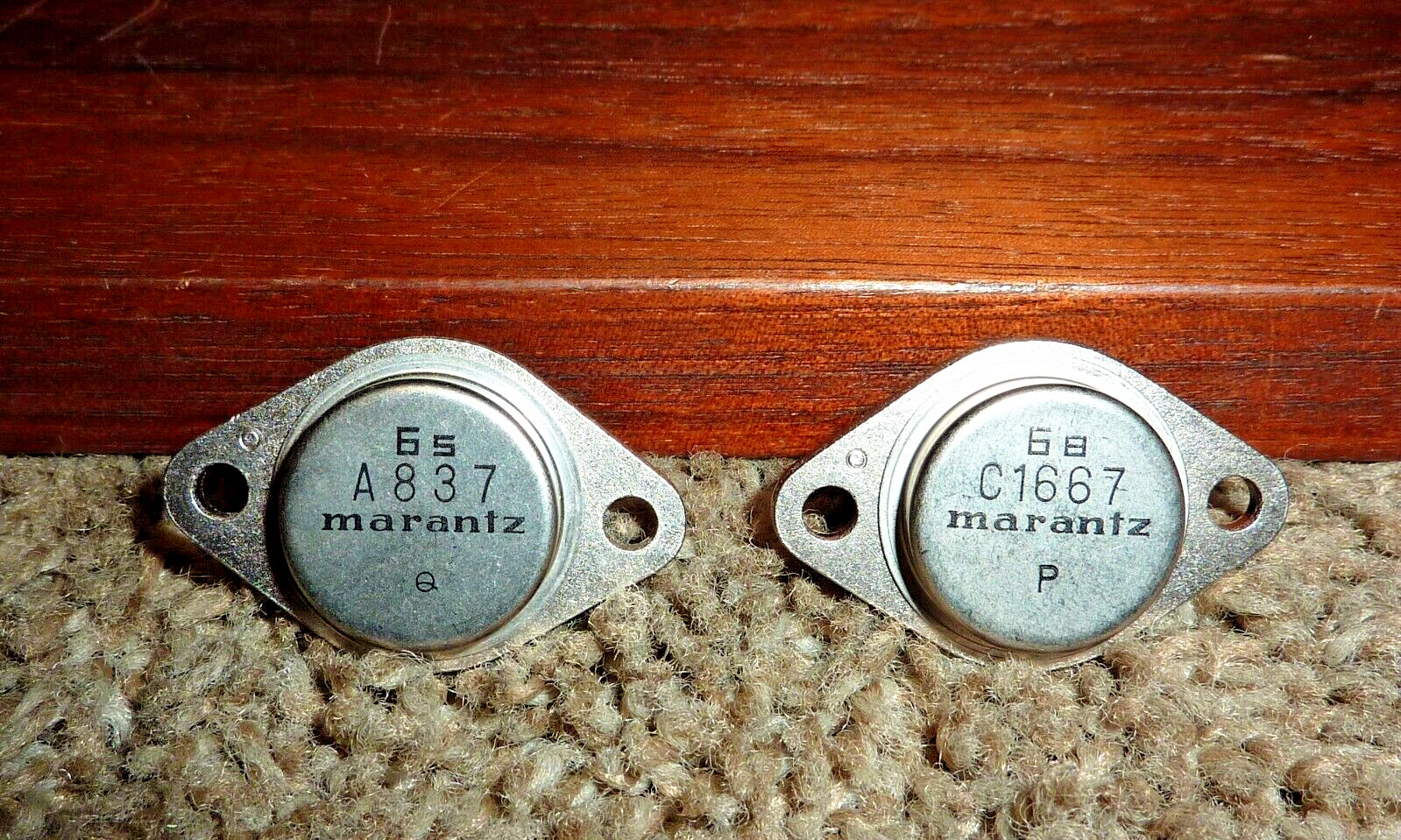
The 1040 uses a fully discrete solid-state output stage — no integrated circuits handling the heavy lifting in the amplifier section — which was already a point of pride in 1973 and reads as a genuine engineering virtue today. Discrete transistor designs age far more gracefully than early IC-based amplifiers, are significantly more repairable, and to many ears simply sound better. The output transistors are sourced from standard manufacturers of the era, and while some are no longer in production, direct equivalents are readily sourced and well-documented. This repairability is not incidental; it is a core reason the 1040 has survived in working form in numbers that should embarrass manufacturers of disposable modern electronics.
Pre-Out / Main-In Jumpers
Separate preamplifier output and main amplifier input jacks allow the 1040 to be split into two discrete components — a preamp and a power amp — or to insert an outboard processor into the signal chain. This flexibility was not standard equipment on most integrated amplifiers of this era, especially at the entry tier. Marantz included them because their customers were serious about this, even if they only had 20 watts. It is a small detail that speaks to a larger design philosophy: build for the person who might grow into this.
The Walnut Cabinet (WC-10)
The optional walnut veneer cabinet — model WC-10 — transforms the 1040 from component to furniture. It adds approximately one inch of height, encloses the sides and top in real wood veneer, and elevates the unit's visual presence in a room. Original cabinets are increasingly rare on the secondary market, and a 1040 with its WC-10 intact commands a premium — typically 20–40% above a bare unit in comparable condition. If you find one without the cabinet, know that replacement is essentially impossible; the WC-10 was specific to the 10xx series and is not interchangeable with other Marantz models.
Historical Context
To understand the 1040, you need to understand what 1973 looked like for home audio. The market was bifurcating sharply. On one side sat the emerging mass-market integrated amps — the Yamaha beginners, the Kenwood budget entries — perfectly functional units that treated audio as an appliance category. On the other sat Marantz, which had been founded in 1953 by Saul Marantz in Kew Gardens, New York, specifically to make equipment that he, personally, couldn't buy anywhere else. By 1973 the company had been acquired by Superscope, Inc. (1964) and manufacturing had shifted to Japan, but the design philosophy — uncompromising, expensive, unapologetic — remained fully intact.
The 10xx integrated amplifier series, launched in the early 1970s with the 1040, represented Marantz's systematic attack on the "serious integrated amp" segment at a moment when that segment was exploding. The post-1965 American middle class was buying stereos with the same enthusiasm it brought to buying cars, and vinyl had just had its format revolution — album rock, progressive stations, the whole beautiful ecosystem that made a great integrated amp genuinely matter. The 1040, arriving in 1973 at 20 watts, told that audience: we see you, we take you seriously, and here is what serious looks like at this price point.
It landed in the market alongside the 1060 (30 WPC, 1973–1975) and the 1090 (45 WPC, 1973–1975) — the opening shots of what historians now call the "Marantz Integrated Era," a several-year power escalation that reads, with hindsight, like the stereo industry briefly going collectively sane. The 1040 predates the full fever pitch of that arms race, and in some ways that makes it more interesting: it was built to be musical rather than to win a spec sheet war. Its sibling models — the 1060 and the 1090 — are more powerful; some would argue the 1060 is the better unit on paper. The 1040, however, remains the one people describe with something approaching love, particularly for headphone use and small-room applications.
Production reportedly ran to several thousand units across the model's two-to-three-year lifespan, with serial numbers suggesting peak manufacturing volume between 1974 and 1975. Exact production totals have never been officially published by Marantz, which is the kind of corporate recordkeeping decision that makes vintage audio researchers slightly unhinged at dinner parties.
Collectibility & Value
The 1040 is, bluntly, one of the most collectible vintage integrated amplifiers in the entry tier. Full stop. In original, fully-working, cosmetically excellent condition, a 1040 commands between $150 and $300 USD on the private market as of 2024, with exceptional examples — original walnut cabinet, verified low hours, perfect faceplate — occasionally reaching $350–$400 at auction. Professionally recapped and restored units from reputable technicians typically sell in the $250–$400 range, reflecting both the restoration investment and the buyer's peace of mind.
That said, buyer education is essential. The 1040 is popular enough that the market for them is thick with optimistically graded "works great!" units that have not actually worked great since approximately 1987. Common failure modes include:
Dried/failed electrolytic capacitors throughout the power supply and signal path — a full recap by a competent technician is essentially mandatory on any unit that hasn't been recently serviced. This is not optional; it is the first service item on any 1040 that has not been touched in twenty years.
Failed lamp sockets and corroded lamp holders in the power meter illumination circuit — the meters are iconic, but the lamps are incandescent and they die. Replacement is straightforward, but the sockets can corrode and require cleaning or replacement.
Dirty or oxidized controls and switches — scratchy volume pots, intermittent input selector switches — typically addressable with DeoxIT D5 and patience. The 1040's control layout is simple, which makes servicing easier than on more complex units.
Output transistor failure, more common in units that have been run hard or improperly stored; less common than on some competing designs, but not unknown. The discrete output stage is robust, but transistors age and can fail if the unit was stored in heat or humidity.
Cosmetically, faceplate scratches are the deal-breaker for most serious collectors. The silver anodized finish is beautiful and irreplaceable — refinishing exists as an option but is expensive and rarely looks perfectly original. Examine photographs critically before purchasing remotely, and if buying in person, bring a flashlight and look at the faceplate at a raking angle. What appears as a clean panel under overhead lighting will reveal its true character under a low-angle beam.
The 1040 has an active and deeply knowledgeable service community. AudioKarma's Marantz forums are an essential resource, as is the Marantz section of Audioaficionado.org. Schematics are freely available through Hifiengine.com (free registration required). If you're a technician comfortable with analog circuitry and you have a copy of the service manual, a 1040 is genuinely one of the more pleasant vintage integrated amps to work on — logical layout, quality original components, and sufficient room inside the chassis to actually maneuver.
Acquire one. Have it properly serviced. Connect it to a pair of efficient, full-range speakers — it has never, to this author's knowledge, been unfairly matched with a pair of vintage small monitors — or plug in a pair of high-impedance headphones and tune in an FM station on a clear night. What you will hear is not nostalgia. It is simply what it sounds like when something was built to last by people who intended it to last, in a factory staffed by engineers who were not yet required to account for planned obsolescence. It sounds, in other words, like craftsmanship. There's not much else like it.
eBay Listings


As an eBay Partner, we earn from qualifying purchases. This helps support our independent vintage technology research.
Service Manuals & Schematics
- Manual — archive.org
- Service Manual — archive.org
Related Models
- Marantz 3600 (1976-1977)
- Marantz MODEL 112 (1971-1973)
- Marantz MODEL 115 (1975-1977)
- Marantz MODEL 260 (1976-1978)
- Marantz MODEL 28 (1971-1973)
- Akai AM-2850 (1975)
- Akai AP-206 (1975)
- Nakamichi BX-1 (1985)
- Acoustic Research research-ar-17 (1978)
- Acoustic Research AR-19 (1994)