Luxman R-113 (1990)
It clicks on, warms up, and just… sounds right—like someone finally got mid-fi to punch above its weight.
Overview
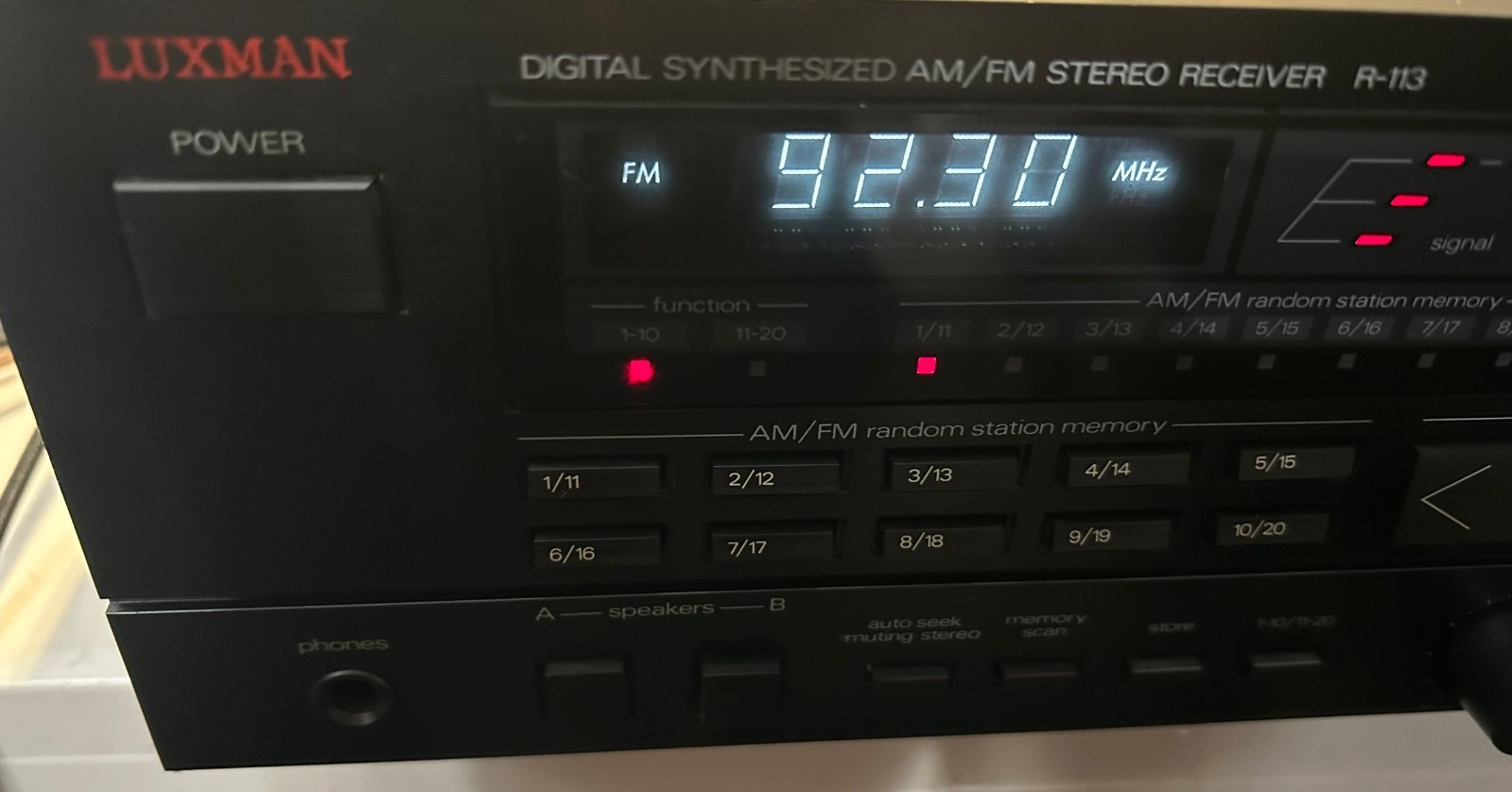
The Luxman R-113 isn’t the kind of receiver that screams for attention. No flashy meters, no stacked EQ bands, no remote control—just a clean, no-nonsense front panel with a satisfying weight to its knobs and a subtle glow from its display. But don’t let the modesty fool you: this is a piece of gear that, when you fire it up, makes you forget you’re listening to anything labeled “budget.” Introduced in **1990** (though some sources cite 1987, manufacturer documentation and major archives favor 1990), the R-113 was positioned as the most affordable model in Luxman’s new line of receivers, a deliberate move after Alpine Electronics acquired the struggling high-end brand and decided its previous offerings were “Bloody Expensive for what you appear to get.”
And yet, even as a cost-conscious design, the R-113 carries the Luxman DNA—solid construction, thoughtful circuitry, and that elusive “tube-like” warmth the brand is known for, despite being fully solid-state. It’s not trying to be exotic; it’s trying to be right. With 35 watts per channel into 8 ohms, it won’t shake your walls, but it’ll fill a room with a rich, full sound that one long-term owner describes as “amazing” after nearly three decades of daily use. It’s the kind of receiver that makes you wonder why you ever needed more.
Specifications
| Manufacturer | Luxman |
| Model | R-113 |
| Year of Release | 1990 |
| Type | AM/FM Stereo Receiver |
| Rated Continuous Power per Channel (20 -20,000 Hz, 8 Ω ) | 35 W |
| Dynamic Power per Channel | 50 W at 8 Ω, 84 W at 4 Ω, 100 W at 2 Ω |
| Dynamic Headroom per Channel at 8 Ω | 1.5 dB |
| THD at rated Continuous Power | 0.085% |
| Input Impedance (1 kHz) | Phono MM : 47 kΩ +25-20%; Tape 1, 2 : 47 kΩ +25-20%; CD, Aux, Video : 47 kΩ +25-20% |
| Input Sensitivity (1 kHz, Rated Power= 40W Output) | Phono MM : 2.5 mV ±0.5 mV; Tape 1, 2 : 150 mV ±20 mV; CD, Aux, Video : 150 mV ±20 mV |
| Frequency Response | Phono : 100 Hz ±0.5 dB; Phono : 10 kHz ±0.5 dB; CD, Aux : 10 Hz - 50 kHz ±2 dB |
| Signal-to-Noise Ratio (input Shorted) | Phono MM : 80 dB; Tape 1, 2 : 86 dB; CD, Aux, Video : 86 dB |
| FM Section Frequency Range | 87.9 - 107.9 MHz |
| FM Stereo Separation | 40 dB |
| General Power Consumption | 200 W |
| Power Supply | 120 V - 220V 50/60 Hz |
| Semiconductors | 96 Transistors; 67 Diodes; 5 Zener Diodes; 9 FET's; 12 IC's |
| Dimensions (W x H x D) | 438 x 110 x 343 mm |
| Weight | 6.1 kg |
| Speaker load impedance | 4Ω to 16Ω |
Key Features
High-Speed Dynamic Amplifier & Toroidal Power Supply
At the heart of the R-113 is a high-speed dynamic amplifier design backed by a high-efficiency toroidal power transformer and high-energy storage capacitors. This isn’t just marketing fluff—it translates to real-world performance. The dynamic power ratings tell the story: 100 watts into 2 ohms means this receiver can handle difficult speaker loads and sudden transients without folding. That 1.5 dB of dynamic headroom might sound trivial on paper, but in practice, it’s the difference between a clean snare hit and one that distorts under pressure.
CD Straight Circuitry
One of the standout features—especially for its time—is the CD Straight function. This routes the CD input directly to the amplifier, bypassing tone controls, loudness circuits, and any unnecessary switching. It’s a nod to purists who want the cleanest possible path from disc to speaker, and it reflects Luxman’s attention to signal integrity even in a budget-oriented model. If you’re playing a well-mastered CD, flipping this switch is like pulling a veil off the sound—suddenly, the staging opens up, and the bass tightens.
Anti-Clipping Protection Relay
The R-113 includes a clever anti-clipping feature: if the volume is turned up too high and clipping is detected, a relay (designated RL1) temporarily cuts off the output. You’ll hear a distinct click—a few seconds after power-up, and sometimes during overdrive—as the protection circuit engages. While some might see this as a limitation, it’s actually a sign of thoughtful engineering. It protects both your speakers and your ears, and it speaks to Luxman’s commitment to reliability, even if the construction has been described by some as “flimsy” compared to earlier, more robust RX-series models.
Build and Layout
The chassis is mostly metal, which helps with shielding and durability, though it’s not as heavy or overbuilt as vintage Luxman gear from the 1970s. The front panel is simple: large tuning and volume knobs, a row of input selectors, and a fluorescent display that shows frequency or input. It’s not flashy, but everything feels deliberate. The speaker terminals are binding posts—solid, if not particularly exotic—and the rear panel is neatly laid out with dedicated outputs, including a pre-out for future expansion.
Historical Context
The R-113 emerged during a pivotal shift for Luxman. After Alpine Electronics took over the financially struggling company, the brand pivoted from ultra-high-end to more accessible, mass-market designs. The R-113, R-115, and R-117 formed part of this new “Ultimate Power” amplifier line, with the R-113 serving as the entry point. It was priced at **$350** at launch (though one 1987 article references $400, the $350 figure is more consistently documented). This was a strategic move to compete in a crowded mid-fi market dominated by brands like Pioneer, Sony, and Kenwood—though Luxman aimed to stand out with superior build and sound.
While older Luxman receivers were “MUCH more substantially built” and “will sound a bit better,” the R-113 was never meant to replace them. It was meant to bring Luxman’s sonic signature to a broader audience—one that might have otherwise settled for “shitty” (in one owner’s words) receivers from other brands.
Collectibility & Value
Today, the R-113 trades in a quiet corner of the vintage audio market. It’s not a showpiece, but it’s a sleeper. Recent asking prices reflect its utilitarian status: $100 on Marketplace, $120 CAD on Canuck Audio Mart, $124 in Argentina, and up to $250 on Reverb for well-documented units. It’s not appreciating like classic tube gear, but it’s not disappearing either.
The real story in ownership is maintenance. A bad relay—specifically RL1, the one in series with the speaker selector switches—is a common cause of problems. Symptoms include channel dropouts, distorted sound, or the output never engaging. The relay is a small plastic box (about 1.5 x 3 cm), often white, black, or transparent, and can sometimes be cleaned with contact solvent and fine paper. But replacement is often the smarter move—look for a DPST, 12V or 24V, 8A, with the correct pinout.
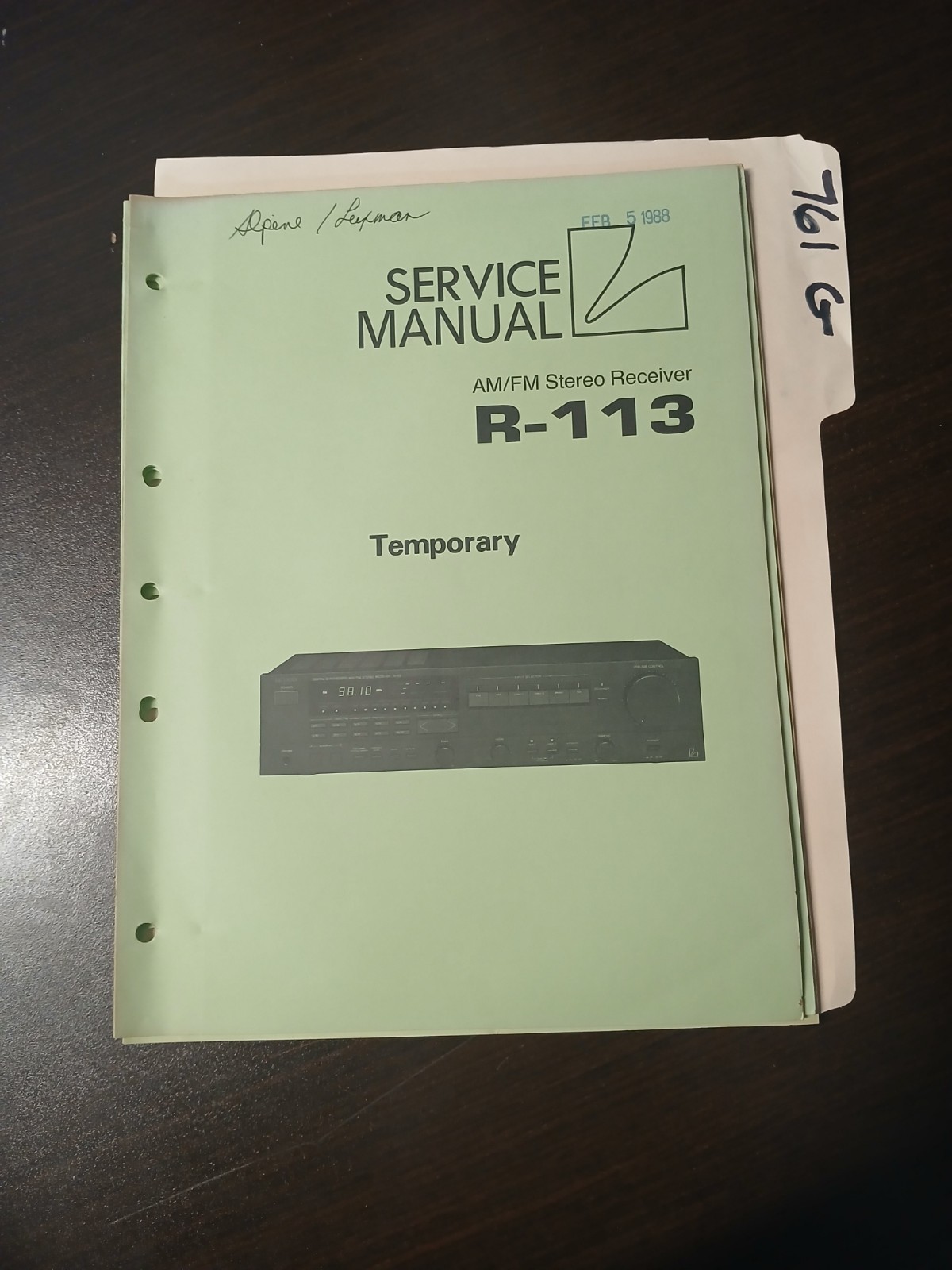
Other issues include crackling buttons and scratchy sound on startup, often tied to dry solder joints, particularly under the relay. One owner notes that “soldering was a bit of a weak point on that era of Luxmans,” so a quick reflow of critical joints can go a long way. A service manual is available, which helps, and some enthusiasts recommend upgrading the output transistors (NJW0281) to more robust modern equivalents.
Despite these quirks, owners consistently report strong performance. “Sounds very nice more like hi end then mid fi,” one writes. Another calls it a “very nice amp, rich full sound.” It’s not perfect, but it’s honest—and in a world of overprocessed audio, that counts for a lot.
eBay Listings


As an eBay Partner, we earn from qualifying purchases. This helps support our independent vintage technology research.
Related Models
- Luxman L-530 (1975)
- Luxman R-404 (1975)
- Luxman RV-371 (1975)
- Luxman SQ-38U (1975)
- Luxman T-14 (1972)
- Luxman T-530 (1975)
- Luxman TX-101 (1975)
- Denon DRA-800 (1985)
- Denon PMA-350Z (1980)
- Denon POA-1500 (1979)