Luxman R-106 (1986)
A solid-state receiver that hums with quiet authority—until it starts humming for real.
Overview
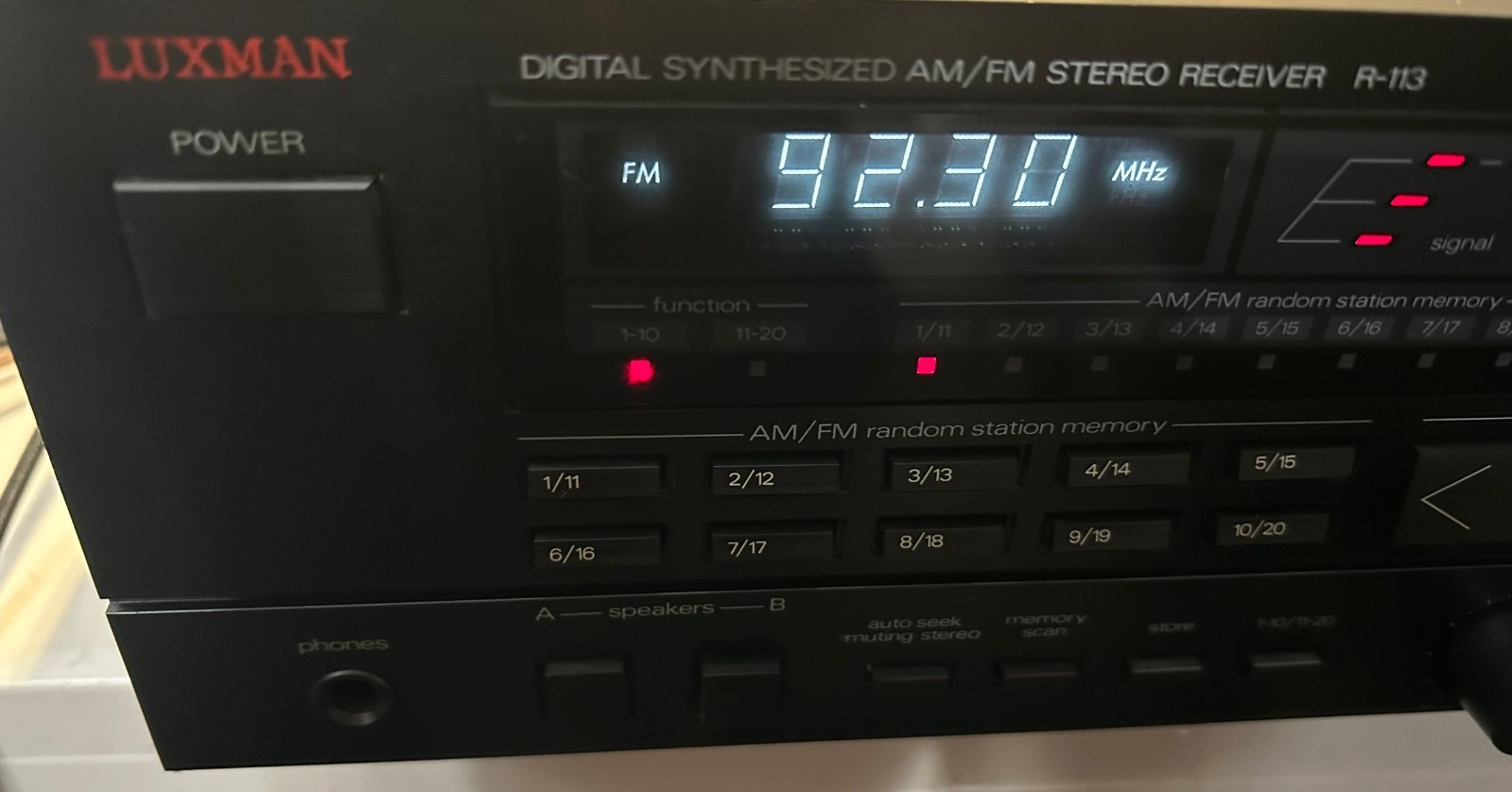
Forget what you thought you knew about Luxman’s golden age—it wasn’t all tubes and warm nostalgia. By 1986, the company had pivoted hard into solid-state design, and the R-106 stands as a prime example of their mid-80s engineering philosophy: clean power, digital precision, and a feature set that felt luxurious without breaking the bank. Marketed as a "Digital Synthesized AM/FM Stereo Receiver," the R-106 wasn’t trying to be retro or romantic. It was built for the buyer who wanted modern convenience, excellent tuner performance, and 60 watts per channel of unflappable clean sound—all in a single chassis from Lux Corporation, Japan.
Owners describe it as "affordable, luxury from the mid-1980's," and that sums it up. This wasn’t a budget receiver, but it wasn’t priced like a flagship either. It landed in that sweet spot where audiophiles could get genuine high-fidelity performance without needing a second mortgage. It came equipped with a phono stage for vinyl, a full suite of tape in/out options, TV/VCR connectivity, and even remote control capability—an impressive package for its time. The digital VTF (Variable Tuning Frequency) display was a standout, offering bright, clear tuning info that felt futuristic in an era still littered with analog dials.
Specifications
| Manufacturer | Lux Corporation, Japan |
| Model | R-106 |
| Year of Manufacture | 1986 |
| Type | Digital Synthesized AM/FM Stereo Receiver |
| Power Output | 60 watts per channel into 8 ohms |
| Total Harmonic Distortion | 0.05% |
| Frequency Response | Phono: 20Hz to 20kHz (±0.5dB). Aux, Tape: 10Hz to 70kHz (+0, -3dB) |
| Signal-to-Noise Ratio | Phono: 76dB (IHF A). Aux, Tape: 90dB (IHF A) |
| Input Sensitivity/Impedance | Phono (MM): 2.5mV/47kΩ. Aux, Tape: 150mV/47kΩ |
| Inputs | Phono (MM), Tuner, Aux, Tape 1, Tape 2 |
| Outputs | 2 x Tape outputs, 2 x speaker outputs |
| Tone Control | Bass: ±10dB at 100Hz. Treble: ±10dB at 10kHz |
| Loudness Control | +6dB at 100Hz |
| Power Requirements | 120V, 60Hz (for North American model) |
| Power Consumption | 170 watts |
| Dimensions (W x H x D) | 438 x 144 x 328 mm (17-1/4" x 5-11/16" x 12-15/16") |
| Weight | 10.5 kg (23.1 lbs) |
| Tuning Range | FM, MW |
Key Features
Duo-Beta Circuitry: The Engine Room
Buried beneath the sleek faceplate is Luxman’s proprietary "Duo-Beta Circuitry"—a design approach aimed at minimizing distortion and maximizing transistor efficiency. While the exact technical implementation isn’t detailed in the fact sheet, the results speak for themselves: a THD rating of just 0.05% and a frequency response that stretches well beyond the audible range on line inputs. This wasn’t just about specs on paper; users report "NICE Sound!" and "60wpc of clean sound," suggesting the circuitry delivered on its promise of transparency and control.
Digital Synthesis & Tuner Performance
The R-106’s digital synthesized tuning was a major upgrade over analog variable capacitors. It offered precise station selection, excellent stability, and strong reception—so strong that one reviewer called the tuner "very good," a compliment not always handed out lightly in the world of vintage receivers. The digital VTF display made tuning intuitive and legible, a small but meaningful quality-of-life improvement over needle meters and dial lights.
Connectivity for the Analog Lifestyle
This was a machine built for the late-80s home audio ecosystem. With dedicated phono (MM) input, two tape loops, aux, and TV/VCR in/outs, it could anchor a full analog setup. The inclusion of a preamp-out/power-amp-in loop (implied by separate tape in/out and signal flow) gave users flexibility to expand later. And yes, it worked with a remote—the RC-406, which still turns up on the secondhand market for around $34, though many units now sell without one.
The Heat Pipe Quandary
Here’s where things get… warm. Very warm. Owners consistently report that the R-106 runs "extremely hot." That’s because it uses a unique "Heat Pipe" cooling system: a copper tube filled with refrigerant, connecting a small heatsink on the output transistors to a finned radiator on the rear. It’s an elegant solution—when it works. But the catch is, these heat pipes can fail when they lose their internal charge. And as one technician noted, Luxman stopped making replacements for these assemblies before 2005. If your R-106 is overheating, the first step isn’t panic—it’s checking the bias in each channel. Drift in the bias circuit, possibly from past adjustments or failing transistors or pots, could be the real culprit. But if the heat pipe itself is dead? That’s a repair that might require improvisation.
Historical Context
Produced in 1986, the R-106 arrived at a time when receivers were getting smarter, sleeker, and more integrated. Digital tuning, remote controls, and expanded connectivity were becoming standard, and Luxman was keeping pace. While not officially confirmed as the top model, one owner believes it was "their top of the line remote receiver in the late eighties"—a claim that, while unverified, aligns with its robust feature set and solid performance. Today, it’s listed under "Discontinued" integrated amplifiers on Luxman’s own website, a quiet nod to its place in the brand’s evolution from analog craftsmanship to digital refinement.
Collectibility & Value
Let’s be honest: the R-106 isn’t a blue-chip collector’s item. It’s not turning up at auctions for thousands. But it’s not forgotten, either. As of 2026, working units are listed on eBay for as low as $99, with most hovering between $119 and $164—often marked "AS IS" with the caveat that the seller couldn’t test the phono input. "Very Good" condition units with shipping have asked $120, and one Canadian listing recently asked $145. The real premium goes to restored units: one electronically refurbished R-106 was listed for $379 in July 2024, nearly triple the price of a standard used model.
The value gap tells you everything. A stock unit is a functional vintage receiver at a fair price. A restored one is a working piece of audio history with the heat pipe and bias issues addressed. If you’re buying, ask: does it run cool? Does the display work? Is the remote included? And most importantly—has someone checked the bias? Because this is a receiver that can sound excellent, as one owner confirmed: "sonically and operationally it is fine." But it’s also one that can silently cook itself to death if that heat pipe has gone quiet.
eBay Listings


As an eBay Partner, we earn from qualifying purchases. This helps support our independent vintage technology research.
Related Models
- Luxman R-3055 (1980)
- Pioneer QX-949A (1978)
- Pioneer SX-2000 (1978)
- Pioneer SX-2500 (1978)
- Marantz SR-2000 (1999–2001)
- Onkyo TX-1500MKII (1975)
- Pioneer QX-646 (1978)
- Pioneer SX-1900 (1978)
- Pioneer SX-201 (1978)
- Pioneer SX-251R (1976)