Luxman L-505uXⅡ (2011–2018)
A hand-built Japanese integrated amplifier that doesn’t just play music—it reveals it, layer by layer, with surgical precision and unexpected warmth.
Overview
Let’s get one thing straight: if you’re hunting for a vintage Luxman preamp from the 1990s called the L-505UX, you’re chasing a ghost—or at least a typo. What actually exists, and what deserves your full attention, is the **Luxman L-505uXⅡ**—a modern-classic integrated amplifier that arrived in 2011 as the second generation of the L-505uX line and quietly set a new benchmark for what an all-in-one amp could do. This isn’t some forgotten relic from the analog past; it’s a precision-engineered, dual-mono powerhouse built during a renaissance for Luxman, where they weren’t just making gear—they were refining philosophy.
The L-505uXⅡ isn’t loud or flashy. It doesn’t scream for attention. But plug it in, cue up a well-recorded jazz trio, and within seconds you’ll notice something unsettling: the equipment disappears. What’s left is space, air, and the uncanny sense that the musicians are *there*, not projected through layers of circuitry. That’s the magic of Luxman’s ODNF 4.0 feedback system and their obsessive “beeline” signal path design—every decision made to get out of the music’s way.
It replaced the original L-505uX (launched in 2011), and while it shares DNA with that model, the Mark II isn’t just an update—it’s a refinement. It inherits discrete buffer circuitry from the flagship C-900u preamplifier, which means the preamp section here performs like it belongs in a separates system costing twice as much. And unlike many integrateds that compromise on phono stages, this one handles both MM and MC cartridges with genuine authority, making it a complete analog hub right out of the box.
At 20.0kg, it’s no lightweight. The chassis is a “snakebody-style” aluminum construction, built like a vault, with loopless grounding to minimize earth impedance and a fully symmetrical dual-mono layout that ensures channel separation so clean it borders on clinical. Yet somehow, it never sounds cold. That’s the Luxman paradox: engineering rigor married to musical soul.
Specifications
| Manufacturer | Luxman |
| Model | L-505uXⅡ |
| Type | Integrated Amplifier |
| Rated output (8Ω) | 100 watts per channel |
| Power output (4Ω) | 150W+150W |
| Inputs | Balanced XLR x1 (with phase inversion), Linear RCA x4, Phono MM/MC (RCA) x1, Main In (RCA) x1, Recording input/output (RCA) x1 |
| Loudspeaker Output | Two systems (A, B, A+B) via 4 pairs of screw terminals |
| Outputs | 6.3 mm headphone jack, Pre Out (RCA), Rec Out (RCA) |
| Phono stage | Built-in, selectable MM/MC |
| Input Sensitivity / Impedance | PHONO (MM): 2.5mV / 47kΩ; PHONO (MC): 0.3mV / 100Ω; LINE (RCA): 180mV / 50kΩ; BALANCED LINE (XLR): 180mV / 50kΩ; MAIN IN: 1.0V / 50kΩ |
| Output Level | Pre Out: 1V; Rec Out: 180mV |
| Harmonic Distortion (THD) | (1kHz, 8Ω): 0.005% or less; (20Hz-20kHz, 8Ω): 0.04% or less |
| Frequency Response | Line Input: 20Hz–100kHz (+0, -3.0dB); Phono Stage: 20Hz–20kHz (-3 dB) |
| Signal-to-Noise Ratio (IHF-A) | LINE: 106dB; PHONO (MM): 91dB; PHONO (MC): 74dB |
| Damping factor | 210 |
| Volume control | LECUA (Luxman Electronically Controlled Ultimate Attenuator), 88 steps |
| Tone control range | ±8dB (at 100Hz and 10kHz) |
| Subsonic filter | 15Hz, -12dB/oct |
| Power supply capacitors | 10,000μF x 4 |
| Power Consumption | 190W |
| Dimensions (W x H x D) | 440 x 156 x 428 mm |
| Weight | 20.0kg |
| Remote control | Universal remote control RA-17A |
Key Features
LECUA Volume Control: 88 Steps of Precision
Forget about scratchy pots or vague digital steps. Luxman’s LECUA (Luxman Electronically Controlled Ultimate Attenuator) uses a ladder network of high-precision resistors, switching in 88 discrete steps to deliver volume changes so smooth and repeatable, you’ll forget you’re not using an analog knob. It’s not just about convenience—it’s about signal integrity. Because there’s no physical wiper dragging across a resistive track, there’s no wear, no noise, and no channel imbalance over time. Owners report that even at whisper-quiet levels, the balance stays rock-solid, which is rare in any amplifier, let alone an integrated.
ODNF 4.0: Feedback Done Right
Most manufacturers slap on global negative feedback to reduce distortion, often at the cost of transient smearing. Luxman takes a different path with ODNF (Only Distortion Negative Feedback) Version 4.0—a multi-stage, ultra-short-loop feedback system that corrects distortion at the source without muddying the leading edges of notes. The result? A claimed THD of just 0.005% at 1kHz, but more importantly, a sound that feels alive. Drums snap, strings breathe, and piano hammers strike with tangible force. It’s not clinical—it’s *correct*.
Dual-Mono, Beeline, and OFC: Signal Path Obsession
Inside the L-505uXⅡ, signal flow is treated like a sacred path. The “beeline construction” philosophy means components are laid out in the shortest possible route from input to output, minimizing capacitance and inductance. Internal wiring uses oxygen-free copper (OFC) with spiral wrapping to reduce electromagnetic interference. The entire preamp section is fully symmetrical dual-mono, meaning left and right channels are completely independent, with their own power supplies and circuitry until the final output stage. This isn’t overkill—it’s why the soundstage is so wide, deep, and stable.
Phono Stage That Punches Above Its Weight
Many integrated amps treat the phono stage as an afterthought. Not here. The L-505uXⅡ includes a fully selectable MM/MC phono stage with separate gain settings (0.3mV sensitivity for MC) and a dedicated MC cartridge gain on/off switch. It’s not just functional—it’s *good*. The signal-to-noise ratio for MC is 74dB, which is respectable for an integrated, and the discrete design means it won’t load down delicate moving-coil cartridges. You can run a high-end turntable straight into this thing and not feel like you’re compromising.
VU Meters and Build That Demands Respect
The front panel features two large VU meters with switchable backlighting—blue or red, depending on your mood. They’re not just decorative; they give real-time feedback on output levels, and they look stunning when lit. The entire chassis is built like a tank, with a heavy aluminum body and a front panel that feels milled from a single block. The large central volume knob has a satisfying heft, and the input selector clicks with precision. This is gear that was built to last, not just perform.
Historical Context
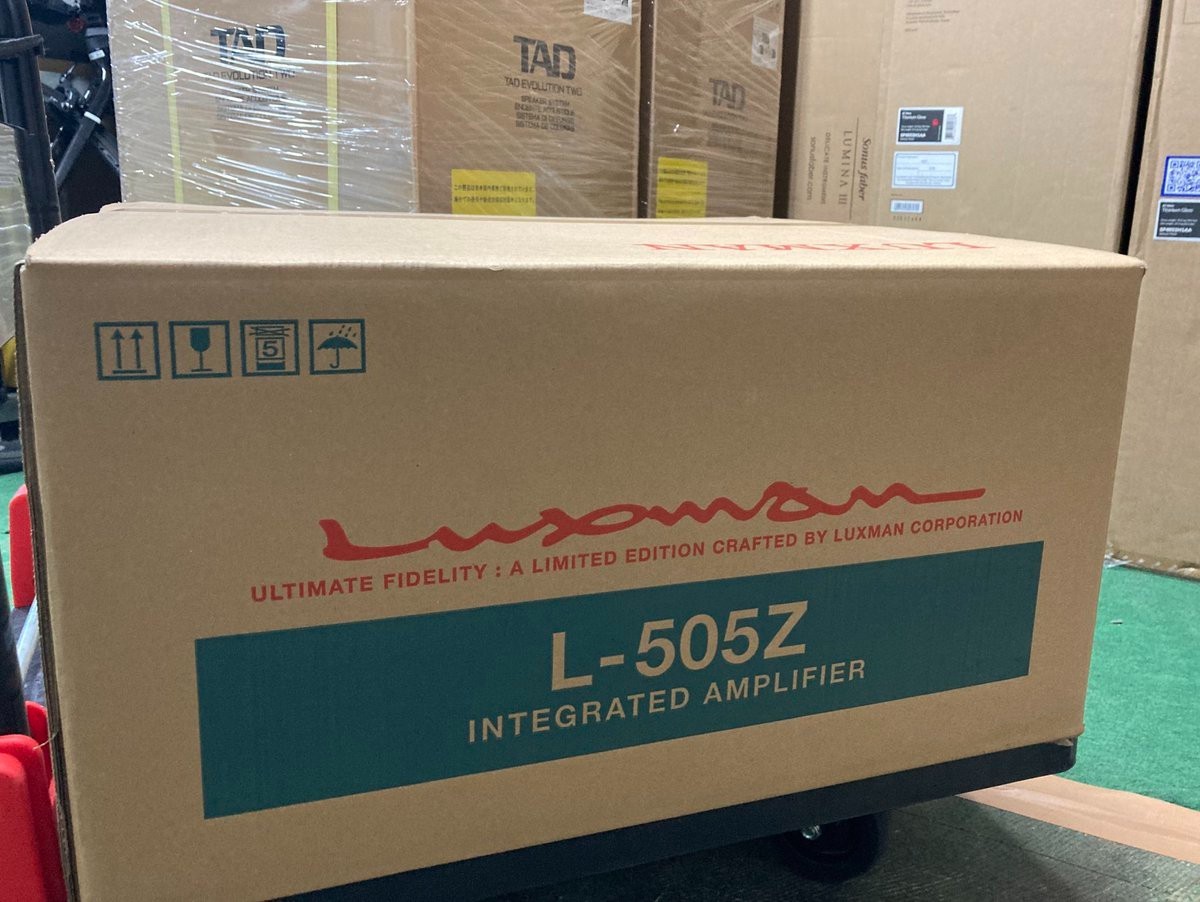
The L-505uXⅡ is the direct successor to the L-505uX, which launched in 2011 and marked a turning point for Luxman’s integrated amplifier line. It wasn’t just another model refresh—it was a statement that integrated amps could rival separates in performance. The Mark II refined that vision, incorporating technology trickled down from higher-end models like the L-590aX and the flagship C-900u preamplifier. Over the span from the original L-505s introduced in 1996 to the L-505uXⅡ, the line saw three major iterations, each pushing further into high-end territory. This model was eventually replaced by the Luxman L-505Z, but the uXⅡ remains a fan favorite for its balance of innovation, musicality, and craftsmanship.
eBay Listings



As an eBay Partner, we earn from qualifying purchases. This helps support our independent vintage technology research.
Related Models
- Luxman L-530 (1975)
- Luxman R-404 (1975)
- Luxman RV-371 (1975)
- Luxman SQ-38U (1975)
- Luxman T-14 (1972)
- Luxman T-530 (1975)
- Luxman TX-101 (1975)
- Denon DRA-800 (1985)
- Denon PMA-350Z (1980)
- Denon POA-1500 (1979)