Luxman K-205 (1985–1988)
A cassette deck that doesn’t just play tapes — it respects them, with a transport so quiet you’ll forget it’s working.
Overview
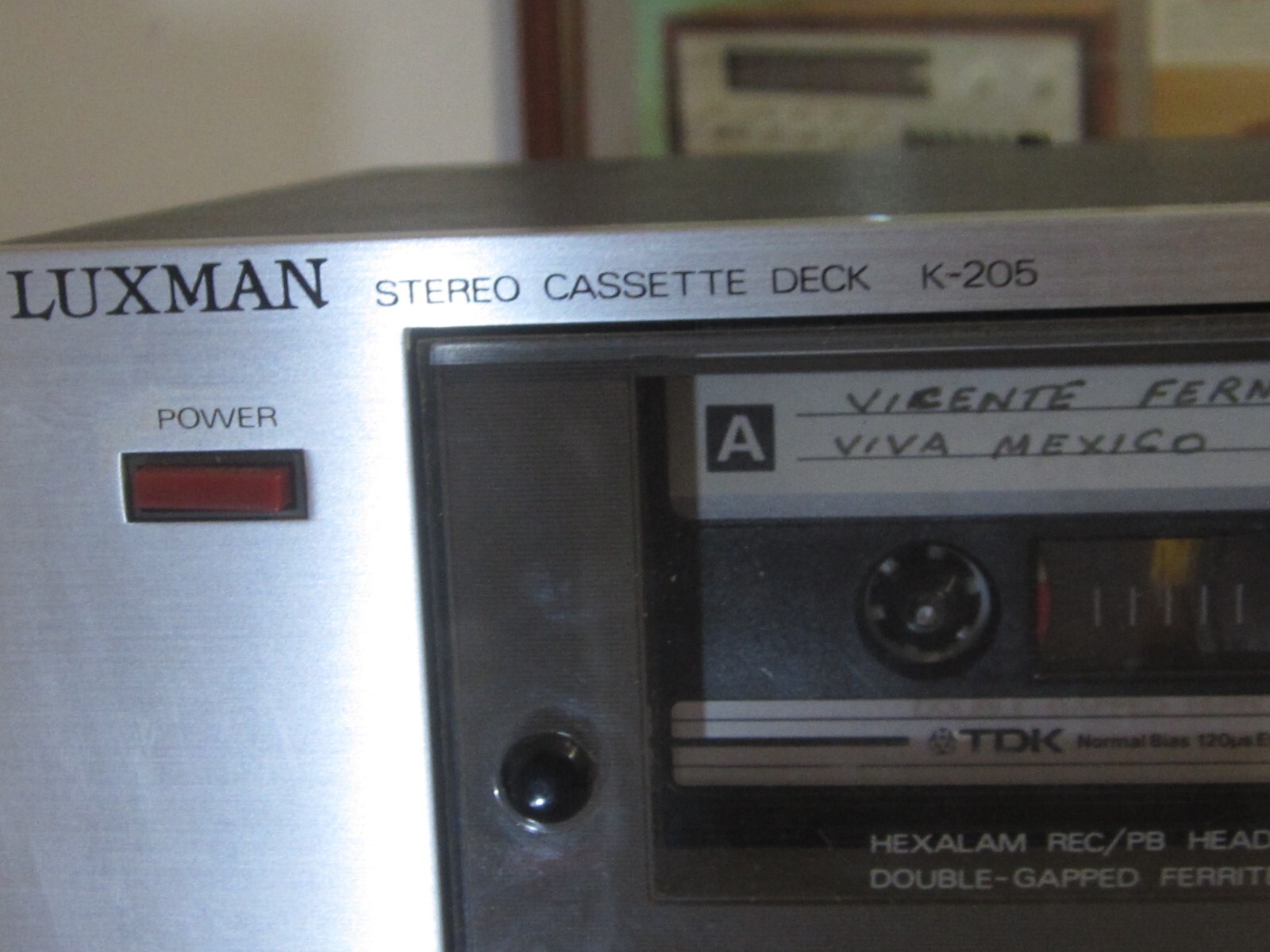
The Luxman K-205 isn’t the loudest name in vintage audio, but for those who know their way around a cassette mechanism, it’s a quiet revelation. Released between 1985 and 1988 — with some sources citing a 1984–1987 window — this stereo cassette deck was built during the golden twilight of high-end tape, when manufacturers like Nakamichi, Sony, and TEAC were pushing the limits of what analog tape could do. Luxman, better known for their amplifiers and tuners, stepped into the arena with a machine that didn’t scream for attention but earned respect through precision and refinement.
Owners report it’s a very good sounding deck — not flashy, not hyped, but honest in its reproduction. That’s no small feat in an era where many decks either over-engineered themselves into fragility or cut corners to hit price points. The K-205 splits the difference: a 3-head, 3-motor configuration with a closed-loop dual capstan drive, logic-controlled solenoid transport, and support for Dolby B and C noise reduction. It’s a spec sheet that reads like a checklist for serious tape enthusiasts, and it delivers on that promise.
Made in Japan and finished in a champagne-colored, matt brushed panel, the K-205 carries the understated elegance typical of Luxman’s design language. It wasn’t trying to look like a spaceship or a luxury watch — it just looked like something built to last, with clean lines, solid weight, and controls that feel deliberate. An optional remote control added convenience without cluttering the front panel, keeping the focus on performance.
This is a deck for people who still believe in the tactile ritual of tape — threading, pressing play, hearing the tape spin up with a whisper — and want it done right.
Specifications
| Manufacturer | Luxman Corporation |
| Model | K-205 |
| Type | 3-head, 3-motor, closed-loop dual capstan cassette deck |
| Track System | 4-track, 2-channel |
| Heads | 1 x record, 1 x playback, 1 x erase |
| Frequency response | 20Hz - 20kHz (Metal tape) |
| Signal to Noise Ratio | 70dB (Dolby C) |
| Wow and Flutter | 0.035% (WRMS) |
| Total Harmonic Distortion | 1.5% |
| Input | 50mV (line) |
| Inputs | 2 x line (RCA) |
| Output | 0.5V (line) |
| Outputs | 2 x line (RCA) |
| Semiconductors | 2 x BA, 2 x LA, 2 x AN, 1 x TA, 1 x STK, 1 x μPC, 4 x transistors |
| Dimensions | 430 x 125 x 310mm |
| Weight | 6.5kg |
| Made in | Japan |
| Color | Champagne, matt brushed |
| Remote control | yes, optional |
Key Features
Logic-Controlled Solenoid Transport
The K-205’s transport isn’t just automated — it’s precise. Using solenoids controlled by logic circuitry, it delivers smooth, reliable tape handling with minimal mechanical shock. Owners note the transport is very smooth and quiet, a critical factor in maintaining consistent tape-to-head contact and minimizing wow and flutter. This isn’t the clunky, spring-loaded mechanism of budget decks; it’s a system designed for repeatable performance, whether you’re cueing up a mixtape or archiving a rare live recording.
Dolby B and C Noise Reduction
Noise reduction was a battlefield in the 1980s, and Dolby C represented the high end of consumer tape hiss suppression. The K-205 includes both Dolby B and C, giving users flexibility depending on tape type and recording quality. With Dolby C engaged, the signal-to-noise ratio hits 70dB — a strong figure for a cassette deck — making it capable of handling dynamic material without the constant whisper of tape noise in the background. It’s not perfect — no cassette is — but it gets close enough to let the music breathe.
Closed-Loop Dual Capstan Drive
One of the standout engineering choices in the K-205 is its closed-loop dual capstan system. Unlike simpler decks that rely on a single motor and rubber pinch roller, this setup uses two capstans with feedback control to maintain precise tape speed. The result? Exceptional speed stability, reflected in the impressively low 0.035% wow and flutter. That’s on par with some of the best decks of the era, and it means vocals stay locked in place, bass stays tight, and there’s no sense of the tape “wobbling” through the heads.
3-Head, 3-Motor Configuration
Having separate record, playback, and erase heads means the K-205 can monitor recordings in real time — you’re not listening to the record head’s output, but the actual tape as it passes the playback head. This allows for accurate monitoring during recording, a must for serious tapers. The three-motor design isolates each function (capstan, supply, take-up), reducing crosstalk and vibration. It’s a layout typically found in high-end decks, and its inclusion here signals Luxman’s intent: this wasn’t a midrange compromise.
Bias Fine Adjustment
For those who demand the last ounce of performance from their metal or Type II tapes, the K-205 includes a bias fine adjustment. This lets users tweak the recording bias to match specific tape formulations, optimizing high-frequency response and distortion. It’s a feature aimed at enthusiasts and professionals who know their BASF from their TDK, and it underscores the K-205’s position as a tool for accurate duplication and archiving, not just casual playback.
Collectibility & Value
The Luxman K-205 isn’t a headline-grabbing collector’s item like a Nakamichi Dragon, but it’s steadily gaining recognition among those who value reliability and sound quality over flash. Current listings show it trading in the used market at modest prices: €100 on Marktplaats (March 2026), CA$100 on Canuck Audio Mart (June 2025), PLN 190 in Poland (May 2025), and 1,500,000 IDR in Indonesia. Most units are listed as “used,” with one noting “in good working condition. Some scratches on top.”
Mechanically, the K-205 is described as a bit complicated, but very reliable — a fair trade-off for its advanced transport. However, like all cassette decks of this age, it will likely need maintenance. The belts and idler tires will need to be replaced, a common refrain for 35-year-old gear. The good news? The main drive belt is a square belt and is still available from some suppliers, making restoration more feasible than with orphaned models.
Because it lacks a cult following, the K-205 remains affordable — a sleeper pick for those building a high-quality analog chain without blowing the budget. It’s not rare, but it’s not common either, and well-maintained examples are worth seeking out.
eBay Listings


As an eBay Partner, we earn from qualifying purchases. This helps support our independent vintage technology research.
Related Models
- Luxman L-530 (1975)
- Luxman R-404 (1975)
- Luxman RV-371 (1975)
- Luxman SQ-38U (1975)
- Luxman T-14 (1972)
- Luxman T-530 (1975)
- Luxman TX-101 (1975)
- Denon DRA-800 (1985)
- Denon PMA-350Z (1980)
- Denon POA-1500 (1979)