Luxman K-105 (1985)
That rare cassette deck that still feels like a revelation—smooth, quiet, and built like it’s meant to outlive us all.
Overview
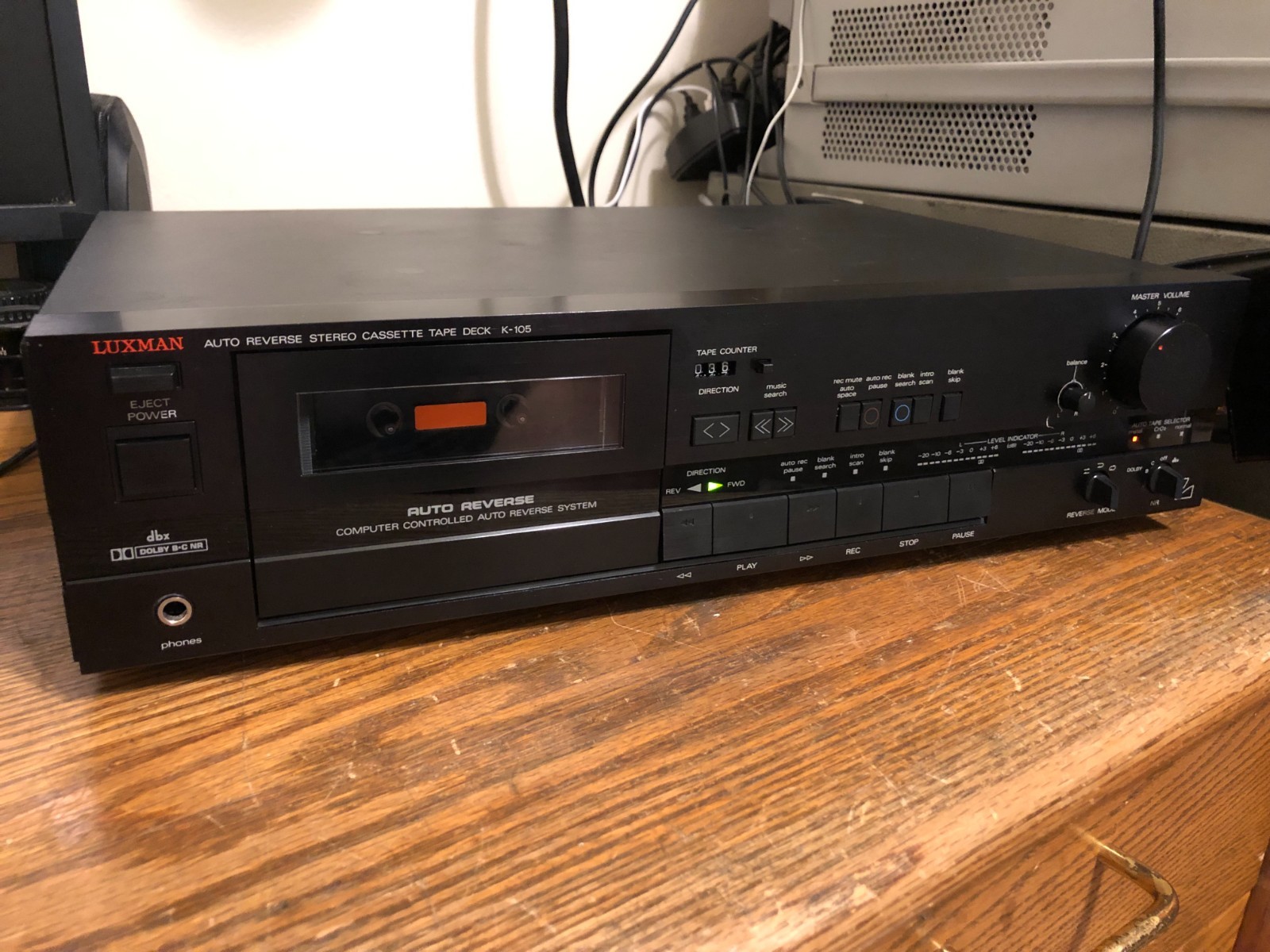
The Luxman K-105 Auto Reverse Stereo Cassette Deck isn’t just another relic from the analog tape era—it’s a statement of intent. Released in October 1985, this 3-head, single compact cassette deck was engineered for those who refused to accept compromise, even on a medium often dismissed as second-tier. Revered for its superior sound quality and robust build, the K-105 stands apart in a field crowded with good-enough decks. It doesn’t shout; it simply performs, with a quiet confidence that only the best Japanese hi-fi gear of the 1980s could muster.
At a time when many manufacturers were cutting corners to hit price points, Luxman doubled down on precision. The K-105 wasn’t designed to be the flashiest on the shelf, but it was built to be one of the most reliable and sonically transparent. Its engineering reflects a philosophy that treated cassette recording not as a convenience, but as a legitimate high-fidelity format. With support for Type I, CrO2, and Metal tapes, automatic equalization selection, and a sophisticated 3-head configuration, it was ready for whatever tape you fed it—no manual adjustments, no guesswork.
Owners report that even today, decades later, the K-105 holds up remarkably well. One user put it plainly: “Its mechanism is superb with the assist motor, and despite being almost forty years old, it works perfectly.” That kind of longevity isn’t accidental. This is a deck that was overbuilt on purpose, with materials and design choices that prioritized durability and signal integrity over cost savings.
Specifications
| Type | 3-head, single compact cassette deck |
| Track System | 4-track, 2-channel stereo |
| Tape Type | Type I, CrO2, Metal |
| Tape Speed | 4.75 cm/s |
| Heads | 1 x record, 1 x playback, 1 x erase |
| Motor | 1 x reel, 1 x capstan |
| Frequency Response | Normal : 20 Hz to 17 kHz; Chrome : 20 Hz to 18 kHz; Metal : 20 Hz to 19 kHz |
| Signal to Noise Ratio | Dolby C, Metal : 71 dB or more; Dolby C, normal : 70 dB or more |
| Wow and Flutter | 0.022% (WRMS) |
| Total Harmonic Distortion | Not more than 0.7% |
| Input | 50mV (line), 0.25mV (mic) |
| Output | 0.5V (line) |
| Power consumption | 18W |
| External dimensions | 430 x 135 x 310mm |
| Weight | 7.5kg |
Key Features
The Oatley Berth Mechanism and Rotary Auto-Reverse
The heart of the K-105’s reliability lies in its Oatley berth mechanism, which uses a rotary head system for seamless auto-reverse operation. Unlike simpler belt-driven systems that physically flip the tape, this design rotates the head assembly, eliminating mechanical stress on the cassette and ensuring consistent head-to-tape contact in both directions. A high-precision aluminum die-cast head loading mechanism handles the rotating part, providing rigidity and damping—critical for maintaining alignment over time. Oilless metal bearings further reduce wear, meaning fewer points of failure as the years pass.
S. T. A. R. Circuit Design
Luxman didn’t just borrow good ideas—they refined them. The K-105 uses the S. T. A. R. circuit, a design philosophy also found in their Brid series amplifiers. This approach eliminates shared power and ground lines throughout the circuit, preventing signal contamination and ensuring a cleaner, more direct audio path. The result? Smoother signal flow, lower noise, and a more dynamic presentation—especially noticeable during quiet passages or complex musical passages where crosstalk can muddy the waters.
Hexaram Record/Playback Head
The record and playback head isn’t just another off-the-shelf component. It’s a Hexaram head, constructed with six layers of hard permalloy laminate. This multi-layer construction enhances magnetic efficiency and reduces distortion, contributing directly to the K-105’s tight frequency response and low THD. Paired with a dual-gap ferrite erase head, it ensures clean, complete erasure without affecting adjacent tracks—a subtle but critical detail for high-quality recording.
Computer-Based Control and Smart Features
For 1985, the K-105 was ahead of the curve in usability. Its control section is computer-based, enabling advanced functions like music search, intro-scan, and blank skip. These weren’t gimmicks—they were practical tools for navigating tapes efficiently. The deck also includes Auto-Tape-Selection, which automatically detects tape type and applies the correct bias and equalization, eliminating user error. Other features like timer recording, reverse-mode, and auto-space further cement its status as a deck built for serious use, not just casual dubbing.
Noise Reduction and Playback Fidelity
Dolby B and Dolby C noise reduction systems are onboard, giving users the tools to maximize tape performance. With a signal-to-noise ratio of 71 dB or more (Dolby C, Metal), the K-105 extracts every bit of clarity from high-grade tapes. One owner admitted, “I wouldn’t claim that this makes the best recordings…”—but quickly added, “this K-105 is a solid unit and a favourite.” That honesty speaks volumes: it’s not a magic box, but it’s trustworthy, consistent, and capable of excellent results when paired with good sources and tapes.
Visual Appeal and User Experience
The side-by-side VU meters may not be the most practical feature—another user noted they’re “not so practical, but they add a lot of charm and still do the job.” And they do. They’re not just decorative; they give real-time feedback on recording levels, and their symmetrical layout adds a touch of elegance to the front panel. It’s a small detail, but one that reflects Luxman’s attention to both function and form.
Collectibility & Value
The Luxman K-105 isn’t a household name like a Nakamichi Dragon, but among cassette enthusiasts, it’s quietly gaining recognition. A unit listed on Reverb.com was priced at $350 USD, though the listing was over a year old—indicating it may have been a patient seller or a particularly pristine example. More realistically, a March 2025 listing on HifiShark.com offered a K-105 needing new belts for $98, suggesting that functional condition dramatically affects value.
Given that service manuals—including circuit diagrams—are available for purchase or download, repairs are feasible for those with technical skill or access to a good technician. The most common failure points aren’t specified in the documentation, but anecdotal evidence points to belts wearing out (expected after 40 years) and potential circuit board issues—like a unit that powers on but whose buttons don’t respond, as noted in one Reverb listing.
For collectors, the K-105 represents a smart buy: it’s not yet overhyped, but its build quality, feature set, and sonic performance suggest it won’t stay under the radar forever. If you’re building a high-end 1980s system or just want a cassette deck that still feels modern in its execution, the K-105 deserves serious consideration.
eBay Listings



As an eBay Partner, we earn from qualifying purchases. This helps support our independent vintage technology research.
Related Models
- Luxman L-530 (1975)
- Luxman R-404 (1975)
- Luxman RV-371 (1975)
- Luxman SQ-38U (1975)
- Luxman T-14 (1972)
- Luxman T-530 (1975)
- Luxman TX-101 (1975)
- Denon DRA-800 (1985)
- Denon PMA-350Z (1980)
- Denon POA-1500 (1979)