Luxman K-03 (1984–1987)
The last word in analog tape precision—a deck so finely engineered, owners call it their crown jewel.
Overview
If you’ve ever chased that elusive blend of clinical accuracy and musical soul in a cassette deck, the Luxman K-03 is where the pursuit ends. Introduced in 1984, this wasn’t just another high-end tape machine—it was Luxman’s final, fully realized statement in the cassette format, a machine built without compromise. Weighing in at 11.1 kg and priced at ¥178,000 at launch, the K-03 wasn’t for casual listeners. It was for those who treated tape as a serious medium, capable of rivaling vinyl when done right.
Positioned as a rare later sibling to the legendary K-05 and K-04, the K-03 inherited their DNA but refined it. It’s essentially a K-04 stripped of the CTS automatic calibration and pitch control, but with meaningful upgrades: a subsonic filter, a playback head demagnetizer, and a visual redesign that gave it a sleeker, more modern face. Fully made by Alpine—yes, that Alpine, the same team behind the big Luxman flagships—the K-03 carries the same obsessive build quality. And while Luxman had a “fantasy” deck, the X-3K, that never made it past prototype, the K-03 was as close to that dream as the public ever got.
Owners don’t just respect this machine—they love it. One calls it their “cassette crown jewel,” another says it “handily sounds more ‘musical’” than their Nakamichi CR-4A. Another, who once owned a Dragon, flatly states: “the Luxman K-03 sounds way better.” That’s not nostalgia talking. That’s a deck that still holds its own, decades later.
Specifications
| Manufacturer | Luxman |
| Model | K-03 |
| Type | Stereo Cassette Deck |
| Production Years | 1984–1987 |
| Tape Speed | 4.75 cm/s |
| Heads | 1x 3-layer laminated sendust (record); 1x Hot Isostatic Press ferrite (playback); 1x dual-gap sendust & ferrite (erase) |
| Motor Configuration | 1x DD-FG Servo core/brush/slotless DC (capstan); 1x DC (reel drive); 1x DC (head-housing lifter) |
| Wow & Flutter | 0.025% (WRMS) |
| Frequency Response (Type IV/Metal) | 20 Hz – 23 kHz (±3 dB) |
| Frequency Response (Type II/CrO2) | 20 Hz – 21 kHz (±3 dB) |
| Frequency Response (Type I/Normal) | 20 Hz – 20 kHz (±3 dB) |
| S/N Ratio (Type IV, Dolby C) | 73 dB (IEC-A) |
| S/N Ratio (Type II, Dolby C) | 73 dB (IEC-A) |
| S/N Ratio (Type I, Dolby C) | 71 dB (IEC-A) |
| THD | 1.3% (1 kHz, 160 nWb/m) |
| Real Analyzed Distortion | 0.6% (1 kHz, 160 nWb/m) |
| Input Sensitivity (Line) | 150 mV |
| Output Level (Line) | 540 mV |
| Headphone Output | 50 mW / 8 Ohm |
| FF/Rew Speed (Standard) | 85 s (C-60) |
| FF/Rew Speed (High) | 50 s (C-60) |
| Dimensions | 453 x 163 x 365 mm |
| Weight | 11.1 kg |
| Power Consumption | 35 W |
| Remote Control | Optional (AK-1, AK-10, AK-20) |
Key Features
The GT Transport: Geometry as Religion
The heart of the K-03 is its diecast zinc alloy GT Transport, a fortress of precision engineering. This isn’t just a chassis—it’s a single, rigid casting that integrates the capstan bearings directly into the motor frame. That means no flex, no misalignment, just perfect geometry. The closed-loop dual capstan drive ensures tape speed stability down to the micrometer, which is why the wow and flutter spec hits an astonishing 0.025% WRMS. When you’re dealing with metal tapes pushing 23 kHz, that kind of stability isn’t optional—it’s essential.
Fixed Headstack: No User Adjustments, No Compromises
One thing you won’t find on the K-03: an azimuth control. That’s because the headstack is fixed at the factory with micron-level precision. The recording and playback gaps are aligned during manufacturing and locked in place. Luxman didn’t trust users to tweak what they’d already perfected. And given how many decks suffer from sloppy head alignment over time, this isn’t a limitation—it’s a feature. The playback head uses Hot Isostatic Press ferrite, a material chosen for its high-frequency clarity, while the record head is a 3-layer laminated sendust, known for its durability and linearity.
Manual Calibration, But Not Alone
Calibration is manual, but it’s not blind. The K-03 is equipped with Duo-ß circuitry, dual-FET DC inputs, and separate power supplies for the record, playback, and Dolby sections. That means no crosstalk, no power supply sag, and ultra-stable bias and level settings. The amp and control circuits each have their own PCBs, and grounding is fine-tuned with current regulation in every section. This is overkill by most standards—but it’s exactly what you need when chasing the last 5% of performance.
Thoughtful Touches That Matter
The K-03 doesn’t just play tapes—it cares for them. The demagnetizer switch activates a 7-second degauss cycle for the playback head, keeping high-frequency response sharp. The subsonic filter eliminates rumble from warped tapes or turntable bleed. The MPX filter is switchable, handy for FM recordings. Tape type selection is manual—Normal, Chrome, Metal—because Luxman trusted the user to know their tape. And the digital linear tape counter? Four digits, clear and precise. No guessing how much tape is left.
Historical Context
The K-03 arrived in 1984, right in the golden era of high-end cassette decks. This was the year Nakamichi dropped the Dragon, and Tandberg and Revox were pushing their own limits. In that company, the K-03 wasn’t just competitive—it was a statement. It represented “the highwater mark for Luxman’s foray into the cassette format,” a final refinement of techniques honed in the K-05 and K-04. While it lacked the CTS automatic calibration of the K-04, it gained practical upgrades that many users preferred. It wasn’t a step down—it was a pivot toward purity and reliability.
And while Luxman flirted with a prototype “fantasy” deck, the X-3K, the K-03 was the last of the line that actually made it to market. After this, the company stepped back from cassette decks, leaving the K-03 as their swan song in the format.
Collectibility & Value
The K-03 is a collector’s machine, and prices reflect that. In September 2024, a used unit drew an auction bid of PLN 14,500—over $3,500 USD at the time. A K-03W, the rare wood-encased variant (though evidence suggests few, if any, were actually produced beyond pre-production), was listed as “near mint” on audioScope. Service manuals are available, which helps with restoration, but there’s no data on common failures or maintenance pitfalls in the sources. Still, given its Alpine-built construction and over-engineered design, it’s likely to survive in good hands.
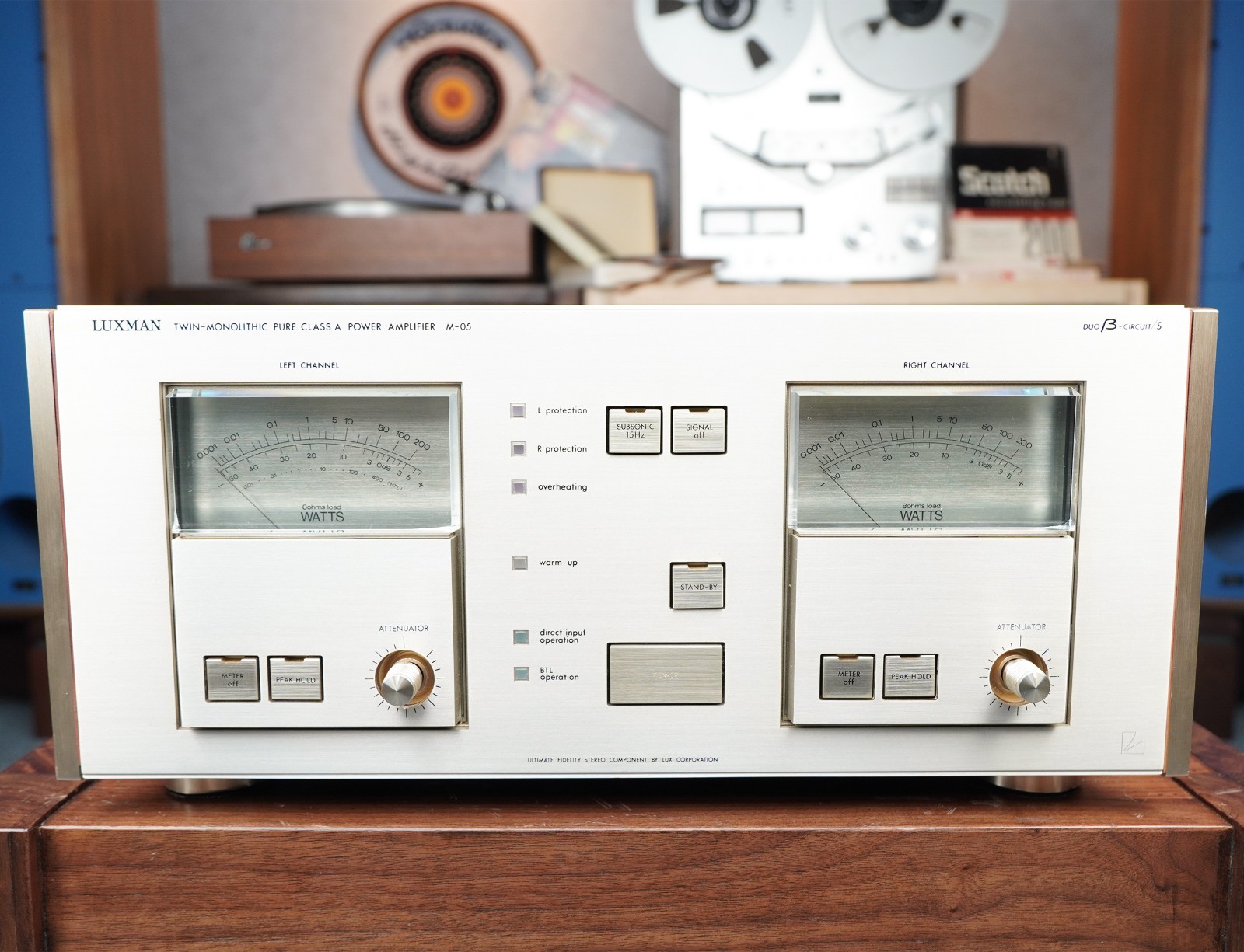
Owners don’t sell these lightly. One says, “I have a K-03 and wouldn’t part with it.” Another pairs it with their Luxman M-05/C-05 stack, treating it as a full member of a high-end system. That’s the ultimate compliment: not as a nostalgic relic, but as a living component that still earns its place.
eBay Listings



As an eBay Partner, we earn from qualifying purchases. This helps support our independent vintage technology research.
Related Models
- Luxman L-530 (1975)
- Luxman R-404 (1975)
- Luxman RV-371 (1975)
- Luxman SQ-38U (1975)
- Luxman T-14 (1972)
- Luxman T-530 (1975)
- Luxman TX-101 (1975)
- Denon DRA-800 (1985)
- Denon PMA-350Z (1980)
- Denon POA-1500 (1979)