Leak Sandwich (1961)
That first listen, when a record sounds like it's speaking directly to you - chances are a Leak Sandwich was behind it.
Overview
H. J. Leak & Co. introduced the original Sandwich in 1961. At a time when most British speakers still relied on paper cones and basic cabinet designs, the Sandwich arrived with one radical idea: eliminate cone breakup by making the driver itself impossibly stiff and lightweight. The speaker tracked transients with uncanny precision, delivered extended highs without harshness, and offered a level of clarity that left reviewers stunned. It was a commercial success, and collectors and audiophiles still chase it more than six decades later.
The company was already respected for amplifiers like the Point One and the TL/12, but the Sandwich was its first step into transducer design. Production ran for about 10 years, and Leak expanded the concept into multiple iterations. Later models like the Sandwich 200 and 600 followed, but the original 1961 release is the foundational piece. It proved a foam-and-foil cone could outperform conventional materials in both rigidity and speed. It was built to tackle the loudspeaker cone stiffness problems that plagued the 1950s, and its influence rippled through the industry for years.
Specifications
| Manufacturer | H. J. Leak & Co. |
| Product type | Loudspeaker |
| Production years | Introduced in 1961. Produced for about 10 years. |
| Driver configuration | 3-way vented-box |
| Driver size | 11" (280mm) Aluminium-Foamcore Sandwich cone bass driver |
| Midrange Driver | 4.25" (108mm) Aluminium-Foamcore Sandwich cone |
| Treble Driver | 1.2" (30mm) Coated Textile Dome |
| Sensitivity | 88.5dB (2.83V @ 1m) |
| Recommended Amplifier Power | 25-250W |
| Peak SPL | 112dB |
| Nominal Impedance | 6Ω (8Ω Compatible) |
| Minimum Impedance | 4 Ω |
| Frequency Response +/-3dB | 42Hz - 26kHz |
| Bass Extension -6dB | 32Hz |
| Crossover Frequency | 470Hz & 3.1kHz |
| Cabinet Volume | 2.7L (mid enclosure), 45.5L (bass enclosure) |
| Speaker Dimensions | 25.8" x 14.5" x 13" (655mm x 370mm x 330mm) |
| Net weight | 27.3kg/pcs |
| Enclosure type | Bass reflex |
| Transducer complement | 3-way |
Key Features
The modern Leak Sandwich 250 carries forward the core idea of the original: a driver built like a structural sandwich. The bass and midrange units use an advanced sandwich driver technology with a stiff aluminum skin bonded to a core of polymethacrylimide (PMI) foam. The goal is the same as it was originally, a cone that is both very light and extremely stiff. That rigidity prevents flex and breakup, which gives cleaner output, tighter bass, and a midrange that doesn't smear under load.
The cabinet is a 'sandwich' of materials with precise internal bracing, and it resists resonance in a way that was revolutionary in 1961 and still works today. The original design used a threaded rod from the bass driver that braced the cabinet via a wooden block carrying the crossover. That kind of structural integration was ahead of its time, and many other manufacturers later adopted the techniques. The 250 updates the execution, but every part of the speaker is still engineered to support the driver's performance, not hinder it.
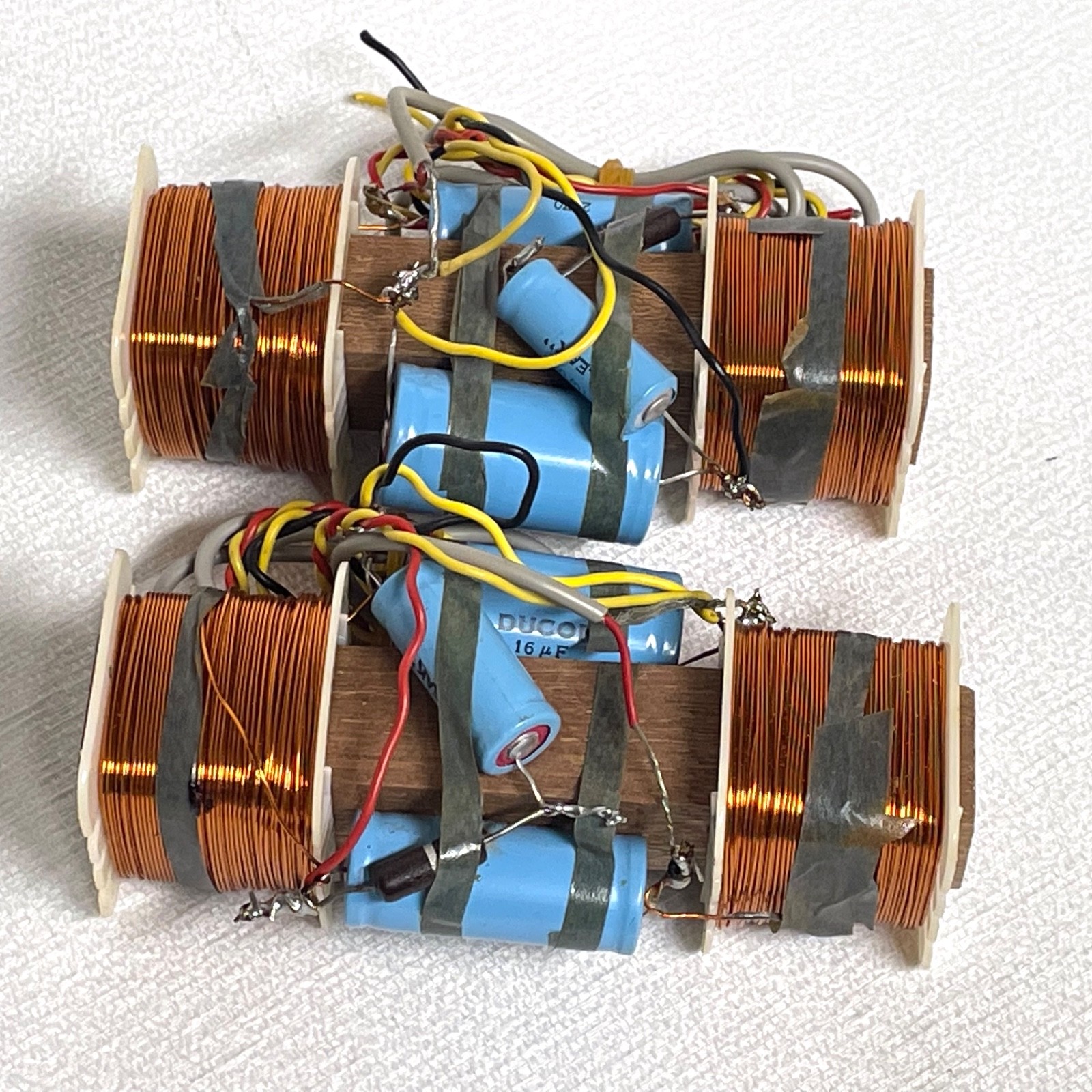
One practical change from the original: the crossover now uses modern components. The original non-polar electrolytic capacitors are known to degrade and distort over time. For owners of vintage units, replacing those capacitors with polyester film types is a well-documented maintenance step, and it can restore the speaker's clarity. The 250 comes with reliable filtering, so there's no need to hunt down vintage-spec replacements.
Historical Context
The LEAK Sandwich was an innovative loudspeaker design introduced in 1961, born from a collaboration between Harold Leak and engineer Don Barlow. Barlow's answer to the era's cone stiffness problems was a composite structure that behaved like a rigid piston across its range. A famous publicity photograph showed Harold Leak standing on a Sandwich cone, to demonstrate its strength and rigidity.
The original two-way design quickly evolved. LEAK produced two-way and three-way iterations through the 1960s and early/mid 1970s, including the Sandwich 200 (which used a 200 mm version of the sandwich driver), the 600, and eventually the 250. The sandwich cone woofer also found its way into other systems, like the Braun L80/2.
Collectibility & Value
Today the Leak Sandwich exists in two forms: vintage and modern reissue. The new Sandwich 250 is available directly from Leak Audio at $2,995.00 USD without stands, or $3,695.00 USD with stands. On the used market, prices vary widely by model and condition, with complete vintage systems ranging from €130 to €2,499 depending on provenance and restoration.
For original units, the most common failure point is the crossover's non-polar electrolytic capacitors, which degrade over time and introduce distortion. A detailed account and circuit diagram for replacing them exists, so restoration is a realistic project for the technically inclined. Owners who have completed the upgrade often report a dramatic improvement, and some describe the result as “gob smacking.”
The original 1961 model remains the holy grail, and the modern 250 brings the concept into the present with updated materials and engineering. Reviewers note that the new models are bass-forward and particularly well-suited to rock and electronic music, though they may not deliver the crisp high-frequency articulation some classical or jazz listeners demand.
eBay Listings


As an eBay Partner, we earn from qualifying purchases. This helps support our independent vintage technology research.
Related Models
- Leak TL/25A
- Leak Moving-Coil Pickup and Arm (1954)
- Leak STEREO-PICKUP (1959)
- Leak TROUGH-LINE-STEREO (1958)
- Leak VARISLOPE-II (1955)
- Braun AUDIO-1 (1965)
- Braun AUDIO-250 (1965)
- Magnavox Component Systems (1972)
- Acoustic Research AR (1967-1976)
- Acoustic Research 11