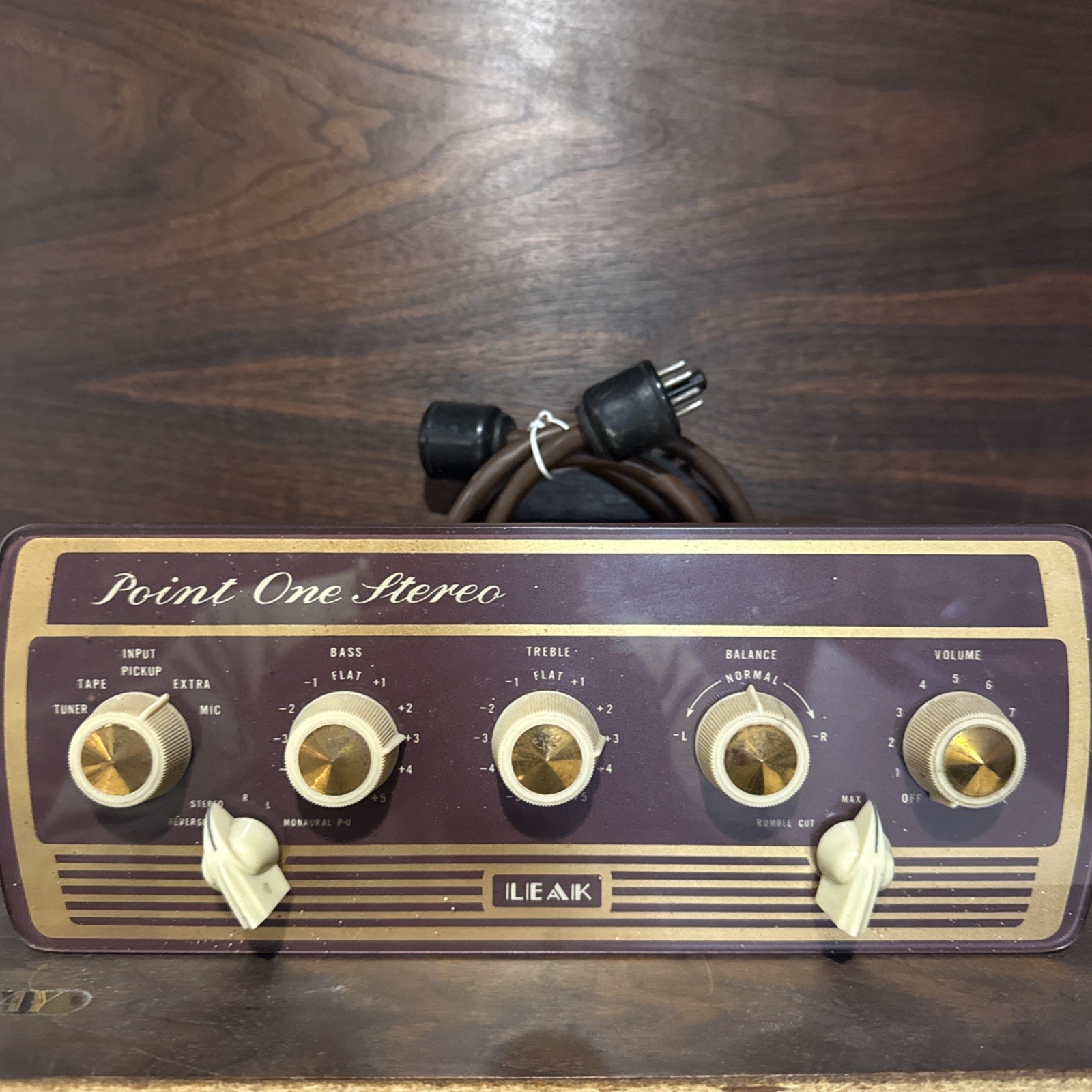
Leak POINT-ONE: The Pioneer of High-Fidelity Phono Cartridges
In the nascent days of high-fidelity audio, when the very concept of “accurate sound reproduction” was still being defined, the Leak POINT-ONE emerged as a groundbreaking innovation. Introduced in 1945 by the British company T. A. Leak & Company—better known simply as Leak—the POINT-ONE was not just another phono cartridge; it was a revelation. As one of the first truly high-performance moving-magnet (MM) cartridges ever produced, the POINT-ONE set new standards for tracking accuracy, low distortion, and musical fidelity, laying the foundation for modern analog playback.
Leak, already respected for its amplifiers and tuners, ventured into cartridge design at a time when most record players used crude ceramic or steel pickups with poor frequency response and high surface noise. The POINT-ONE changed that paradigm. Designed with meticulous engineering and a deep understanding of acoustics, it brought a level of refinement previously unheard in domestic audio systems. For audiophiles of the 1940s and 1950s, owning a Leak POINT-ONE was akin to possessing a piece of cutting-edge science—a tool that could unlock the true potential of vinyl records.
Technical Specifications
| Specification | Detail |
| Manufacturer | T. A. Leak & Company, UK |
| Model | POINT-ONE |
| Year Introduced | 1945 |
| Type | Moving-Magnet (MM) |
| Output Voltage | ~3.5 mV (at 5 cm/s, 1 kHz) |
| Frequency Response | 20 Hz – 15,000 Hz (±2 dB) |
| Tracking Force | 2.5 – 3.0 grams |
| Stylus Type | Conical (originally polished diamond) |
| Cantilever | Aluminum, lightweight rigid design |
| Channel Separation | >25 dB at 1 kHz |
| Load Impedance | 47 kΩ recommended |
| Load Capacitance | 100–200 pF recommended |
| Weight | ~7.5 grams |
| Mounting | Standard ½-inch mount |
The POINT-ONE was engineered for precision. Its moving-magnet design used a small permanent magnet attached to the stylus cantilever, which vibrated within a fixed coil assembly to generate an electrical signal. This was a significant improvement over earlier piezoelectric cartridges, offering lower mass, better transient response, and reduced record wear. The lightweight aluminum cantilever and carefully aligned magnetic circuit contributed to its exceptional tracking ability, allowing it to follow groove modulations with remarkable fidelity.
Sound Characteristics and Performance
The sonic signature of the Leak POINT-ONE is best described as balanced, natural, and deeply musical. Unlike some modern cartridges that emphasize analytical detail, the POINT-ONE delivers a warm, organic presentation that many describe as “alive.” Its frequency response is impressively flat for its era, with smooth extension at both ends—bass is tight and controlled, while treble remains clear without harshness.
One of the most celebrated aspects of the POINT-ONE is its midrange clarity. Vocals and acoustic instruments are rendered with exceptional presence and texture, making it a favorite among jazz and classical enthusiasts. The cartridge’s low distortion and excellent channel separation contribute to a spacious stereo image, even by today’s standards. When properly set up on a quality tonearm and turntable, the POINT-ONE can deliver a listening experience that feels remarkably modern—proof of Leak’s forward-thinking design.
While its conical stylus limits ultimate resolution compared to modern elliptical or fine-line profiles, the POINT-ONE’s tracking is surprisingly capable, especially when used with the recommended 2.5–3.0 gram tracking force. It handles dynamic swings with ease and maintains composure even on heavily modulated passages.
Notable Features and Innovations
The Leak POINT-ONE was revolutionary for several reasons:
- Pioneering Moving-Magnet Design: At a time when most cartridges were ceramic or moving-iron types, the POINT-ONE’s MM design offered superior linearity and lower moving mass, resulting in better transient response and reduced record wear.
- Precision Engineering: Leak employed tight manufacturing tolerances and high-quality materials, including a rigid aluminum body and precisely aligned internal components, ensuring consistency and reliability.
- Optimized Magnetic Circuit: The POINT-ONE featured a carefully balanced magnetic structure that maximized output while minimizing distortion—a hallmark of Leak’s engineering philosophy.
- Standardized Mounting: Its ½-inch mounting pattern became an industry standard, ensuring compatibility with a wide range of tonearms and facilitating easy upgrades.
- British Craftsmanship: Built in the UK with meticulous attention to detail, the POINT-ONE reflected the post-war British commitment to precision engineering and high standards in audio reproduction.
Common Issues and Maintenance
Due to its age, surviving Leak POINT-ONE cartridges require careful evaluation before use. Common issues include:
- Stylus Wear: Most original styli have long since been replaced or worn out. Using a worn stylus can damage records and degrade sound. Replacement conical diamond styli are available from specialist suppliers, though they are rare and often expensive.
- Cantilever Misalignment: Over time, the delicate cantilever may become bent or misaligned, affecting tracking and channel balance. Professional realignment is recommended.
- Coil Degradation: While the fixed coils are generally robust, moisture or physical shock can cause internal breaks or short circuits. Output testing with a multimeter can help diagnose such issues.
- Dirt and Oxidation: Dust accumulation and oxidation on terminals can impair signal transfer. Gentle cleaning with contact cleaner and a soft brush is advised.
Owners are strongly encouraged to have a POINT-ONE professionally serviced before use. Proper alignment, correct tracking force, and a clean, undamaged stylus are essential for optimal performance and record preservation.
Current Market Value and Collectibility
The Leak POINT-ONE is a highly sought-after collector’s item. In working condition with a good stylus, prices typically range from $300 to $600, depending on condition, originality, and provenance. NOS (New Old Stock) units in original packaging can command even higher prices, sometimes exceeding $800–$1,000 at auction or through specialist dealers.
Its collectibility stems not only from its historical significance but also from its enduring sonic performance. Unlike many vintage cartridges that are now museum pieces, the POINT-ONE remains a viable option for period-correct restorations or for audiophiles seeking a vintage-inspired sound.
Conclusion and Legacy
The Leak POINT-ONE is more than a relic of audio history—it is a milestone in the evolution of high-fidelity sound. As one of the first high-performance phono cartridges, it helped define what was possible in analog playback and influenced generations of cartridge designers. Its combination of engineering excellence, musicality, and build quality set a benchmark that resonates to this day.
For vintage audio enthusiasts, the POINT-ONE represents a tangible link to the origins of modern hi-fi. Whether used in a restored 1950s system or appreciated as a collector’s gem, it stands as a testament to British innovation and the enduring appeal of analog sound. In the world of vintage cartridges, the Leak POINT-ONE isn’t just a footnote—it’s a foundational chapter.
eBay Listings



As an eBay Partner, we earn from qualifying purchases. This helps support our independent vintage technology research.
Related Models
- Leak SANDWICH (1953)
- Leak Moving-Coil Pickup and Arm (1954)
- Leak STEREO-PICKUP (1959)
- Leak TROUGH-LINE-STEREO (1958)
- Leak VARISLOPE-II (1955)
- Akai AM-2850 (1975)
- Akai AP-206 (1975)
- Nakamichi BX-1 (1985)
- Acoustic Research research-ar-17 (1978)
- Acoustic Research AR-19 (1994)