Kenwood LS-X-1-S (1995–1998)
Small on size, big on presence—these THX-certified cubes were built to anchor a home theater without stealing the living room’s soul.
Overview
Pull one out of the box today and you’ll notice how dense it feels for its size—like a brick wrapped in vinyl. That’s no accident. The LS-X-1-S was designed during the mid-’90s boom in home theater, when manufacturers weren’t just selling speakers—they were selling lifestyle integration. Kenwood didn’t want these to dominate the room; they wanted them to disappear into it, sonically and visually. But don’t let the compact, boxy shape fool you. These are serious monitors, THX-certified no less, engineered to meet the strict dispersion, output, and frequency roll-off standards that Lucasfilm demanded for proper cinematic sound reproduction.
Each speaker is a three-way design with six drivers packed into a deceptively simple cabinet: dual 5-inch (120mm) woofers, dual 3-inch (80mm) midrange domes, and dual dome tweeters stacked vertically. That’s not overkill—it’s precision. The vertical array helps maintain coherent off-axis response, critical for THX compliance, where dialogue clarity from the center channel (or front L/R in a stereo setup) must remain consistent even when you're not sitting dead-center. The crossover hits at 300 Hz and 3.5 kHz, cleanly handing off duties between drivers, and the nominal 8-ohm impedance makes them relatively easy to drive—though they’re rated to handle between 30 and 150 watts, so don’t pair them with a flea-powered amp expecting fireworks.
Sensitivity is 86 dB, which is modest by vintage standards. These aren’t the kind of speakers that leap to life with a whisper of voltage. They need current, and they need control. But feed them properly and they deliver a remarkably neutral, composed sound—especially for movie dialogue and midrange-heavy effects. There’s no bloated bass to muddy the mix, because the LS-X-1-S rolls off sharply below 125 Hz. That’s by design: this speaker expects a subwoofer. In fact, it practically demands one. It’s not a flaw—it’s part of the THX ecosystem. These are satellites in all but name, built to work in harmony with a capable low-frequency driver like Kenwood’s matching SW-X1 passive radiator sub.
They came in two finishes: a white laminate (LS-X-1-S) and a black PVC-wrapped version (LS-X-1-S(B)), both with a slightly industrial, utilitarian look. The front baffle is rounded at the edges, a subtle touch to reduce diffraction, and the grille is a simple magnetic fabric cover—no frills. At just under 13 pounds each and measuring 12” H x 9 9/16” W x 5 13/16” D, they’re compact enough for shelf mounting or small stands, but substantial enough to avoid sounding hollow or thin.
Specifications
| Manufacturer | Kenwood |
| Production Years | 1995–1998 |
| Original Price | $600/pair |
| Type | 3-way, 6-driver loudspeaker system |
| Frequency Response | 125 Hz – 20,000 Hz |
| Crossover Frequencies | 300 Hz, 3,500 Hz |
| Nominal Impedance | 8 Ω |
| Minimum Impedance | 3.5 Ω |
| Sensitivity | 86 dB (2.83V/1m) |
| Recommended Amplifier Power | 30 – 150 W |
| Woofer | 2 x 120 mm cone (5") |
| Midrange | 2 x 80 mm dome (3") |
| Tweeter | 2 x dome tweeters |
| Enclosure Type | Acoustic Air Suspension (sealed) |
| Dimensions (H x W x D) | 12" x 9 9/16" x 5 13/16" |
| Weight | 12.8 lbs (5.8 kg) each |
| Finish | High-density particle board with PVC laminate (white or black) |
| THX Certification | Yes |
Key Features
THX-Certified Design for Cinematic Accuracy
Kenwood didn’t slap the THX badge on lightly. To earn certification in the mid-’90s, a speaker had to pass rigorous testing for off-axis response, maximum SPL, and bass roll-off characteristics. The LS-X-1-S clears that bar with its controlled dispersion pattern and flat midrange. The vertically aligned drivers help maintain a consistent sonic image across a wide listening area—ideal for living rooms where not everyone can sit in the sweet spot. Dialogue cuts through with clarity, and effects pan smoothly across the front soundstage. This isn’t about audiophile warmth or romantic tonality; it’s about accuracy under pressure, which is exactly what THX was built for.
Sealed Enclosure for Tight, Controlled Bass
The Acoustic Air Suspension (A.S.) design means no port, no chuffing, no boomy resonances. It also means the bass rolls off early—there’s essentially no output below 125 Hz. That’s not a shortcoming; it’s a feature. By cleanly handing off to a subwoofer at 80–100 Hz (via receiver crossover), the LS-X-1-S avoids the muddiness that plagues many small speakers trying to do too much. The sealed box delivers faster transient response than a ported design, so kick drums and punchy effects have snap rather than smear. But it does require a good subwoofer partnership. A mismatched or underpowered sub will leave a hole in the mix, making the system sound disjointed.
Robust Build with No-Frills Aesthetic
These aren’t showpieces. The high-density particle board cabinet is wrapped in durable PVC laminate, available in white or black. It’s not real wood veneer, but it’s not flimsy plastic either—it’s built for durability and mass production. The rounded baffle edges reduce edge diffraction, a thoughtful touch for a speaker at this price point. Grilles are simple and magnetically attached, easy to remove for a cleaner look. Internally, the crossover uses quality components for the era, though service technicians note that capacitor aging can become an issue after 25+ years, especially if the speakers were driven hard or stored in humid environments.
Historical Context
The LS-X-1-S arrived in 1995, right as home theater was shifting from niche hobby to mainstream living room fixture. DVDs were on the horizon, Dolby Digital and DTS were becoming standard on laserdiscs, and consumers wanted systems that could deliver a cinema-like experience without requiring a full wall of floorstanders. Kenwood positioned itself as a premium A/V brand during this era, releasing a full THX-certified ecosystem: receivers like the KR-X1, power amps, and the passive SW-X1 subwoofer. The LS-X-1-S was the anchor of that front channel setup—compact enough for tight spaces, but certified to deliver the dynamics and clarity needed for multi-channel sound.
It competed directly with systems from Boston Acoustics, Jamo, and even Yamaha’s entry-level THX packages. While brands like Bose dominated the “disappearing speaker” market with ultra-compact designs, Kenwood took a different path: slightly larger cabinets with real drivers and proper engineering. They weren’t trying to hide the physics—they were working within it. The LS-X-1-S wasn’t marketed to two-channel purists; it was for the growing number of buyers who wanted movie nights to feel like events. And in that context, it delivered. Reviews from the time praise its dialogue clarity and punchy dynamics, even if they note its limited bass extension.
Collectibility & Value
Today, the LS-X-1-S trades in a narrow but dedicated niche. They’re not cult classics like the Kenwood LS-1900, nor are they rare oddities like the planar LS-1000. They’re vintage workhorses—functional, well-built, and increasingly scarce as people discard old home theater gear. Pairs in good cosmetic and operational condition typically sell between $150 and $300, depending on finish and whether they come with original grilles and documentation. The white versions are slightly rarer and often command a small premium.
The most common failure points are aging foam surrounds on the woofers and dried-out crossover capacitors. Foam rot is nearly inevitable after 25+ years, especially if the speakers were kept in damp basements or sunlit rooms. Re-foaming is a common and cost-effective fix—usually $60–$100 per speaker—but it’s essential for restoring full bass response and preventing rattles. Crossover rebuilds are less common but may be needed if the sound becomes thin or one driver drops out. Service technicians observe that the original capacitors were decent for the era, but not immortal.
Buyers should check for cabinet warping, especially on the baffle, and ensure the binding posts are tight and corrosion-free. These speakers were often paired with Kenwood’s KM-X1 or Z1 electronics, which had a slightly bright character—so pairing them today with a forward amplifier can exaggerate the upper midrange lift some owners report. A warmer, tube-based amp or a modern receiver with tone controls can help balance that.
They’re not ideal for stereo music purists—there’s no magic sparkle or soundstage depth that will make you rediscover your vinyl collection. But for vintage home theater enthusiasts, or anyone building a period-correct 1990s surround system, the LS-X-1-S remains a smart, authentic choice. They’re honest speakers: not flashy, not flawed, just built for a job and built well.
eBay Listings
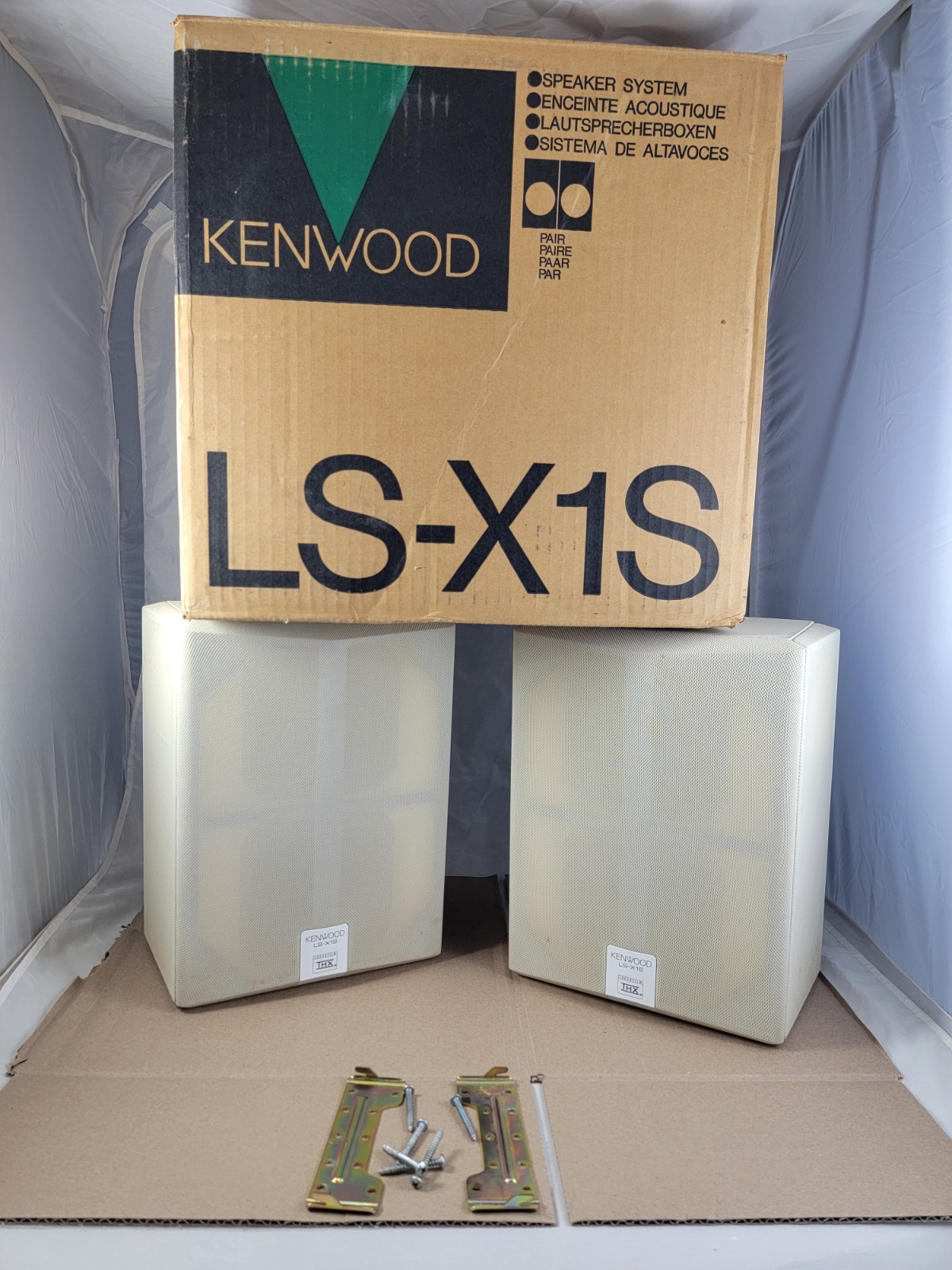
As an eBay Partner, we earn from qualifying purchases. This helps support our independent vintage technology research.
Related Models
- Kenwood kl-888s (Late 1970s (approximately 1978-1980))
- Kenwood kd-1500 (1972-1975)
- Kenwood ls-500 (Late 1970s (approximately 1978-1980))
- Kenwood kd-5070 (1979-1981)
- Kenwood kd-5077 (1978-1980)
- Sony ps-5550 (1978-1980)
- Sony ps-lx5r (1983-1985)
- Sony ss-7220a (1970s)
- Sony ss-97 (Late 1970s (approximately 1977-1979))
- Sony ss-999 (Late 1970s (approximately 1977-1979))