Kenwood KX-51 (1983)
It hums to life with a soft mechanical sigh, the tape counter ticking forward like a metronome set to memory — this is the sound of analog ritual, preserved in a 4.6kg slab of early '80s engineering.
Overview
The Kenwood KX-51 — sometimes listed as the KX-51/51B — isn’t one of those showstopper decks that made magazine covers or haunted audiophile dreams. It’s the quiet worker, the unassuming stereo cassette deck from 1983 that Kenwood built for people who wanted solid performance without the price tag of a flagship. And yet, owners who’ve dug into its mechanics report a machine that punches above its class in fidelity, even if the service experience can feel like punishment. It’s not flashy, but under that brushed front panel lies a belt-driven, single-capstan transport with full-logic control and a spec sheet that suggests Kenwood didn’t cut every corner. With support for normal, chrome, and metal tapes via manual selection, it was built for the era when tape formulation mattered and bias tweaking was part of the ritual. It won’t wow you with automation, but it will play back your old recordings with a clarity that surprises — provided the belts haven’t turned to goo.
This is a machine of contradictions: technically competent, mechanically fussy. The frequency response stretches to 17kHz on metal tape, wow and flutter are impressively low at 0.04%, and the signal-to-noise ratio hits 67dB with Dolby B — numbers that sit comfortably among mid-tier decks of its time. But those specs mean little when the thing won’t load right because the solenoid-driven mechanism seized up after thirty years of dormancy. It’s a common story. The KX-51 uses a belt-driven system, and like so many of its era, those rubber belts don’t age well. They dry, they crack, they slip — and replacing them? That’s where the love-hate relationship begins.
Specifications
| Manufacturer | Kenwood Corporation |
| Product Type | Stereo Cassette Deck |
| Year | 1983 |
| Heads | 2 heads |
| Tape Counter | analog 3 digit tape counter |
| Tape Type Support | manual tape type selection with support for normal, chrome and metal tapes |
| Transport | belt driven single-capstan transport |
| Frequency Response | 20Hz to 17kHz (Metal tape) |
| Signal to Noise Ratio | 67dB (dolby B) |
| Wow and Flutter | 0.04% |
| Total Harmonic Distortion | 1.0% |
| Input | 77.5mV (line), 0.7mV (mic) |
| Output | 0.27V (line) |
| Dimensions | 440 x 117 x 232mm |
| Weight | 4.6kg |
Key Features
Solenoid-Driven Transport with Full-Logic Control
The KX-51 uses a solenoid-operated, belt-driven mechanism — a design that was common in mid-range decks of the early '80s. Unlike motor-driven systems that rely on friction wheels, solenoids provide precise, snap-action control over tape movement, reducing wear and improving reliability in theory. In practice, it’s the belts that betray you. The transport itself is full-logic, meaning it automatically stops and ejects the tape when it reaches the end, and prevents conflicting operations (like trying to record while already playing). It’s not as slick as a Nakamichi’s direct-drive elegance, but it’s functional, deliberate, and built to last — at least mechanically. The real headache isn’t the logic; it’s what happens when time catches up with the rubber.
Digital Peak Level Meters with Multi-Color Indication
Flanking the tape well are generic digital peak reading meters with multi-color indication — a modest but useful feature for a deck at this level. They’re not the sweeping VU needles of a Revox, nor the hyper-accurate bargraphs of a high-end Tandberg, but they get the job done. The multi-color display helps you spot clipping before it ruins a dub, and they’re especially handy when recording from line or mic sources. The input sensitivity is standard (77.5mV line, 0.7mV mic), so it integrates easily with most preamps and tuners of the era. Output is a healthy 0.27V, enough to drive most power amps without strain.
Manual Tape Type Selection
No auto-sensing here — the KX-51 requires manual tape type selection for normal, chrome, or metal tapes. That means you have to know what you’re playing and set it accordingly, but it also means you can tweak the recording bias if your service manual is handy and your patience is long. This was Kenwood’s way of offering flexibility without the cost of advanced electronics. It’s a throwback even for 1983, as some competitors were already rolling out chrome-sensing or metal-detect systems, but it keeps the signal path simpler and the price lower. For purists who like to fine-tune their recordings, it’s a feature. For casual users, it’s just another step before pressing play.
Collectibility & Value
The Kenwood KX-51 isn’t a grail, but it’s not forgotten. Its collectibility is rated a modest 5 out of 10 — not because it sounds bad (in fact, its 0.04% wow and flutter and 17kHz metal-tape response suggest it sounds quite good), but because ownership comes with strings attached. Belts fail. They fail often, and they fail completely. Forum posts describe units arriving with belts “kaput” — dried, cracked, or stretched into uselessness. Replacing them is technically possible, but owners report it as a “nightmare” and a “herculean task,” largely due to the difficulty of realigning gears and the flywheel after the new belts are installed. The mechanism is tight, the tolerances unforgiving, and without proper documentation, it’s easy to misalign something critical.
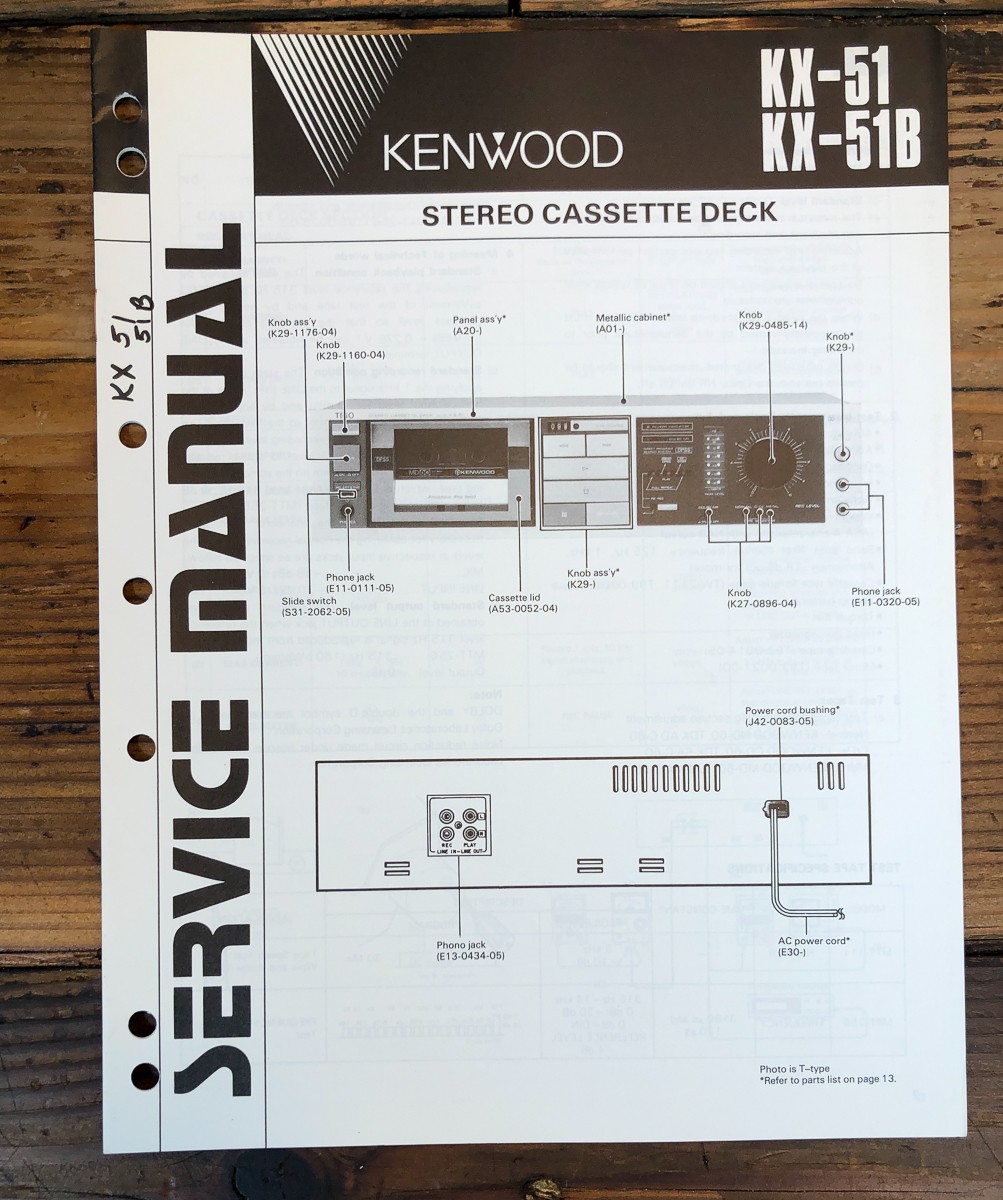
A service manual exists, but it’s not freely available. Some sellers charge a steep price for it, which only adds to the friction of ownership. While manuals can be found on eBay, Vintage Audio Store, and MikesManuals, they’re not cheap, and they’re not always complete. For the DIY tinkerer, this is a challenge. For the casual collector, it’s a warning label. There’s no data on current market prices for the deck itself, but given its mid-tier status and mechanical fragility, it’s unlikely to command more than a modest premium — assuming it works. A non-functional unit is essentially a parts donor or a shelf piece unless you’re willing to dive into the guts.
eBay Listings


As an eBay Partner, we earn from qualifying purchases. This helps support our independent vintage technology research.
Related Models
- Kenwood KX-3060 (1982)
- Kenwood KX-3050 (1984)
- Kenwood kx-520 (1980-1982)
- Kenwood kx-71r (1982-1984)
- Kenwood kx-1000 (1981-1983)
- Sony TC-2050SD (1978)
- Aiwa AD-F990 (1993)
- Sony TC-2130A (1974)
- Sony TC-2220 (1972)
- Sony TC-FX6 (1982)