Kenwood KX-520 (1977-1979)
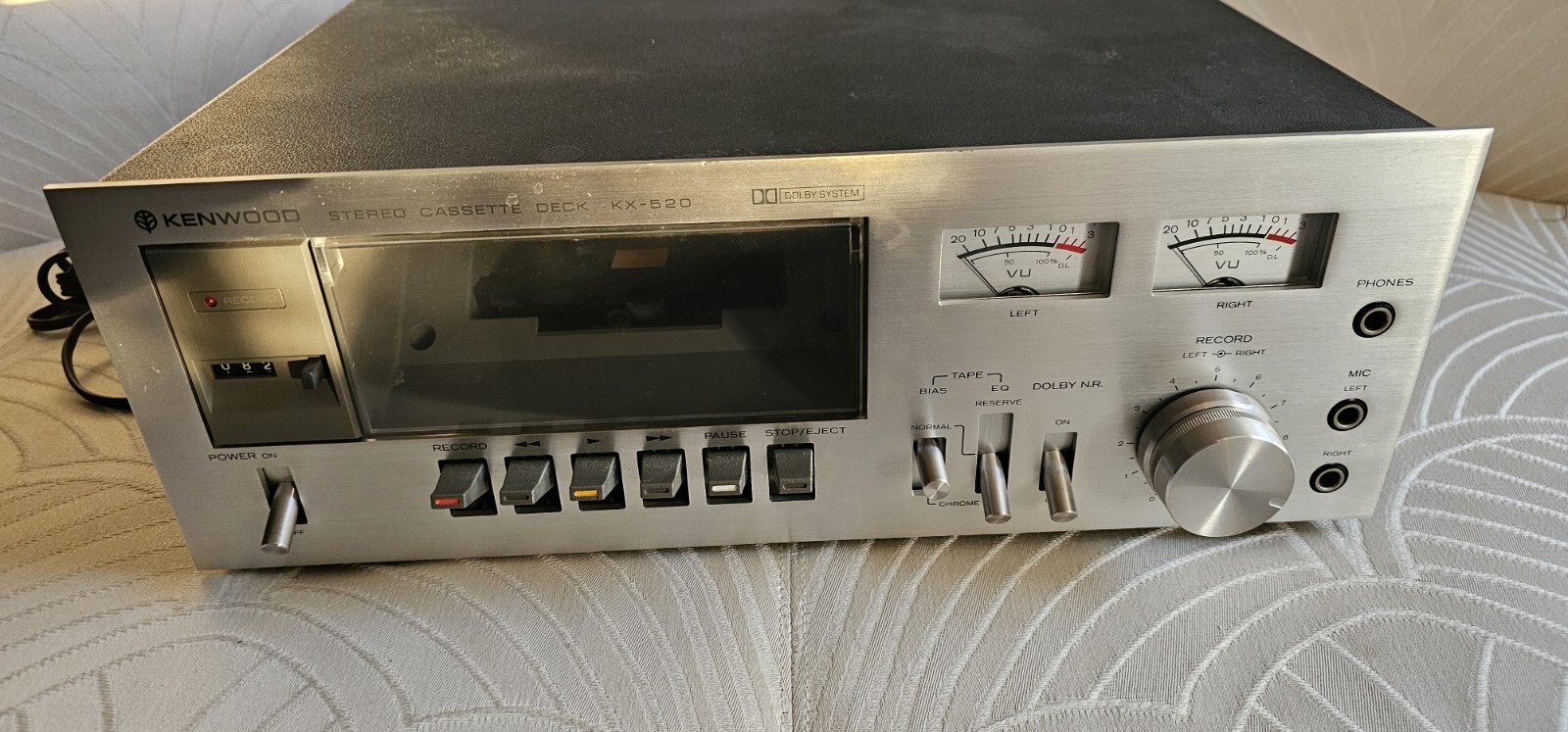
A frontloading cassette deck from Kenwood's late-'70s lineup, built for reliability and solid performance. It leaves out the extras of its higher-end siblings.
Overview
The Kenwood KX-520 has no flashy meters, no Dolby C and no three-head setup. It was released between 1977 and 1979 as a 2-head, single compact cassette deck for listeners who wanted clean recording and playback without fuss. It retailed for around 600 Deutsche Mark back in the day. That put it in the mid-tier of Kenwood's offerings, with a focus on durability and straightforward operation.
It is frontloading and silver-finished, and it comes from Japan. It supports Type I, CrO2, and FeCr tapes, with Dolby B noise reduction to keep hiss under control, which is especially useful on chrome formulations. The motor is an electronically controlled DC type, which helps hold tape speed steady at 4.75 cm/s, a standard for high fidelity in compact cassettes. It is a 4-track, 2-channel stereo system. Playback and recording both go through a single record/playback head, backed by a dedicated erase head.
You won’t find manual bias or frequency calibration here—that kind of tinkering was reserved for models like the KX-720 or KX-920. But for someone who just wants to make decent dubs or play pre-recorded tapes with accuracy, the KX-520 delivers. Its frequency response stretches from 30Hz to 16kHz when using CrO2 tape, and 30Hz to 13kHz on normal Type I tapes. Wow and flutter sit at a respectable 0.09%, and with Dolby B engaged, the signal-to-noise ratio hits 62dB. Total harmonic distortion is listed as 2% in multiple sources, though one (hifi-wiki.com) claims "< 1.0%"—a discrepancy with no clear resolution, so take that lower figure with a grain of salt.
This was gear for real systems, often paired with Kenwood amps like the KA-1500, KA-3500, or KA-5500, where consistency mattered more than showy specs.
Specifications
| Manufacturer | Kenwood |
| Year | 1977-1979 |
| Dimensions | 380 x 140 x 288 mm (W x H x D) |
| Weight | 6.1 kg |
| Power consumption | 11 watts |
| Track System | 4-track, 2-channel stereo |
| Tape Speed | 4.75 cm/s |
| Heads | 1 x record/playback, 1 x erase |
| Motor | electronically controlled DC |
| Tape Type | type I, CrO2, FeCr |
| Noise Reduction | B |
| Frequency Response | 30Hz to 16kHz (CrO2 tape) |
| Frequency Response (Normal Tape) | 30 - 13,000 Hz |
| Signal to Noise Ratio | 62dB (dolby B) |
| Wow and Flutter | 0.09% |
| Total Harmonic Distortion | 2% |
| Input | 77.5mV (line), 0.2mV (mic) |
| Output | 0.49V (line) |
| Premagnetization frequency | 85 kHz |
| Rewind time | 80 seconds for C-60 |
| Color | Silver |
| Made in | Japan |
Collectibility & Value
The Kenwood KX-520 isn't a grail item, but it isn't forgotten either. Recent listings show a unit at €125 on Bazaraki (March 30, 2025) and another at NOK 2,600 on Finn (January 17, 2025). Regional pricing varies widely, possibly due to condition or local demand.
If you're buying one today, assume it needs servicing. A restoration kit for the KX-520 (and its service twin, the KX-502) is available on eBay for $95.00, specifically for a "complete recap of all the electrolytic capacitors" on the PCBs. Owners note that a proper restoration must replace all electrolytic capacitors, a common failure point in decks of this age. Without that, you risk channel imbalance, power instability, or motor speed issues. Beyond caps, the usual suspects apply: rubber idlers drying out, pinch rollers hardening, and heads needing demagnetizing or cleaning. The KX-520 and KX-502 share a service manual, so repair paths are at least documented.
Reverb listings confirm some units are verified working, and one that has been recapped and tested is a dependable addition to a vintage setup. Never buy one untested.
eBay Listings
As an eBay Partner, we earn from qualifying purchases. This helps support our independent vintage technology research.
Related Models
- Kenwood KX-3050 (1984)
- Kenwood KX-3060S
- Kenwood KX-3510 (1985)
- Kenwood kx-51 (1980-1982)
- Kenwood kx-1000 (1981-1983)
- Infinity RS-IIA (1977)
- Infinity RS-4.5 (1978)
- Sony TC-K333ESG (1989)
- Sony TC-K333ESJ (1991)
- Sony TC-K333ESX (1991)