Kenwood KT-815 (1979-1981)
At 8.5 kg, it sits on the rack like a promise—one that delivers on selectivity but demands patience from the listener.
Overview
The Kenwood KT-815 is an AM/FM stereo analog tuner built during the transition from analog dials to digital precision, and it shows. Released in 1979 with a launch price of $440 (approximately 1,098 DM), this unit landed in a market hungry for synthesized tuning and preset convenience. It wasn’t the flashiest on the shelf, but it wasn’t meant to be. This was serious gear for listeners who cared about lock-on stability and clean signal extraction, not just aesthetics. At 440 mm wide and drawing 17W of power, it occupies space with purpose—solid, dense, and grounded.
Owners report a machine engineered for performance, not showmanship. The flywheel tuning mechanism gives the knob a smooth, damped feel, a tactile bridge between old-school precision and the new digital era. Paired with quartz PLL synthesized tuning, it offered rock-solid station locking at a time when drift and instability still plagued lesser tuners. Eight presets were generous for the era, and the digital display—while not flashy by today’s standards—was a clear indicator of Kenwood’s push toward modern usability. It was designed to work within a system, notably alongside the Kenwood KA-801 amplifier, though it stands alone as a disciplined front-end component.
Still, it’s not without its quirks. One owner review notes it’s a “damned nice tuner—hardly their best,” a backhanded compliment that hints at its position in Kenwood’s hierarchy. Another praises its “very high sensitivity and a beautiful piece, inside and out,” confirming its internal craftsmanship. But a shootout commentary cuts deeper: “Bass thin, treble forward. It cries out for a new audio stage.” That observation, while subjective, points to a known limitation—its audio output stage may benefit from restoration or modification to meet modern expectations.
Specifications
| Manufacturer | Kenwood |
| Product type | AM/FM Stereo Analog Tuner |
| Production years | 1979-1981 |
| Original price | $440 |
| Power consumption | 17W |
| Dimensions (W x H x D) | 440 x 150 x 340 mm |
| Weight | 8.5 kg |
| Frequency response | 20Hz - 15kHz |
| THD (mono) | 0.15% |
| THD (stereo) | 0.3% |
| Signal-to-noise ratio (mono) | 70dB |
| Signal-to-noise ratio (stereo) | 65dB |
| Capture ratio | 1.0dB |
| Selectivity | 80dB |
| Sensitivity (IHF, mono) | 10.3dBF (1.8uV) |
| Sensitivity (IHF, stereo) | 17.2dBF (3.5uV) |
| Image rejection ratio | 80dB |
| IF rejection ratio | 100dB |
| Spurious response rejection | 100dB |
| AM suppression | 55dB |
| Stereo separation | 40dB |
| Output level | 0.5V |
| Muting threshold | 5uV |
| Tuning method | Quartz PLL synthesized tuning |
| Presets | 8 |
| Inputs/Outputs | DIN REC OUT |
| Multipath outputs | Vertical: 0.02V, 1 kOhm; Horizontal: 0.35V |
| Sub Carrier Product Ratio | 70dB |
Key Features
Quartz PLL Synthesized Tuning with 8 Presets
The KT-815 ditches the old variable capacitor approach in favor of quartz PLL synthesized tuning—a significant step forward in tuning accuracy and stability. This system uses a phase-locked loop to lock onto stations with minimal drift, a major advantage in urban environments with signal congestion. The 8 presets allow users to store favorite stations, a convenience that was still relatively premium in the late 1970s. The digital display reinforces this modernity, offering clear frequency readouts without the guesswork of analog scales.
Flywheel Tuning Mechanism
Despite its digital internals, the KT-815 retains a physical tuning knob with a flywheel mechanism. This isn’t just nostalgia—it provides a smooth, inertia-damped feel that makes fine-tuning a tactile pleasure. The flywheel reduces overshoot and gives the user precise control, especially useful when hunting for weak stations or avoiding adjacent-channel interference. It’s a thoughtful blend of mechanical feedback and electronic precision.
PLL MPX Decoder Circuit Topology
The tuner employs a PLL MPX decoder for stereo demodulation, a design known for its stable stereo imaging and reduced crosstalk. This circuit locks onto the 19kHz pilot tone with high accuracy, contributing to the reported 40dB of stereo separation. While not the highest in class, it’s sufficient for clean channel distinction under normal reception conditions. The use of PLL technology here aligns with Kenwood’s focus on stability across the signal chain.
Electronic Equivalent of 4 Gangs
Though not using physical ganged capacitors, the KT-815 achieves the functional equivalent of a 4-gang tuning system through its synthesized design. This allows for precise alignment across RF, oscillator, and mixer stages, improving tracking accuracy and reducing the need for manual alignment—a maintenance win for owners. It’s an elegant solution to a persistent analog problem.
DIN REC OUT and Multipath Outputs
The inclusion of a DIN REC OUT connector reflects the era’s preference for compact, multi-pin connections, though adapters are now essential for modern setups. More interesting is the presence of dedicated multipath outputs—Vertical at 0.02V (1 kOhm) and Horizontal at 0.35V—allowing users to monitor signal phase issues and optimize antenna placement. This level of diagnostic access was rare in consumer gear and speaks to the KT-815’s semi-professional aspirations.
Collectibility & Value
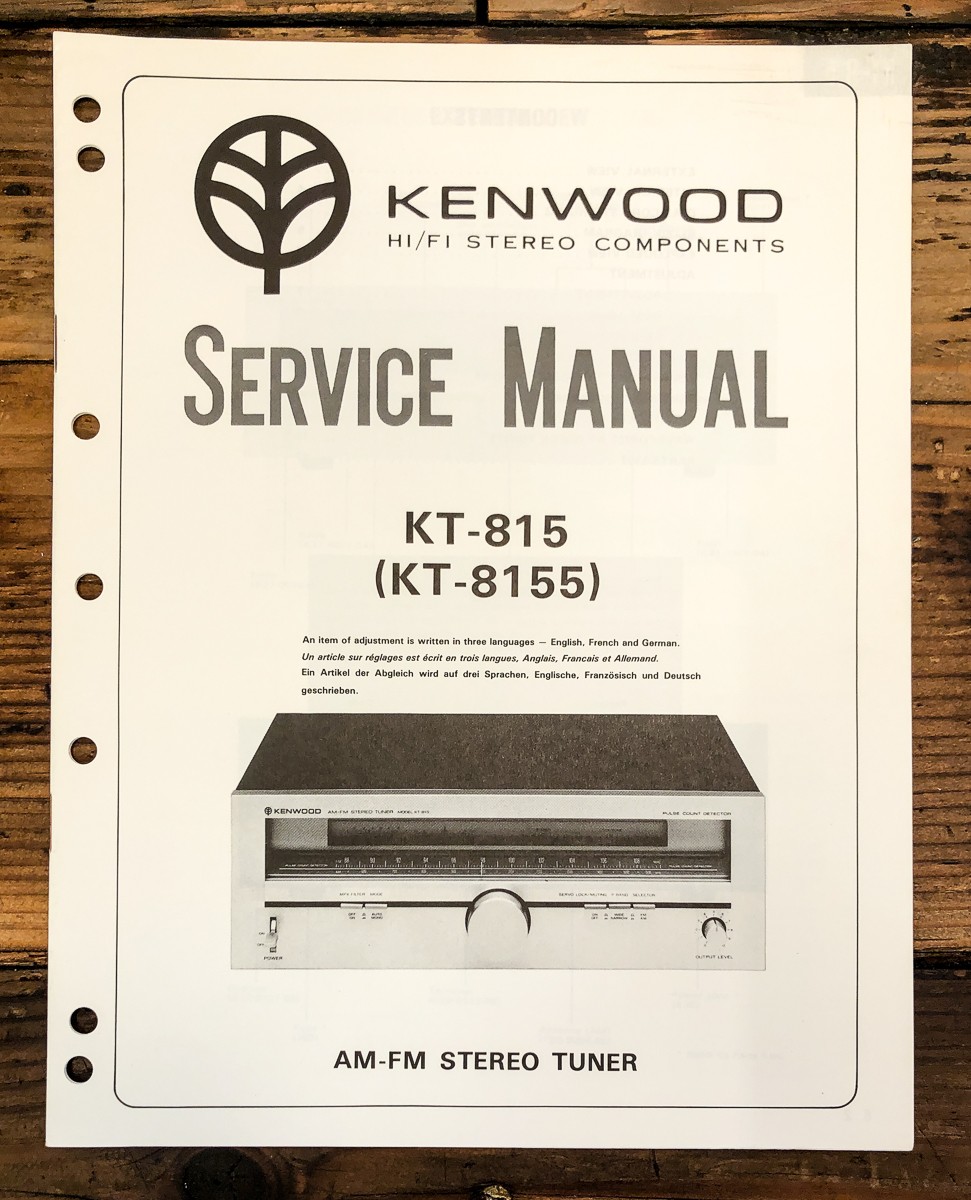
No official data exists on current market value or collectibility trends, but used units appear regularly on second-hand hi-fi markets. A service manual is available for $34.97, suggesting active support among restorers. The most consistent owner feedback points to the audio stage as a potential weak link—“cries out for a new audio stage,” one reviewer notes—implying that capacitor aging or op-amp degradation may be common. Those seeking the KT-815 today likely value its exceptional selectivity (80dB) and sensitivity (1.8µV mono) over sonic warmth, treating it as a restoration project or a precision tool rather than a plug-and-play classic.
eBay Listings


As an eBay Partner, we earn from qualifying purchases. This helps support our independent vintage technology research.
Related Models
- Kenwood kl-888s (Late 1970s (approximately 1978-1980))
- Kenwood kd-1500 (1972-1975)
- Kenwood ls-500 (Late 1970s (approximately 1978-1980))
- Kenwood kd-5070 (1979-1981)
- Kenwood kd-5077 (1978-1980)
- Sony ps-5550 (1978-1980)
- Sony ps-lx5r (1983-1985)
- Sony ss-7220a (1970s)
- Sony ss-97 (Late 1970s (approximately 1977-1979))
- Sony ss-999 (Late 1970s (approximately 1977-1979))