Kenwood KT-6500 (1977–1979)
At 8.5 kg, it lands on the rack with the solid thud of late-'70s Japanese engineering—no frills, all function.
Overview
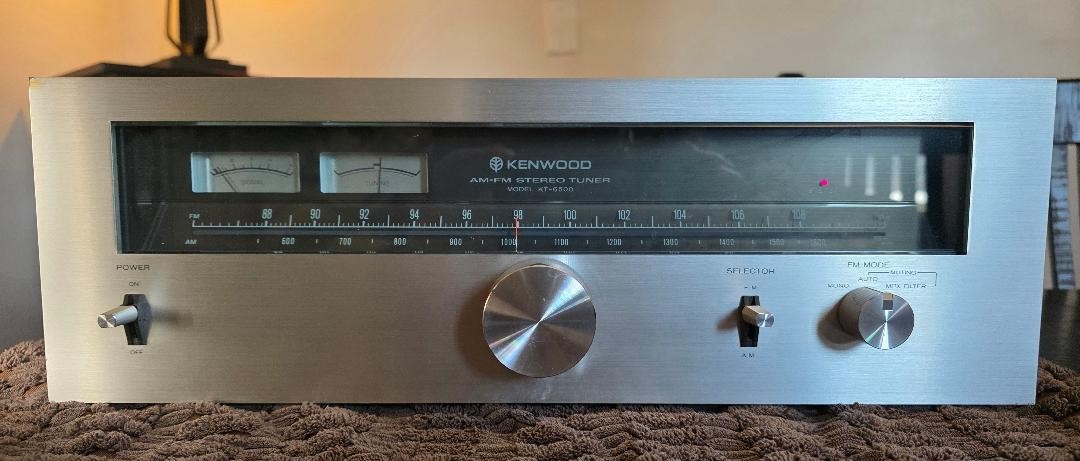
The Kenwood KT-6500 isn’t a showpiece with glowing VU meters or walnut cladding, but a serious AM/FM stereo tuner built during the golden stretch of analog broadcast fidelity. Released between 1977 and 1979, it carries the no-nonsense design language of its era—clean silver faceplate, recessed function switches, and a layout that prioritizes signal integrity over flash. Owners report it was marketed under both the Kenwood and Trio-Kenwood names, a quirk of branding common in international audio markets at the time. This is a tuner for listeners who cared about lockable stereo reception, low distortion, and the ability to pull in weak stations without noise swamping the music. It doesn’t pretend to be exotic; it’s a tool, built to spec, and built well.
While the KT-6500 doesn’t boast the legendary status of some contemporaries, its spec sheet reveals a machine tuned for real-world performance. The front end uses five FM gangs, with dual gangs allocated to the local oscillator—a design choice aimed at improving stability and reducing drift, particularly in the crowded FM bands of the late '70s. That attention to circuit architecture suggests Kenwood wasn’t cutting corners, even in what appears to be a mid-tier offering. The inclusion of a digital signal-strength meter in dB was still relatively novel at this price point, giving users precise feedback on station quality rather than relying on a sweeping analog needle. It’s also reportedly RDS-capable and designed to work with remote control systems, features that hint at a forward-looking approach despite its analog core.
Specifications
| Manufacturer | Kenwood |
| Product type | AM/FM stereo tuner |
| Usable Sensitivity | 10.8 dBF (2.0 µV / 75 ohms) |
| Signal-to-Noise Ratio | 70 dB |
| Total Harmonic Distortion | 0.15% |
| Capture Ratio | 1.5 dB |
| Alternate Channel Selectivity | 70 dB |
| Image Rejection | 80 dB |
| IF Rejection | 90 dB |
| Spurious Response Rejection | 80 dB |
| AM Suppression | 55 dB |
| Stereo Separation | 40 dB |
| Frequency Response | 30-15,000 Hz ±1.0 dB |
| Output Level | 750 mV |
| Dimensions (W x H x D) | 440 x 145 x 330 mm |
| Weight | 8.5 kg |
Key Features
Five-Gang FM Front End with Dual Oscillator Design
The KT-6500’s RF section relies on five FM gangs, two of which are dedicated to the local oscillator. This configuration, noted by owners, was intended to enhance tracking accuracy and reduce phase noise—critical for maintaining stereo lock and minimizing distortion on marginal signals. It’s a design more commonly seen in higher-end tuners of the period, suggesting Kenwood allocated serious engineering to the KT-6500’s core performance.
Digital Signal-Strength Meter in dB
Unlike the analog S-meters found on most tuners of its class, the KT-6500 features a digital readout calibrated in decibels. This gives users a precise, repeatable measurement of incoming signal strength, making it easier to optimize antenna placement or fine-tune reception without guesswork. It’s a small but meaningful step toward measurement-based tuning, a rarity outside professional gear at the time.
RDS and Remote Control Capability
Despite its unassuming appearance, the KT-6500 supports RDS (Radio Data System), allowing it to decode station identification and program information—a feature ahead of its time for a tuner in this segment. It’s also built to interface with remote control units, indicating Kenwood envisioned it as part of a broader, integrated system rather than a standalone component.
Classic Silver-Face Aesthetic with High-Quality Build
Owners consistently highlight the tuner’s silver-face front panel and robust construction. The chassis feels dense and well-shielded, typical of Japanese audio gear from the late 1970s. There’s no wood or chrome—just milled aluminum, precise switch detents, and a layout that feels both utilitarian and deliberate. It’s not flashy, but it inspires confidence the moment you power it up.
Historical Context
The Kenwood KT-6500 entered the market between 1977 and 1979, a period when FM stereo broadcasting was maturing and audiophiles were demanding better selectivity and lower distortion from their tuners. It shared a product line with the KT-5500, suggesting a tiered strategy within Kenwood’s tuner range. At launch, it carried an approximate price of $200 in the US or 598 DM in Germany—solidly mid-range for a feature-rich FM/AM stereo tuner of its caliber. This was gear aimed at serious listeners who wanted performance without the premium price tag of flagship models.
Collectibility & Value
While detailed market data is sparse, one European eBay listing from recent years showed a tested unit priced at approximately $184.14, suggesting strong demand among collectors. Described as a "sought-after collector's item known for its quality craftsmanship and reliable performance," the KT-6500 has quietly gained respect in niche circles. However, its reputation isn't universally settled—some owners still question, "Is it a decent tuner?" while others recall its sound with fondness, noting, "If my aural memory serves, the sound is between..." This ambiguity reflects its position: not a legend, but a well-built machine that delivered where it counted.
eBay Listings


As an eBay Partner, we earn from qualifying purchases. This helps support our independent vintage technology research.
Related Models
- Kenwood kl-888s (Late 1970s (approximately 1978-1980))
- Kenwood kd-1500 (1972-1975)
- Kenwood ls-500 (Late 1970s (approximately 1978-1980))
- Kenwood kd-5070 (1979-1981)
- Kenwood kd-5077 (1978-1980)
- Sony ps-5550 (1978-1980)
- Sony ps-lx5r (1983-1985)
- Sony ss-7220a (1970s)
- Sony ss-97 (Late 1970s (approximately 1977-1979))
- Sony ss-999 (Late 1970s (approximately 1977-1979))