Kenwood KT-500 (1980–1982)
A no-nonsense tuner with surgical tuning precision and a cult following among FM obsessives who still care about that needle twitching just right.
Overview
You don’t pick up a KT-500 because it’s flashy — you pick it up because you want to find stations, not just stumble onto them. This is Kenwood’s mid-tier FM/AM stereo tuner from the early '80s, built when Japanese engineering was hitting its stride: solid, unshowy, and packed with thoughtful design touches that only reveal themselves after hours of use. It doesn’t scream “audiophile,” but it listens like one. The front panel is all business — a large analog dial, a tuning knob with just the right resistance, and a cluster of small meters that tell you exactly what the signal is doing. No digital displays, no gimmicks. Just a tuner that does its job with quiet confidence.
It slots in just below Kenwood’s elite KT-7000 and KT-917 models, but don’t mistake its position for mediocrity. The KT-500 shares design DNA with those flagships, particularly in its IF (intermediate frequency) stage and metering system, but trims the fat where it counts: fewer RF stages, a simpler filter setup, and no exotic pulse-count detection. What it keeps, though, is the core Kenwood tuning philosophy — stability, clarity, and a level of hands-on control that makes chasing weak signals feel like a sport. It’s the tuner you’d buy if you lived in a fringe reception area, or if you just hated the idea of your stereo guessing what a stereo signal should sound like.
And it sounds clean — not lush, not warm, but accurate. FM stereo separation is strong for its class, and the de-emphasis switch lets you toggle between 50µs and 75µs settings, which matters if you’re pulling in European or older American broadcasts. The audio output is buffered properly, so you won’t load down the next stage in your chain, and the fixed/variable output options give you flexibility whether you’re feeding a preamp or going straight into power amps. It won’t melt your face with detail like a KT-917, but it won’t lie to you either.
Specifications
| Manufacturer | Kenwood |
| Production Years | 1980–1982 |
| Model | KT-500 |
| Type | AM/FM Stereo Tuner |
| Made in | Japan |
| Original Price | Approx. 550 DM (Germany) |
| Power Consumption | 22W |
| Dimensions (WxHxD) | 440 x 52 x 247 mm |
| Weight | 4.3 kg |
| FM Frequency Range | 87.5–108 MHz |
| AM Frequency Range | 530–1600 kHz |
| IF Frequency | 10.7 MHz (FM), 455 kHz (AM) |
| FM Sensitivity | 1.8 µV (50 dB SINAD) |
| AM Sensitivity | 30 µV/m (20 dB SNR) |
| FM Stereo Separation | 50 dB @ 1 kHz |
| FM Signal-to-Noise Ratio | 70 dB (DIN) |
| De-emphasis | 50 µs / 75 µs switchable |
| Outputs | RCA (x2, fixed and variable) |
| Metering | Signal strength, tuning, stereo indicator |
| Remote Control | RC-500 (optional) |
Key Features
The Metering System That Tells the Truth
Most tuners from this era slap on a “tuning eye” or a bouncing needle that’s more for show than function. The KT-500 doesn’t play that game. Its trio of meters — signal strength, tuning center, and stereo lock — are calibrated and useful. You can actually read signal strength in dB increments if you know how to interpret the scale, and the tuning meter responds with surgical precision. When you’re nudging the dial to peak a weak station, you’re not guessing — you’re measuring. This isn’t just for show; it’s a tool. DXers (long-distance FM hunters) love this because it lets them optimize antenna positioning in real time. And unlike some tuners that fake stereo detection, the KT-500’s indicator only lights when a real stereo pilot signal is present and stable. No false positives.
Solid-State Simplicity Done Right
Kenwood didn’t overload the KT-500 with exotic circuitry, but what’s inside is well-executed. It uses a single RF amplifier stage — not two like the higher-end 600T or 700T — which means slightly lower sensitivity, but also fewer failure points. The IF strip is conventional double-tuned, using LC filters rather than the ultra-narrow ceramic filters found in the KT-917. That makes it less of a DX monster, but more forgiving on marginal signals. The MPX (stereo decoder) stage is discrete, not integrated, which helps with channel separation and long-term reliability. And while it lacks the pulse-count FM detector of Kenwood’s top models, its quadrature detector is stable and quiet, especially after a recapping.
Build Quality You Can Feel
Slide the KT-500 out of its rack and you immediately notice the heft — 4.3 kg is substantial for a tuner of this size. The chassis is steel, the front panel is thick aluminum, and the tuning knob has a damped, mechanical feel that modern plastic knobs can’t touch. The RCA jacks are mounted directly to the board with metal strain relief, and the power supply is modest but well-filtered. It was made in Japan during Kenwood’s golden era, when even mid-tier gear got proper attention to layout, grounding, and shielding. No rattles, no flex, no cheap switches. It’s not flashy, but it’s built like something that should outlive its owner.
Historical Context
The KT-500 arrived in 1980, right as FM broadcasting was hitting its cultural peak in Europe and North America. Stereo FM was no longer a novelty — it was the standard. Audiophiles were building separates systems again, after the brief reign of the all-in-one receiver, and tuners were back in demand. Kenwood was in the thick of it, competing with Yamaha, Pioneer, Sony, and Sansui for the loyalty of serious listeners. The KT-500 wasn’t the star of the lineup — that was the KT-917 or the FM-only 600T — but it was the workhorse. It filled the gap between entry-level tuners (like the KT-50) and the exotic, six-figure beasts that graced the covers of Audio Magazine.
At the time, the big differentiators were sensitivity, selectivity, and stereo decoding accuracy. Kenwood’s top models led in all three, but the KT-500 offered 80% of the performance at half the price. It shared the same industrial design language as the rest of Kenwood’s silver-face gear — clean lines, recessed meters, and a layout that prioritized function over flair. It also supported the optional RC-500 remote, which was rare for a tuner at this level. That little detail says a lot: Kenwood expected people to use this daily, not just as a weekend showpiece.
Collectibility & Value
The KT-500 isn’t a unicorn, but it’s not common either. It’s the kind of tuner that stayed in service for decades because it worked too well to throw out. Today, clean, fully operational units sell for $150–$250 on the secondary market, depending on condition and whether the meters are accurate. Units with cloudy or dim meters — a common issue as the internal LEDs age — drop to $100 or less. Fully recapped and aligned examples with verified sensitivity can command $300, especially if they come with the RC-500 remote.
The biggest threat to longevity? Electrolytic capacitors. Like most gear from this era, the KT-500’s power supply and audio coupling caps are now 40+ years old. When they go, you get hum, low output, or complete channel failure. The IF strip is also vulnerable — one forum repair note mentions IC2, an op-amp in the IF stage, as a known failure point that can kill both AM and FM bands. Replacement with an NTE 703A or modern equivalent usually fixes it, but alignment afterward is recommended.
Before buying one, test the meters — they should respond smoothly and return to zero. Check for station drift (a sign of aging capacitors in the oscillator), and verify that stereo decoding locks cleanly. The tuning knob should turn without wobble, and the front panel shouldn’t be scratched or oxidized. Silver-face Kenwood gear tends to hold up well, but UV exposure can fade the labels over time.
It’s not a “must-have” like a KT-917, but for someone building a realistic vintage system on a budget, the KT-500 is a smart, honest choice. It won’t win beauty contests, but it will pull in stations your modern stereo misses.
eBay Listings


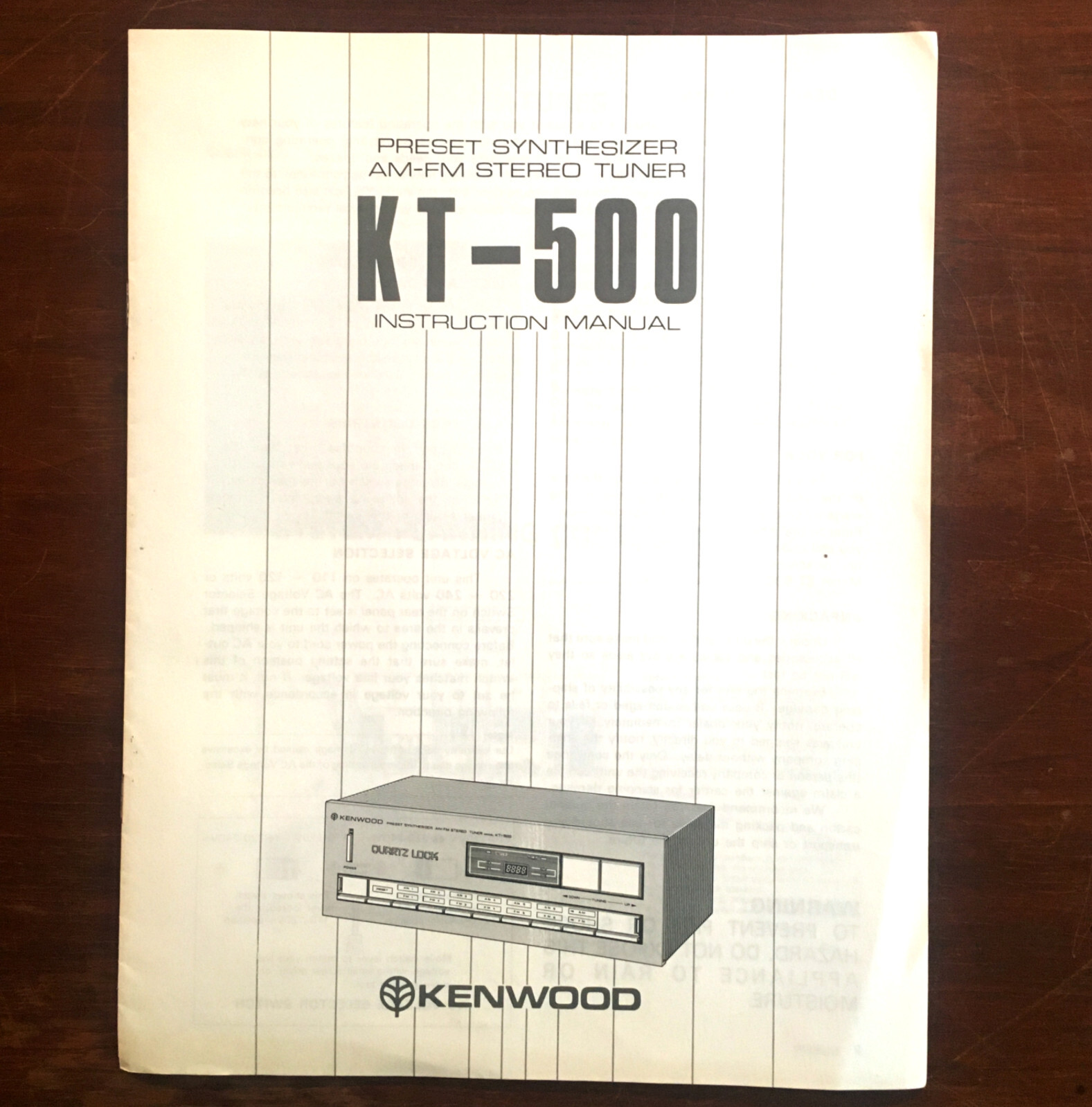
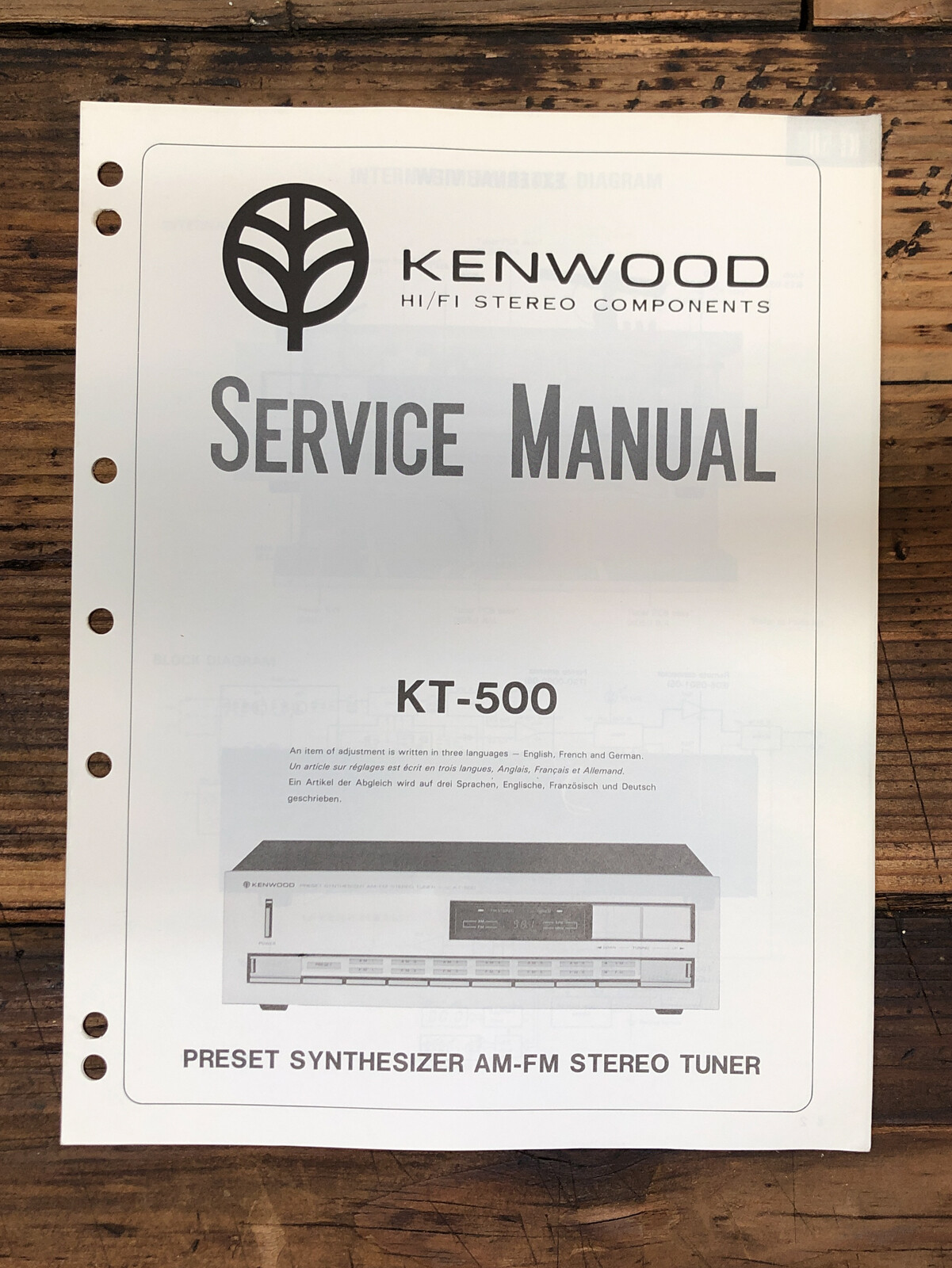
As an eBay Partner, we earn from qualifying purchases. This helps support our independent vintage technology research.
Related Models
- Kenwood kl-888s (Late 1970s (approximately 1978-1980))
- Kenwood kd-1500 (1972-1975)
- Kenwood ls-500 (Late 1970s (approximately 1978-1980))
- Kenwood kd-5070 (1979-1981)
- Kenwood kd-5077 (1978-1980)
- Sony ps-5550 (1978-1980)
- Sony ps-lx5r (1983-1985)
- Sony ss-7220a (1970s)
- Sony ss-97 (Late 1970s (approximately 1977-1979))
- Sony ss-999 (Late 1970s (approximately 1977-1979))