Kenwood KT-2030L (1991–1993)
It doesn’t scream for attention, but this unassuming tuner delivers rock-solid tuning and a surprisingly musical listen—when you can find one that still clicks.
Overview
Kenwood didn’t make a spectacle of the KT-2030L when it arrived between 1991 and 1993, and honestly, it still doesn’t demand the spotlight. This is a quartz synthesizer AM/FM stereo tuner built for reliability, not drama. It’s the kind of component you’d find tucked neatly into a modest living room stack, quietly pulling in stations while the rest of the system did the heavy lifting. But don’t mistake its modesty for mediocrity—this thing tunes with surgical precision thanks to its Quartz PLL synthesizer system, a step up from analog dials and a sign of the digital shift happening in mid-tier tuners at the time.
It covers the basics: FM, medium wave (MW), and long wave (LW), which already gives it a broader reach than many of its FM-focused peers. With 30 presets, you could stock it full of local stations, nostalgic shortwave oddities, or late-night European broadcasts if you were into that sort of thing. The front panel probably doesn’t wow anyone today—no flashy VU meters or sweeping displays—but it was clean, functional, and built to be used. One listing even called it “pleasant sounding,” which, while not exactly a rave, is meaningful when you consider how many tuners from this era either sound thin or collapse into mush on weaker signals.
What’s interesting is how little we actually know about its guts. No frequency response, no signal-to-noise ratio, no distortion specs—just silence where the engineering details should be. We do know it weighs 2.6kg (about 5.72lbs), so it’s not a featherweight, but not exactly built like a tank either. It’s compact at 440mm wide, just under 8cm tall, and around 26.5cm deep, making it easy to fit into tight racks. There’s a switched AC outlet for turning a connected device on and off with the tuner, plus a timer or sleep function—small conveniences, but ones people actually used.
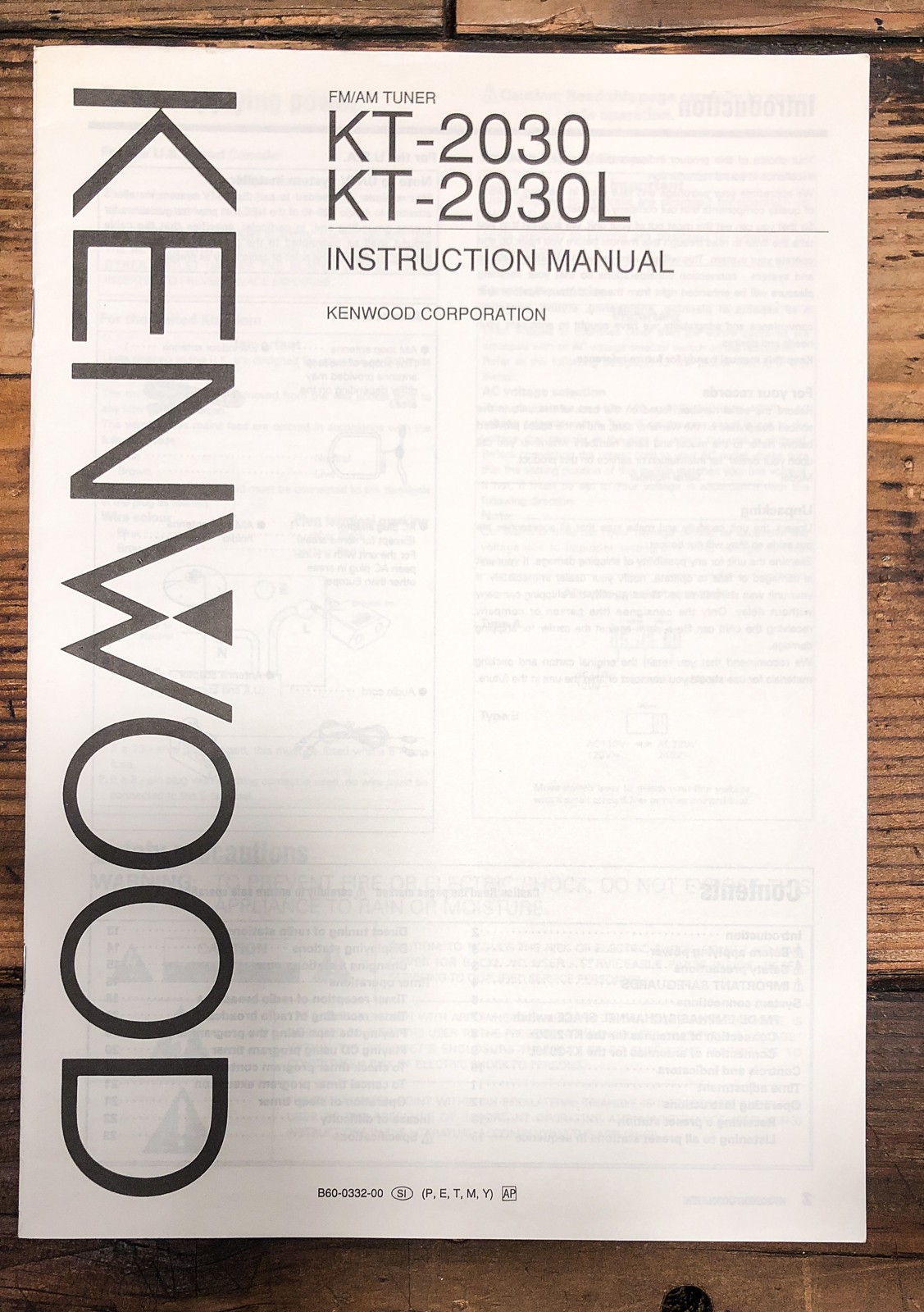
And used it they did. You can still find owner’s manuals floating around online, with people downloading them not just for repairs, but because the programming isn’t entirely intuitive. One user admitted they couldn’t figure out the preset options without the manual—classic early digital interface design, where the logic made sense to the engineer but not necessarily to the person holding the remote.
Specifications
| Manufacturer | Kenwood |
| Model | KT-2030L |
| Type | Quartz Synthesizer AM/FM Stereo Tuner |
| Production Years | 1991–1993 |
| Dimensions | 440 x 79 x 264mm (Width x Height x Depth) |
| Weight | 2.6kg / 5.72lbs |
| Tuning Bands | FM/MW/LW |
| Presets | 30 |
| Features | Timer/sleep, AC outlet (switched) |
| Tuning System | Quartz PLL synthesizer |
Collectibility & Value
The Kenwood KT-2030L isn’t exactly turning heads at flea markets or commanding big money online—but that’s part of its charm. If you're looking to complete a Kenwood stack from the early '90s or just want a tuner that actually works without breaking the bank, this is a solid contender. Recent listings show it trading between €12 and €45, with most settled prices hovering in the €25–€35 range. There’s a CZK 600 listing (about €24), a HUF 6,000 offer (roughly €16), and one eBay listing asking EUR 39.90 (~$41) for a used unit. That’s pocket change for vintage gear, even if it's not particularly rare.
One seller listed a whole lot—KT-2030L, DP-4030, and KA-4020—for €155 back in 2024, suggesting the tuner alone wasn’t expected to carry much value on its own. Still, parts aren’t impossible to find. A spare control cable (E30-1392-05 synchronization cable with mini-pl) popped up for £33.96, which is steep for a cable, but not unheard of for obscure Kenwood interconnects. Service manuals are available for purchase (€12) or free download from several archive sites, which helps when troubleshooting. Owners report seeking out the manual not just for repairs, but to actually understand how to program the presets—a small frustration, but one that speaks to the era’s love of hidden menu systems.
There’s no data on common failures, but the fact that people are actively downloading service manuals suggests it’s not entirely bulletproof. No surprise there—quartz synthesizer tuners from this period can suffer from aging capacitors, dried-out potentiometers, or failing display segments. But with documentation available and a simple signal path, it’s not a lost cause. Just don’t expect audiophile miracles. It’s not a Marantz or a Revox-tier tuner, but for what it is—a modest, functional, digitally-tuned receiver from the early '90s—it holds up. And if a listing says it sounds “pleasant,” that might be the highest praise this little Kenwood ever gets.
eBay Listings


As an eBay Partner, we earn from qualifying purchases. This helps support our independent vintage technology research.
Related Models
- Kenwood kl-888s (Late 1970s (approximately 1978-1980))
- Kenwood kd-1500 (1972-1975)
- Kenwood ls-500 (Late 1970s (approximately 1978-1980))
- Kenwood kd-5070 (1979-1981)
- Kenwood kd-5077 (1978-1980)
- Sony ps-5550 (1978-1980)
- Sony ps-lx5r (1983-1985)
- Sony ss-7220a (1970s)
- Sony ss-97 (Late 1970s (approximately 1977-1979))
- Sony ss-999 (Late 1970s (approximately 1977-1979))