Kenwood KL-777 (1972–1975)
A 102 dB sensitivity monster from 1972 that demands power and rewards with raw, unfiltered presence
Overview
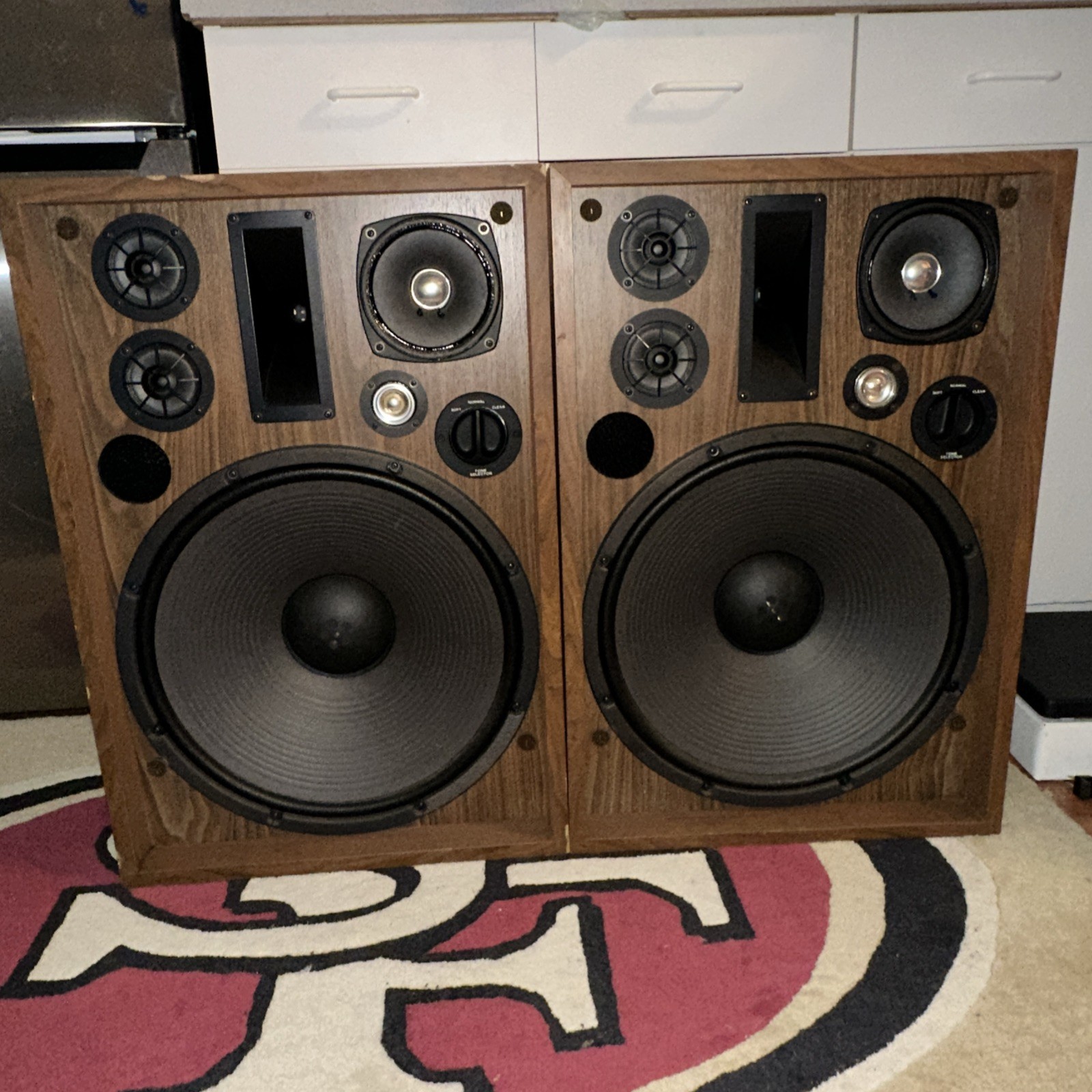
At 22.5 kilograms, the Kenwood KL-777 doesn’t just sit in a room—it stakes a claim. Introduced in 1972 as part of Kenwood’s high-end speaker push (marketed under the Trio name in some regions), this 4-way system was engineered to dominate. Priced at approximately 1,000 Deutsche Mark at launch, it targeted serious audiophiles who valued output and presence over polite refinement. With a sensitivity rating of 102 dB, the KL-777 is one of the loudest passive speakers ever mass-produced, capable of explosive volume with minimal amplifier strain—provided the amp can actually keep up. Owners report that while the speaker responds to modest power, its true character only ignites under serious drive; one user noted that even a 100W RMS amplifier left the bass thin, but switching to a 220W RMS Kenwood C2/M2A setup transformed the sound into something “serious” and full-range, even at punishing levels.
The KL-777’s design philosophy leans toward brute-force transparency. Its closed (acoustic suspension) cabinet keeps bass tight and immediate, avoiding the lag of ported designs, while the four-way crossover divides labor across six drivers: a 15" (38cm) woofer, dual 5" (13cm) midrange units, two horn-loaded tweeters, and a Mylar-film super tweeter for air above 10 kHz. That crossover—reportedly using a 12 dB/octave slope with ferrite-core inductors—routes signals with surgical intent, though it demands clean input. The system’s 8 Ω impedance makes it amplifier-friendly on paper, but its appetite for current, especially at low frequencies, means underpowered receivers quickly buckle. Pairings with contemporaneous Kenwood electronics like the KR-9060 receiver are praised in user reports for synergy, with one enthusiast claiming a setup using four KL-777s “could have blown the roof off her little duplex.”
Despite its size, the cabinet was described at the time as “comparatively compact and slim,” a relative boast in the era of floor-sweeping speaker stacks. The front grille’s “bow line” design adds a subtle visual rhythm, but this is no showpiece—it’s a workhorse in a modest suit. The one-touch speaker terminals were a convenience for the era, though they’ve proven less durable than binding posts over time, according to repair technicians. A built-in 3-step tone selector offers “Soft,” “Clear,” and “Normal” voicing options, letting users tweak the response to room or taste without touching the amplifier. But make no mistake: the KL-777’s character is bold, forward, and unapologetically physical.
Specifications
| Manufacturer | Kenwood (also referred to as Trio) |
| Product type | 4-Way Loudspeaker System / Speaker |
| Production years | 1972 to 1975 |
| System | 4-way, 6-speaker system |
| Enclosure type | Acoustic suspension type / closed |
| Drivers | 1x 15" (38cm) woofer, 2x 5" (13cm) mid-range, 2x horn tweeters, 1x super tweeter |
| Maximum Input Power | 100 W |
| Sensitivity | 102 dB |
| Frequency Response | 25 - 22,000 Hz |
| Crossover Frequency | 800; 5,000; 10,000 Hz |
| Crossover Network | 12 dB/oct |
| Impedance | 8 Ω |
| Dimensions (W x H x D) | 16-1/4" x 25" x 11" (41.8 x 62.5 x 27.5 cm) |
| Weight | 49.4 lbs (22.4 kg / 22.5 kg) |
| Special Features | Built-in 3-step tone selector |
Key Features
15" (38cm) Free-Edge Woofer with Long-Throw Suspension
The KL-777’s bass driver is a standout—marketed as a “newly developed powerful 15", free-edge type” with long-throw capability. This design prioritizes deep excursion over speed, allowing it to move serious air down to 25 Hz. Unlike ported systems that rely on resonance, the acoustic suspension cabinet demands mechanical authority, which this woofer delivers. The free-edge surround reduces non-linearities at extreme excursions, though aging units may suffer from dried rubber. Replacement parts, such as the TRIO T11-0043-05 woofer, are occasionally available for around $75, a testament to lingering support.
Dual 5" Corn-Type Mid-Range Drivers
Handling the critical vocal and instrumental midband, two 5" corn-type cones split the load. This dual-driver approach increases cone area without the coloration risks of a single large midbass unit. The “corn-type” designation refers to the cone’s textured surface, which may help break up standing waves. Positioned symmetrically around the tweeter array, they contribute to a wide, stable imaging field—though their output is ultimately governed by the crossover’s 800 Hz and 5,000 Hz transition points.
Parallel Horn Tweeters for Directivity Control
Instead of a single high-frequency horn, the KL-777 uses two horn tweeters mounted side by side. This parallel arrangement was intended to improve directivity and dispersion, reducing the “beaming” effect common in single-horn designs. The result is a more consistent high-frequency response across a wider listening area. However, this setup can become fatiguing at high volumes if the source material is already bright.
Mylar-Film Super Tweeter for Extended Air
Topping the range is a dedicated super tweeter using a Mylar film diaphragm, tasked with reproducing frequencies above 10,000 Hz. This driver adds a sense of “air” and harmonic extension that the horn tweeters alone might not achieve. While effective, Mylar films can degrade over decades, especially in humid environments, leading to a loss of high-end sparkle or, in worst cases, failure.
Full-Scale 12 dB/oct Crossover with Ferrite Core
The crossover is described as a “full scale network of 12 dB/oct with the ferrite core,” indicating the use of high-quality inductors to manage power and reduce distortion. The three crossover points—800 Hz, 5,000 Hz, and 10,000 Hz—ensure each driver operates within its optimal band. While 12 dB/oct slopes are less aggressive than 24 dB/oct designs, they place higher demands on driver linearity, suggesting Kenwood selected units with strong out-of-band rejection.
3-Step Tone Selector: Soft, Clear, Normal
A rare onboard feature for a speaker of this class, the 3-step tone selector allows real-time voicing changes. “Soft” likely rolls off the highs and possibly the bass peak, “Clear” may boost upper mids or treble, and “Normal” is the flat reference. This flexibility lets owners adapt the speaker to room acoustics or program material without external EQ—a practical touch in an era before digital room correction.
Collectibility & Value
The Kenwood KL-777 occupies a niche but passionate corner of the vintage audio market. One owner reported purchasing a pair of KL-777A variants for $150, though current listings suggest higher valuations—$800 has been seen as an asking price for a KL-777D pair, and a lot of eight KL-777 speakers once sold for $499.99. Condition is critical: original grilles, undamaged drivers, and functional tone selectors significantly affect value. The availability of replacement woofers indicates parts support exists, but full restoration may require crossover component recalibration. These speakers are not for the faint of amplifier—prospective buyers must pair them with high-current power to avoid underwhelming performance.
eBay Listings



As an eBay Partner, we earn from qualifying purchases. This helps support our independent vintage technology research.
Related Models
- Kenwood kl-888s (Late 1970s (approximately 1978-1980))
- Kenwood kd-1500 (1972-1975)
- Kenwood ls-500 (Late 1970s (approximately 1978-1980))
- Kenwood kd-5070 (1979-1981)
- Kenwood kd-5077 (1978-1980)
- Sony ps-5550 (1978-1980)
- Sony ps-lx5r (1983-1985)
- Sony ss-7220a (1970s)
- Sony ss-97 (Late 1970s (approximately 1977-1979))
- Sony ss-999 (Late 1970s (approximately 1977-1979))