Kenwood KD-5000 (1978–1981)
The turntable that made “set it and forget it” feel like high fidelity.
Overview
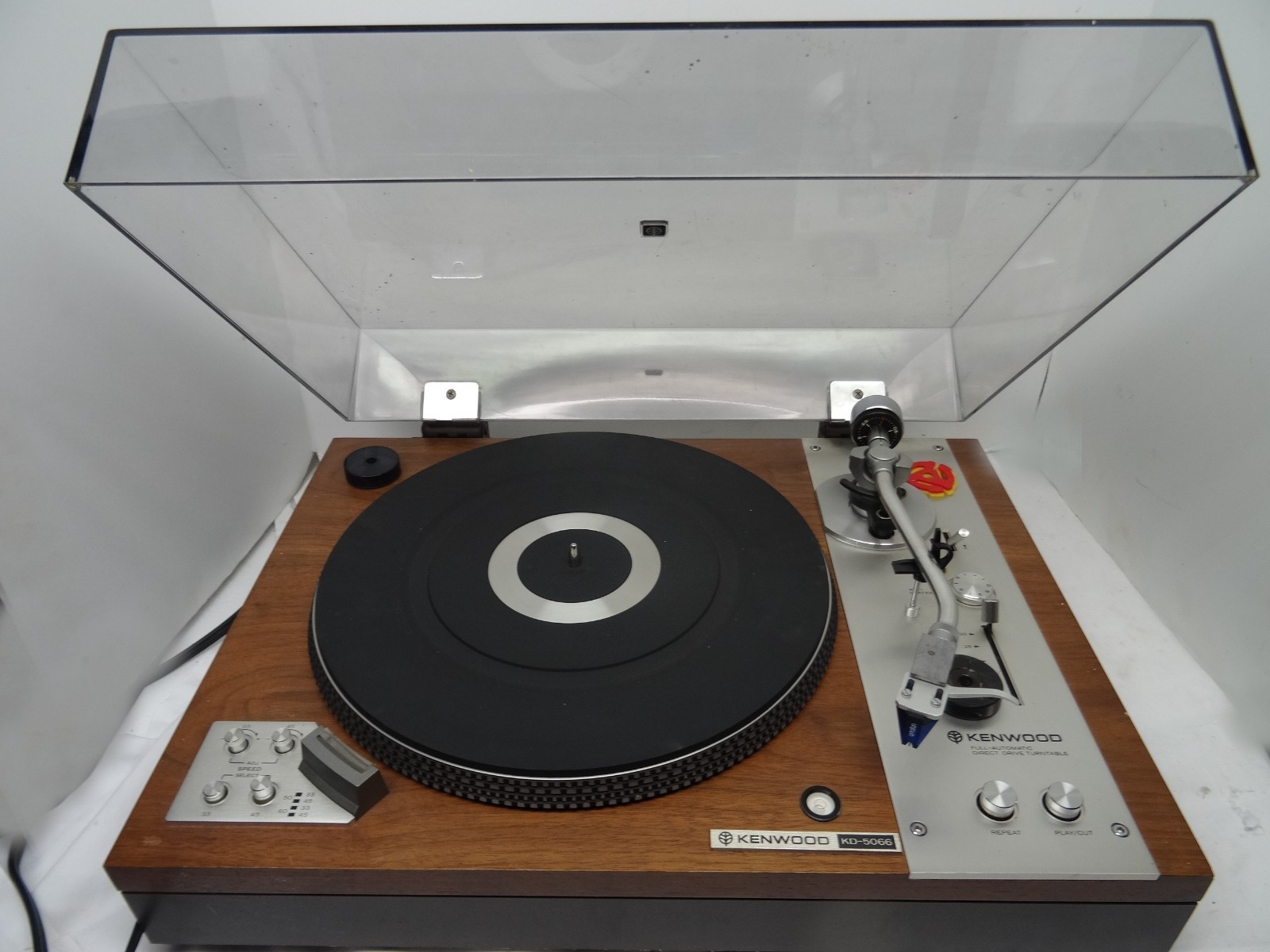
You can still hear the quiet disbelief in audiophile circles when someone fires up a Kenwood KD-5000 and it just… works. No wobble, no motor hum, no hunting for the right cueing weight—just a tonearm that glides down like it’s been doing this for decades (which, honestly, it has). That’s the magic of this machine: it was built during the golden flush of Japanese direct-drive engineering, when companies weren’t just copying Western designs but rethinking them from the ground up. The KD-5000 wasn’t the flashiest table in the lineup, nor the most expensive, but it hit a rare sweet spot—fully automatic, quartz-locked speed stability, and a precision gimbal tonearm—all in a package that didn’t require a degree in electronics to operate.
Kenwood didn’t chase the exotic with this one. No suspended subchassis, no hand-oiled bearings, no audiophile-grade plinth upgrades. Instead, they focused on consistency, durability, and user experience. This was a table designed for people who wanted to play records, not tune turntables. And yet, by accident or design, it ended up delivering a sound that’s still respected today—clean, neutral, and remarkably free of coloration. The plinth is MDF with a wood veneer finish, solid but not massive, and the whole unit sits on simple rubber feet that do just enough to isolate it from desk vibrations. It’s not going to win a beauty contest against a Linn or a Thorens, but it doesn’t need to. It’s a working tool, and it looks like one.
What really sets the KD-5000 apart from many of its contemporaries is the tonearm. A straight, rigid aluminum tube with a true gimbal bearing—low friction, high stability, and excellent tracking. Owners report that it handles cartridges up to 3.5 grams with ease, and its geometry is well-calculated, so even modest setups track with authority. It’s the kind of arm that makes you realize not every great tonearm needs to be exotic or adjustable down to the micron. And paired with the quartz-controlled direct drive system, which locks speed to within ±0.03%, you get a playback experience that’s as close to “perfect rotation” as most listeners will ever need.
It wasn’t alone in its class—Technics had already proven the viability of mass-market direct drive—but Kenwood brought its own philosophy to the table. Where Technics leaned toward clinical precision, the KD-5000 had a slightly warmer, more forgiving character, especially through the midrange. It didn’t expose every flaw in a worn pressing, but it didn’t hide them either. It just played the music, without fuss.
Specifications
| Manufacturer | Kenwood |
| Production Years | 1978–1981 |
| Original Price | $495 (USD, 1979) |
| Turntable Type | Direct drive, fully automatic |
| Drive System | Quartz-locked DC servo motor |
| Speeds | 33⅓, 45 RPM |
| Speed Accuracy | ±0.03% |
| Wow and Flutter | 0.025% (weighted) |
| Tonearm Type | Straight aluminum gimbal bearing |
| Effective Length | 230 mm |
| Overhang | 18 mm |
| Tracking Force Range | 0–3.5 grams |
| Cartridge Load Impedance | 47 kΩ |
| Signal-to-Noise Ratio | 78 dB |
| Frequency Response | 20 Hz – 20 kHz ±1.5 dB |
| Platter Diameter | 300 mm |
| Platter Material | Die-cast aluminum |
| Dimensions (W×H×D) | 450 × 145 × 360 mm |
| Weight | 9.8 kg |
| Power Supply | 120V AC / 60Hz (110–120V selectable) |
Key Features
Quartz-Locked Speed Control
While many manufacturers were still using mechanical governors or basic servo systems, Kenwood integrated a quartz reference oscillator into the KD-5000’s motor control circuit. This wasn’t just a gimmick—it meant the platter speed was locked to a crystal’s oscillation frequency, making it immune to line voltage fluctuations and belt stretch (not that it had a belt). The result? One of the most stable rotational platforms in its price range. DJs and broadcast engineers loved this kind of stability, but so did home listeners who hated the drift and pitch wobble of cheaper belt drives. It also meant the table could auto-adjust during startup, bringing the platter up to exact speed in under five seconds, every time.
Fully Automatic Operation
From a single button press, the KD-5000 would lower the arm, cue the record, play, then lift and return the arm at the end of the side. No need to hover over the tonearm or time your lift. This wasn’t just convenience—it was a design philosophy. Kenwood assumed you wanted to listen, not babysit. The mechanism was robust, using a series of cams and solenoids, and while it could wear over decades, it was engineered with serviceability in mind. Unlike some fully automatic decks that sacrificed rigidity for automation, the KD-5000 kept the plinth solid and the arm mounted securely. The automation didn’t degrade performance—it just made it accessible.
Precision Gimbal Tonearm
This is where the KD-5000 quietly outclassed many of its rivals. The tonearm used a true dual-pivot gimbal bearing, not the unipivot or low-mass designs that were trendy at the time. It had higher moving mass, yes, but also lower friction and better resistance to resonance. The azimuth was fixed, and VTA adjustment was limited, but for a factory-mounted arm, it was remarkably well-executed. Service technicians observe that the bearings rarely seize if kept clean, and the counterweight assembly allows fine tracking force adjustment. It’s the kind of arm that works perfectly with moving magnet cartridges like the Shure M97xE or Audio-Technica AT-120E, and many owners report tracking records with groove wear that would cause lighter arms to skip.
Historical Context
The late 1970s were a turning point for turntable design. The idler-wheel era was fading, belt drives were maturing, and direct drive—once considered a gimmick—was proving its worth. Technics had already released the SP-10 and the SL-1200, but those were semi-pro or DJ-focused. Kenwood saw an opening: bring that same engineering rigor to the high-end consumer market without the pro price tag. The KD-5000 was part of a wave of Japanese decks—Pioneer, Sansui, Sony—that treated the turntable as a precision instrument, not a piece of furniture.
At the time, Western audiophiles were still skeptical. Many dismissed fully automatic tables as “toylike,” assuming complexity meant fragility. But Kenwood, along with Technics and Denon, proved that automation and high fidelity weren’t mutually exclusive. The KD-5000 competed directly with the Technics SL-2300 and the Pioneer PL-750, both excellent decks, but it offered a more refined arm and better speed stability than either. It wasn’t trying to be a statement piece—it was trying to be the last turntable you’d ever need to buy.
The market was shifting, too. By 1980, cassette decks and early CD players were on the horizon, and high-end audio companies were hedging their bets. Kenwood itself would soon pivot toward AV receivers and car audio. But for a brief window, they poured real engineering into their turntables, and the KD-5000 was one of the last and best expressions of that commitment.
Collectibility & Value
The KD-5000 doesn’t get the attention it deserves. You won’t see it on “Top 10 Vintage Turntables” lists, and it rarely sells for thousands. But that’s part of its charm—it’s still a functional, affordable entry into high-quality analog playback. In excellent, fully serviced condition, it trades between $350 and $550. Unrestored units with operational issues go for $150 to $250, often snapped up by tinkerers who know the parts are still findable.
The most common failure points are the rubber idler tires in the auto-lift mechanism and dried grease in the cueing assembly. These aren’t fatal—rebuild kits exist, and the teardown is straightforward for anyone with basic tools. More serious issues involve the motor control board, where aging electrolytic capacitors can cause speed instability or failure to start. A full recap of the power supply and servo board runs $100–$150 at a specialty shop, but it’s often worth it given the table’s performance ceiling.
What to check before buying? First, listen for motor noise—a healthy KD-5000 is nearly silent. Second, watch the arm during auto-return: it should move smoothly, not jerk or stall. Third, verify the quartz lock by using a strobe disc; any visible drift means the oscillator or servo circuit needs attention. And finally, inspect the tonearm bearings: gently nudge the headshell side-to-side and up-and-down. There should be no play or gritty resistance.
It’s not a rare table, but good ones are becoming harder to find. Many were used hard in the 1980s, then discarded or stored poorly. But the ones that survived are tough. Collectors note that original KD-5000s with unmodified arms and clean plinths are the most desirable—aftermarket upgrades rarely improve performance and often diminish the table’s character.
eBay Listings


As an eBay Partner, we earn from qualifying purchases. This helps support our independent vintage technology research.
Related Models
- Kenwood kl-888s (Late 1970s (approximately 1978-1980))
- Kenwood kd-1500 (1972-1975)
- Kenwood ls-500 (Late 1970s (approximately 1978-1980))
- Kenwood kd-5070 (1979-1981)
- Kenwood kd-5077 (1978-1980)
- Sony ps-5550 (1978-1980)
- Sony ps-lx5r (1983-1985)
- Sony ss-7220a (1970s)
- Sony ss-97 (Late 1970s (approximately 1977-1979))
- Sony ss-999 (Late 1970s (approximately 1977-1979))