Kenwood KD-4100R (1979–1981)
Heavy, precise, and packed with automation—this is a turntable that wants to do everything for you, even if it sometimes forgets how.
Overview
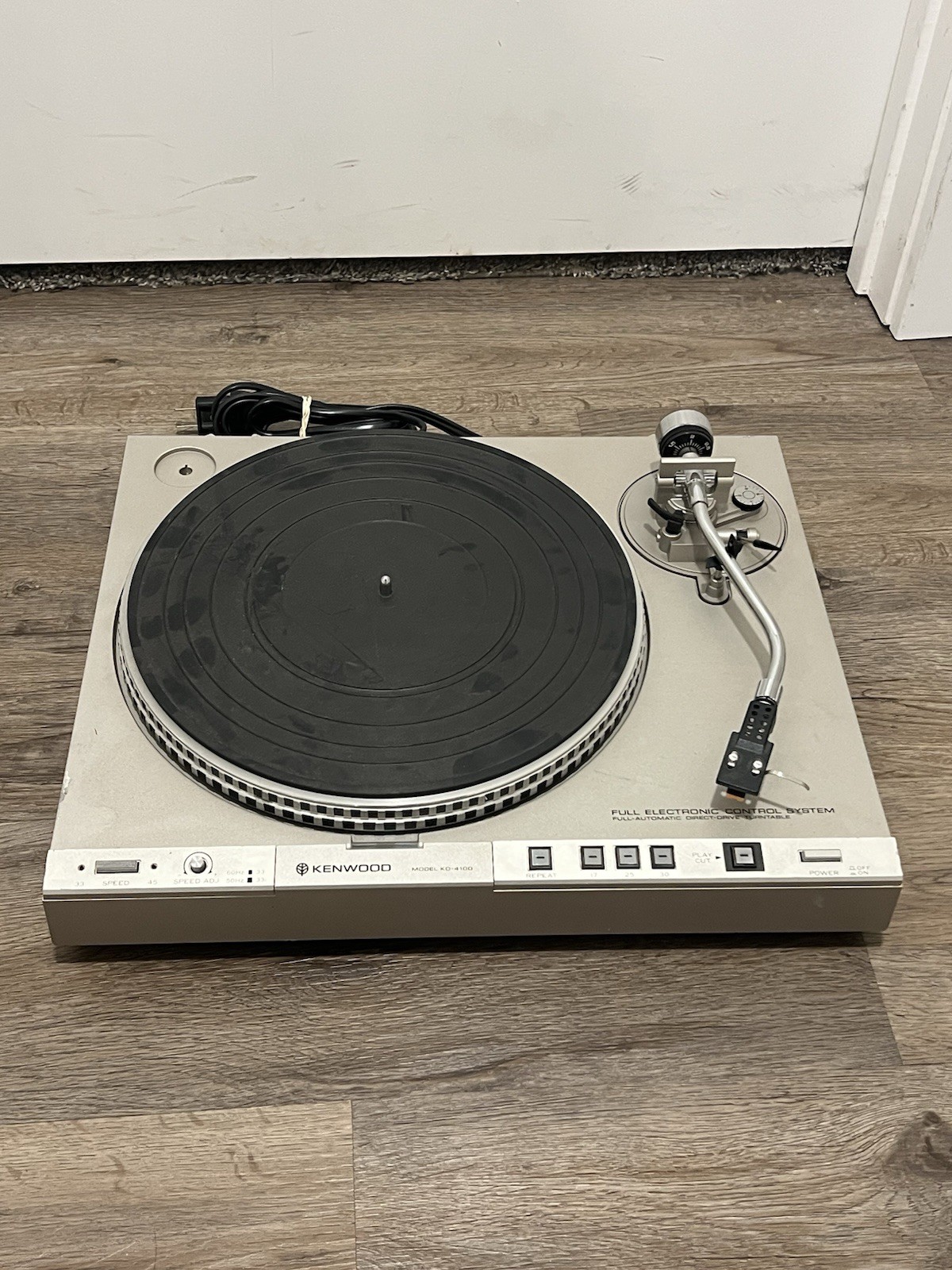
The Kenwood KD-4100R isn’t subtle. At nearly 8kg, with a 310mm die-cast platter that feels like it could anchor a small boat, it announces itself as serious hardware. Built between 1979 and 1981, this fully-automatic direct-drive turntable sits in that sweet spot where Japanese engineering met the golden age of vinyl automation. It’s not a minimalist’s dream, nor is it a stripped-down purist’s tool—this thing is wired for convenience, complete with self-lifting tonearm, auto-start, auto-stop, and even a size selector button (though more on that later).
Kenwood, sometimes seen under the Trio name in certain markets, didn’t mess around with flimsy parts here. The coreless and slotless DC servo motor promises rock-solid speed stability, and the specs back it up: a wow and flutter rating of just 0.03% wrms is exceptional, even by modern standards. That kind of precision wasn’t cheap back then, and while we don’t have the original MSRP, today’s market suggests it’s still not considered disposable.
Owners tend to fall into two camps: those who inherited one from a dusty shelf and were surprised by how well it spins, and those who sought it out deliberately, drawn by the allure of a heavy, well-damped plinth and a reputation for durability. One user called it a “great table,” while another, more cautiously optimistic, noted they hadn’t tried it but expected it to “be a good performer.” That’s about right—this isn’t a legendary name like Technics SL-1200, but it’s not a budget afterthought either. It’s the kind of machine that, when working right, delivers smooth, consistent playback with a confidence that says, “I’ve got this.”
But—and there’s always a but—automation comes at a cost. When it works, the KD-4100R feels like a marvel of late-’70s convenience. When it doesn’t, you’re left wrestling with a turntable that won’t start, won’t stop, or won’t let go of the record. Some report that issues with the automatic functions can render the unit unusable even in manual mode, which is a serious flaw in a machine meant to be reliable. The “17” size selector button, meant to adjust for different record sizes, has been known not to lock when pressed, leaving the automation confused. And the auto-return function? It can fail, often due to a worn tonearm belt—but that’s fixable, at least.
Still, there’s a reason people are still talking about it. At 71dB of rumble suppression, it keeps motor noise well out of the groove, and the S-shaped tubular tonearm, while not exotic, is a familiar design that many find easy to set up. It’s not a high-mass arm, and it’s statically balanced, which means it won’t fight you on tracking force. If you’re pairing it with a standard MM cartridge—say, a replacement BC3600, which was listed at $47 in 2020—it should track most records without drama.
This is a turntable that wants to be your daily driver, not your museum piece. And with proper care, owners believe it can deliver “many years of good useful life.” But that care matters. The automation system, while clever, is a known point of failure. There’s no denying that the KD-4100R is a product of its time—packed with features, built solidly, but not immune to the quirks that come with age and complexity.
Specifications
| Manufacturer | Kenwood |
| Drive system | direct drive |
| Platter | 310mm, 1.15kg aluminium alloy die-cast |
| Speeds | 33 and 45rpm |
| Wow and flutter | 0.03% wrms |
| Rumble | 71dB |
| Tonearm | static balance type, s-shaped tubular tonearm |
| Effective length | 225mm |
| Overhang | 15mm |
| Dimensions | 440 x 140 x 375mm |
| Weight | 7.9kg |
| Motors | coreless and slotless DC servo motor, 2-pole, 3-slot DC micro motor for auto functions |
Key Features
Direct Drive with Precision Motor
The KD-4100R uses a coreless and slotless DC servo motor for the platter, a design that eliminates cogging and delivers smooth, consistent rotation. This isn’t just marketing fluff—0.03% wow and flutter is a real number, and it means your records spin with the kind of stability that makes pitch drift all but disappear. Paired with a hefty 1.15kg die-cast aluminium platter, the system has serious inertia, which helps reject external vibrations and keeps resonance in check. It’s not a suspended subchassis design, so isolation depends more on the feet and plinth damping, but the mass helps.
Full Automation—For Better or Worse
Kenwood didn’t skimp on convenience. The KD-4100R is fully automatic: press play, and it lowers the arm, starts spinning, tracks the record, and lifts and returns the arm when it’s done. All of this is handled by a separate 2-pole, 3-slot DC micro motor dedicated to the auto functions. In theory, it’s perfect for casual listening, parties, or anyone who doesn’t want to fiddle with manual operation. In practice, it’s also the most common point of failure. When the automation glitches—like the size selector button failing to lock or the auto-return not triggering—the whole system can lock up. Some users report that these issues can even prevent manual operation, which is a serious design flaw. But there’s hope: replacing the tonearm belt often fixes auto-return problems, and a service supplement available on Vinyl Engine has helped others diagnose button sequence issues.
Sturdy S-Shaped Tonearm
The static-balance, S-shaped tubular tonearm is a no-frills but functional design. At 225mm effective length with 15mm of overhang, it’s a standard geometry that works well with a wide range of cartridges. It’s not gimbaled with dual bearings, nor does it offer adjustable azimuth or VTF dials—it’s simpler than that. But for a turntable in this class, that’s expected. What matters is that it’s rigid, reasonably low-mass, and tracks without excessive skating. Paired with a decent MM cartridge, it should handle most records without complaint. Just don’t expect the kind of micro-detail retrieval you’d get from a high-end arm—this is about reliable, consistent performance.
Collectibility & Value
The Kenwood KD-4100R trades in a narrow but active band. As of recent listings, it’s been priced at $300 USD (sold out at The Turntable Store), $190 USD on eBay (July 2024), and even as high as PLN 2,000 (~$500 USD) on HifiShark in early 2026—showing that condition and location dramatically affect value. It’s not a blue-chip collector’s item like a Linn or a classic Technics, but it’s not a garage-sale throwaway either. Buyers seem to fall into two categories: those looking for a solid, heavy turntable with full auto features, and those who need a parts donor for a sibling model.
The main red flags for buyers are automation failures. Speed control instability has been reported, and the auto functions—especially the size selector and auto-return—can degrade over time. A worn tonearm belt is a common fix for return issues, but deeper problems in the control circuitry may require more effort. There’s no widespread report of capacitor plague or specific IC failures, but given the age, it’s safe to assume electrolytics may need replacing in units that have been sitting. The Vinyl Engine service supplement has proven “very useful” for diagnosing button-related automation faults, so it’s worth tracking down before diving into repairs.
If you’re buying one today, inspect the automation cycle carefully. Make sure the arm lifts and returns reliably, that the size selector locks in place, and that speed is stable. A unit that works smoothly is a gem; one that’s half-broken is a project. And while the BC3600 replacement cartridge is still available (priced at $47 as of 2020), don’t assume the original cartridge is worth keeping—many will have worn styli or degraded rubber.
eBay Listings



As an eBay Partner, we earn from qualifying purchases. This helps support our independent vintage technology research.
Related Models
- Kenwood kl-888s (Late 1970s (approximately 1978-1980))
- Kenwood kd-1500 (1972-1975)
- Kenwood ls-500 (Late 1970s (approximately 1978-1980))
- Kenwood kd-5070 (1979-1981)
- Kenwood kd-5077 (1978-1980)
- Sony ps-5550 (1978-1980)
- Sony ps-lx5r (1983-1985)
- Sony ss-7220a (1970s)
- Sony ss-97 (Late 1970s (approximately 1977-1979))
- Sony ss-999 (Late 1970s (approximately 1977-1979))