Kenwood KD-2100 (1980–1982)
That first deep thump of the platter spinning up—solid, unhurried, like a machine that knows it doesn’t need to prove anything—tells you this isn’t some flimsy auto-return relic.
Overview
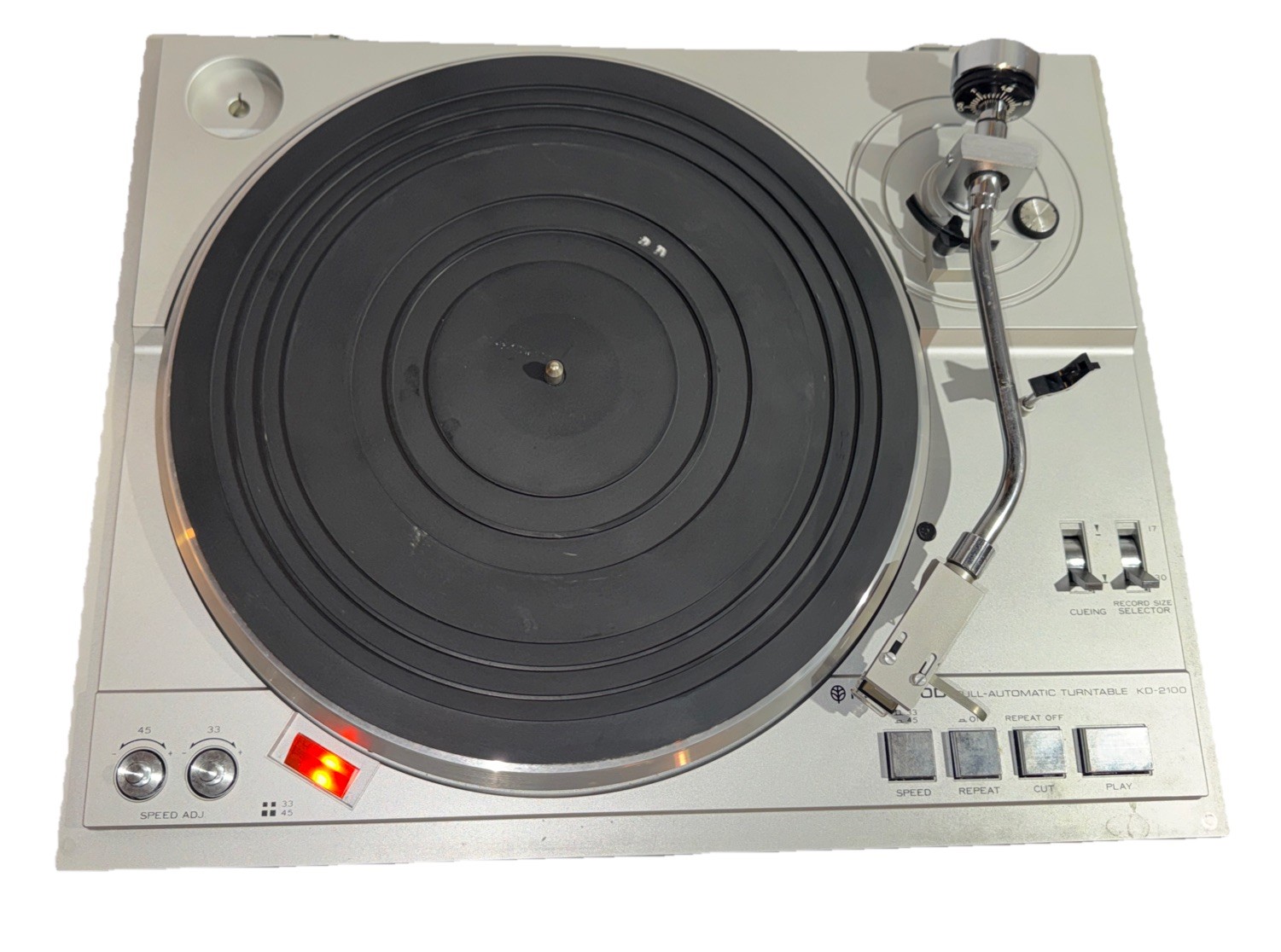
The Kenwood KD-2100 doesn’t announce itself with flash or fuss. It arrives quietly on a slab of die-cast aluminum, its platter a 310mm disc of dense, vibration-damping metal that spins with a gravitas most belt-drive decks half its age can’t match. When you drop the needle, there’s no wobble, no audible motor intrusion—just the record coming to life with a clarity that feels more deliberate than showy. This is the kind of turntable that was built to disappear into a living room console, to be used daily without fuss, yet it carries engineering choices that still impress decades later. It’s not a showpiece for audiophiles chasing exotic materials or exposed tonearms, but beneath its reserved silver chassis lies a fully automatic belt-drive system with a DC servo motor that manages to balance convenience and performance in a way few of its era could.
Kenwood didn’t try to reinvent the wheel here—they refined it. The KD-2100 sits just below the more celebrated KD-5000 series in the lineup, but it wasn’t a budget model by any stretch. It was the sweet spot for buyers who wanted full auto operation (cue, play, return) without sacrificing too much in rigidity or speed stability. The die-cast platter, while not as massive as some high-end contemporaries, is notably heavier than the plastic or stamped metal found on entry-level decks from Sony or Pioneer. Paired with a well-damped subchassis and a precision idler pulley system, the belt drive isolates motor noise effectively, making the KD-2100 one of the quieter performers in its class. The tonearm, a straight aluminum tube with magnetic damping, isn’t fancy, but it tracks reliably and is forgiving of minor setup errors—important for a machine meant to be used by non-enthusiasts.
What’s striking today is how well the KD-2100 holds up sonically. It doesn’t have the ethereal detail of a high-mass direct drive like a late-model Technics, nor the warmth of a Thorens, but it delivers a balanced, neutral presentation that works across genres. Bass is tight and controlled, mids are clear without being forward, and highs are smooth without rolling off too early. It’s the kind of deck that won’t draw attention to itself—until you realize you’ve listened to three sides in a row without thinking about it. That’s the hallmark of good design: it gets out of the way.
Specifications
| Manufacturer | Kenwood, Trio-Kenwood Inc.; Komagane |
| Production Years | 1980–1982 |
| Model Type | Full-Automatic Turntable |
| Drive System | Belt Drive |
| Motor | DC Servo Motor |
| Turntable Platter | Die-cast aluminum, 310 mm diameter, 0.7 kg |
| Speeds | 33.3 rpm, 45 rpm |
| Speed Accuracy | ±0.3% (33.3 rpm), ±0.5% (45 rpm) |
| Wow and Flutter | 0.08% WRMS |
| Tonearm Type | Straight aluminum, magnetic damping |
| Tracking Force | 1.0–2.5 grams (adjustable) |
| Cartridge Type | Spherical (original: V-39 mk III) |
| Automatic Functions | Full auto (cue, play, return) |
| Power Supply | AC 120 / 220 / 240 V |
| Power Consumption | 30 watts |
| Dimensions (WHD) | 440 mm × 135 mm × 360 mm (17.3" × 5.3" × 14.2") |
| Weight | 5.5 kg (12 lb 1.8 oz) |
| Color | Silver |
| Manufactured In | Japan |
| Original Price | 300 DM (West Germany) |
Key Features
Die-Cast Aluminum Platter and Subchassis Isolation
Most full-auto turntables of the early '80s cut corners on platter mass to save cost and weight, often ending up with flimsy plastic or thin metal discs that amplified resonance. The KD-2100 bucks that trend with a genuine die-cast aluminum platter—310mm in diameter and weighing 700 grams—that provides meaningful inertia for stable rotation. More importantly, the entire turntable subassembly is suspended on rubber dampers within the chassis, decoupling it from external vibrations and cabinet resonance. This dual approach—mass plus isolation—was a hallmark of higher-end Japanese decks, and its inclusion here suggests Kenwood didn’t treat the KD-2100 as disposable furniture audio. The result is a deck that resists feedback from speakers placed nearby and maintains speed consistency even on less-than-ideal surfaces.
DC Servo Motor with Precision Belt Drive
The use of a DC servo motor—rather than a cheaper AC hysteresis type—gives the KD-2100 tighter speed regulation and faster startup response. The servo circuit monitors platter speed via a feedback loop, adjusting motor output in real time to maintain accuracy. Combined with a high-quality rubber belt and a precision-machined drive pulley, this system achieves a wow and flutter rating of just 0.08% WRMS, which is exceptional for a fully automatic belt-drive deck. It’s quieter than many contemporary models that cost significantly more, and it contributes to the KD-2100’s reputation for stable pitch and rhythmic coherence. The belt itself is accessible and replaceable without major disassembly, a thoughtful design touch that extends the deck’s usable life.
Full Automatic Operation with Magnetic Tonearm Damping
The KD-2100’s auto-cue and return mechanism is smooth and reliable, using a cam-driven system that lifts and positions the tonearm with consistent precision. Unlike some budget auto-return decks that slam the arm down or jerk it back, the KD-2100 operates with a deliberate, almost graceful motion. The tonearm uses magnetic damping to control its vertical movement, eliminating the need for messy silicone fluid that can leak or degrade over time. This not only improves long-term reliability but also ensures consistent tracking force delivery. The arm’s effective mass is moderate, making it compatible with a range of moving magnet cartridges beyond the stock V-39 mk III, though it performs best with lighter models in the 4–6 mV output range.
Historical Context
The early 1980s marked a turning point for home audio. The golden age of direct-drive turntables was in full swing, led by Technics’ SL-1200 and Pioneer’s PL series, but there remained a robust market for more affordable, user-friendly belt-drive decks—especially in Europe and Japan. Kenwood, already known for its high-quality receivers and tuners, positioned the KD-2100 as a premium full-auto model that bridged convenience and fidelity. It wasn’t competing directly with audiophile darlings like the Linn LP12 or the AR XA, but rather with mainstream offerings from Sony, Yamaha, and Dual. In that context, the KD-2100 stood out by borrowing design cues from higher-end models: the die-cast platter, subchassis suspension, and DC servo motor were features typically reserved for more expensive decks.
The KD-2100 also arrived at a time when automatic turntables were still seen as modern and desirable—not yet stigmatized as “lesser” by the audiophile community. Full auto functionality was a selling point, especially for casual listeners who didn’t want to fiddle with manual cueing. Kenwood didn’t try to appeal to tweak-happy hobbyists; instead, they focused on building a turntable that worked flawlessly day after day. That philosophy shows in the build quality and serviceability. Unlike some contemporaries that glued components in place or used proprietary fasteners, the KD-2100 was designed to be repaired. Service manuals were available, schematics were published, and parts like belts and cartridges were standardized. This practicality helped it endure in households where it was used heavily, not just displayed.
Collectibility & Value
Today, the Kenwood KD-2100 trades in a quiet but steady market. It’s not a trophy piece like a mint Technics SL-1500C, nor does it command cult status among modders, but it has earned a loyal following among collectors who value reliability and understated performance. Units in working condition typically sell between $120 and $200, with fully serviced examples—new belt, cleaned bearings, aligned cartridge—reaching $250. Unopened or NOS (new old stock) units are rare but occasionally surface on European auction sites, sometimes fetching over $300 due to their pristine condition and original packaging.
The most common failure points are predictable: dried belts, hardened damping gel in the subchassis, and worn idler tires (though the KD-2100 uses a belt, not an idler). The rubber belt is the first thing to check—original ones often harden or snap after decades of disuse. Replacement belts are widely available and inexpensive, and installation is straightforward. More concerning are the suspension grommets; if the deck has been stored improperly or exposed to heat, these can degrade, leading to a loss of isolation and increased vibration. Replacing them requires partial disassembly but is within reach of intermediate DIYers.
Another issue is the auto-return mechanism, which relies on a series of plastic cams and gears. While generally robust, these can wear or crack if the deck was frequently overloaded or used with warped records. Service technicians observe that most problems stem from neglect rather than design flaws—decks that were used regularly but never cleaned tend to accumulate dust in the tonearm rail, causing stuttering or incomplete returns. A thorough cleaning and lubrication of the transport mechanism can restore smooth operation.
For buyers, the key is to verify operation before purchase. Listen for motor noise during playback—any hum or rumble suggests bearing wear or power supply issues. Check that the auto-cue engages and returns without hesitation, and confirm that the platter spins freely without wobble. If the unit powers on but the platter doesn’t turn, the belt is likely the culprit. Also, inspect the cartridge: many KD-2100s still have the original V-39 mk III, which, while durable, is long past its usable life. A replacement with a modern elliptical stylus (like an Audio-Technica AT91 or Ortofon 2M Red) can dramatically improve performance.
Despite its age, the KD-2100 remains a viable entry-level analog player. It won’t match the resolution of a modern $500 turntable, but with a simple refurbishment, it delivers honest, fatigue-free sound that suits everything from jazz to rock. Its real value lies in its completeness: it’s a self-contained system that asks for nothing more than a receiver and speakers. For someone building a vintage setup without breaking the bank, it’s a smart, sensible choice—one that reflects a time when convenience and quality weren’t mutually exclusive.
eBay Listings



As an eBay Partner, we earn from qualifying purchases. This helps support our independent vintage technology research.
Related Models
- Kenwood kl-888s (Late 1970s (approximately 1978-1980))
- Kenwood kd-1500 (1972-1975)
- Kenwood ls-500 (Late 1970s (approximately 1978-1980))
- Kenwood kd-5070 (1979-1981)
- Kenwood kd-5077 (1978-1980)
- Sony ps-5550 (1978-1980)
- Sony ps-lx5r (1983-1985)
- Sony ss-7220a (1970s)
- Sony ss-97 (Late 1970s (approximately 1977-1979))
- Sony ss-999 (Late 1970s (approximately 1977-1979))