Kenwood KA-7100 (1977–1979)
Sixty watts a side, 0.02% distortion, and a pair of separate power supplies - Kenwood's "smaller sibling" to the KA-9100 that never quite got its credit.
Overview
Pick up a KA-7100 and the first thing you notice is the weight. It's 11.5kg of Japanese steel and copper in a chassis roughly 43cm wide, 14.9cm tall, and 38.4cm deep. That's not a bookshelf amp. By the late 1970s Kenwood had figured out how to build serious solid-state gear without charging Accuphase money for it.
The KA-7100 is a DC stereo integrated amplifier, built in Japan and sold from approximately 1977 to 1979. It sat below the KA-9100 in Kenwood's lineup. thevintageknob.org calls it the "smaller sibling to the KA-9100, less powerful but just as carefully built." List price was around $300, according to a period review at hifi-classic.net. That bought 60 watts per channel into 8 ohms, and the distortion figure was the headline: 0.02% total harmonic distortion at rated power. That's not a typo. Two-hundredths of one percent.
Audio (May 1978, p.79) described the KA-7100 as an integrated DC amplifier with dual power supplies delivering 60 watts per channel, minimum RMS at 8 ohms from 20-20,000 Hz, with no more than 0.02% total harmonic distortion. It also noted that the combination of separate amp and tuner gave performance "unheard of in other separate components." High Fidelity ran the same Kenwood campaign in its February 1978 issue (p.136), and HiFi-Stereo (January 1978, p.49) carried identical specs. The marketing was aggressive, but the measurements backed it up.
What makes the 7100 interesting isn't just the numbers — it's how Kenwood got there. The company's engineers had identified something they called "Dynamic Crosstalk distortion," a form of interference that conventional lab measurements missed but that showed up during real musical reproduction, particularly during dynamic crescendos involving brass and percussion. Their solution was radical for the price point: two completely independent power supplies, one per channel, with a large EI-core transformer feeding two separate windings and four 6,000µF electrolytic capacitors.
According to Kenwood's own documentation, the result was a significant reduction in dynamic crosstalk, with improvements in transient response and damping. Each instrument could be heard in its correct location in the stereo field, at its natural level. Reproduced sound, right down to the first octave, was described as "wonderfully crisp and clear." That's manufacturer copy, so take it with some salt.
Key Features
Dual Power Supplies with Separate Windings
The dual-mono power supply is the KA-7100's defining feature. Rather than one supply feeding both channels, Kenwood used a large EI-core transformer with two independent secondary windings, each feeding its own rectifier and filter network. Four 6,000µF capacitors, two per channel, handle the smoothing. A full-scale transistor voltage regulator in the preamplifier stage prevents interference between stages.
Channel separation and stereo imaging depend on keeping the two channels electrically isolated, and a shared supply inevitably introduces some interaction. With separate supplies, a heavy bass transient in the left channel can't modulate the right channel's supply voltage. The spec sheet claims a power amplifier signal-to-noise ratio of 120dB, though that's measured with the input short-circuited, a best-case scenario. More realistic is the 80dB at the phono inputs, which is still respectable for the era.
DC-Coupled Amplifier Design
The KA-7100 uses a direct-coupled (DC) amplifier topology, meaning there are no coupling capacitors in the signal path between stages. The claimed frequency response runs from DC, effectively 0Hz, to 100kHz, with a tolerance of +0/-1.5dB. That's wider than any speaker or human ear can reproduce, so what matters is what happens in the audible range.
Leaving out the coupling capacitors avoids the phase shift and low-frequency rolloff they introduce. The amplifier maintains low distortion right down to the ultra-low frequency range, and the phase and transient characteristics are correspondingly good. The power bandwidth is specified as 5Hz to 45kHz, which means the amplifier can deliver its rated power across that range without significant distortion. A 10Hz square wave passed through the KA-7100 comes out looking like a 10Hz square wave.
DC coupling has a practical downside. If something goes wrong in the output stage, DC offset can appear at the speaker terminals and cook your woofers. Kenwood addressed this with a built-in limiter protection circuit and protection relays, but owners should still check it. More on that in the maintenance section.
FET Phono Stage with ICL Circuitry
The phono stage is where the KA-7100 earns its keep. Kenwood used a three-stage ICL (input capacitorless) circuit with FETs in the first stage. That gives good phase and transient response and avoids the distortion that input capacitors can introduce. The class A amplifier stage uses constant-current output for low distortion across the audible range.
RIAA equalization accuracy is specified at ±0.2dB, which is exceptionally tight. The maximum phono input level is 200mV, which is unusually high. You won't overload the stage with high-output cartridges or particularly dynamic passages.
Input sensitivity is 2.5mV for moving magnet cartridges and 150mV for line-level sources. The fact sheet also lists MC phono compatibility, though the specific loading options for moving coil cartridges aren't documented in the available sources.
Two-Stage Loudness Control
The KA-7100 has a two-position loudness control that boosts low frequencies at reduced volume levels. Position 1 adds 3dB at 100Hz. Position 2 adds 6dB. The idea is to compensate for the human ear's reduced sensitivity to bass at low listening levels, a phenomenon known as the Fletcher-Munson curve.
Purists tend to leave loudness controls disengaged and hear the recording as mixed. For late-night listening at low volumes, the two-step design is more flexible than a simple on/off switch.
Baxandall Tone Controls with Defeat Switch
The tone controls use a Baxandall-type negative feedback circuit, which is known for low distortion and stable operation. Bass and treble are each adjustable by ±7.5dB, with the bass centered at 100Hz and treble at 10kHz. The controls work in 1.5dB click-stop steps, which makes precise adjustment easier than continuous potentiometers.
A tone defeat switch bypasses the tone control section completely. With it engaged, the signal path is as short and clean as possible. Most owners will use this setting for critical listening.
Attenuator-Type Volume Control
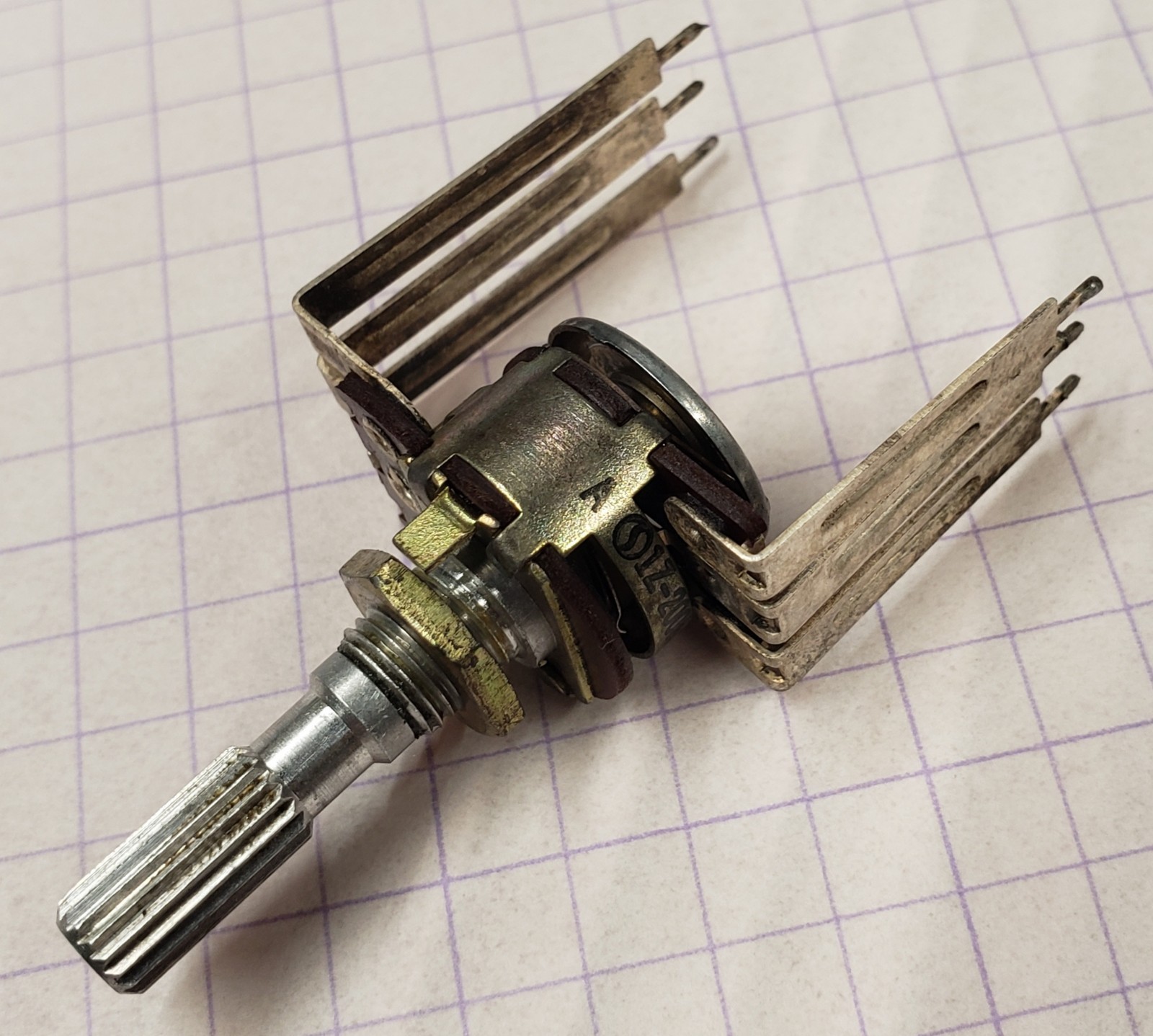
Instead of a conventional potentiometer, the KA-7100 uses a 32-contact attenuator-type volume control. The advantage is channel tracking. Conventional volume pots often exhibit "gang error," a deviation between channels, particularly at low settings, which results in an uneven stereo image. The attenuator design increases or reduces level logarithmically and keeps balance at all settings.
Kenwood also included a -20dB muting switch, which instantly cuts the output level. It's handy for answering the phone or having a conversation without fumbling for the volume knob. Combined with the attenuator, it gives precise, repeatable level control.
Subsonic and High Filters
Two filters are provided: a subsonic filter at 20Hz with a 6dB/octave slope, and a high filter at 8kHz with a 12dB/octave slope. The subsonic filter eliminates turntable rumble and record warp without significantly affecting audible bass. The high filter can tame tape hiss or overly bright recordings, though most users will leave it disengaged.
Simplified Internal Layout
Kenwood made a deliberate effort to cut internal wiring in the KA-7100. The speaker selector switch is mounted next to the speaker terminals and connected by a long mechanical shaft, rather than by wires run to the back panel where they could pick up noise. Where cables are necessary, the company used 7-lead parallel molded flat cables with ground wires on each side, a design intended to minimize distortion-inducing fields.
The heat sink doubles as a chassis divider, running through the center of the unit. It stiffens the chassis and also physically separates the small-signal circuitry from the high-current output stage and power transformer. That contributes to the amplifier's low noise floor.
Historical Context
The KA-7100 arrived during what's often called the golden age of Japanese solid-state audio, when Kenwood, Pioneer, Sansui, and Technics were competing fiercely for the enthusiast market. The fact sheet describes it as "a flagship of its elite 'Supreme' series," though thevintageknob.org positions it more modestly as a smaller sibling to the KA-9100.
Sources disagree a little on production years. The fact sheet gives 1978-1980, HiFi Engine says 1977-79, and thevintageknob.org's timeline notation suggests October 1976 through 1978. The most commonly cited range is 1977-1979, which is what most collectors use. The amplifier was typically paired with the Kenwood KT-7500 tuner, a well-regarded AM/FM unit produced from 1977 to 1979.
Kenwood's marketing at the time was confident to the point of cocky. The "1980 Kenwoods" campaign, which ran in Audio, High Fidelity, and HiFi-Stereo, claimed that by 1980 the kind of performance these amplifiers delivered would be "considered commonplace." Whether that proved true is debatable, but the specs were genuinely impressive for a $300 integrated amplifier in 1978.
Collectibility & Value
On the vintage market the KA-7100 isn't as sought-after as the KA-9100 or the separates from Kenwood's higher tiers, but people who know it respect it. The fact sheet gives a market value of $300-$600 depending on condition and cosmetic appearance, with a collectibility rating of 8/10. Clean, working examples turn up regularly, and fully restored units command the upper end of that range.
Prices vary. A fully restored example was listed on Canuck Audio Mart at CA$350. Muse Audio Service listed one at $750. A combo of the KA-7100 and KT-7500 tuner was offered at $879 plus tax and shipping. At the other end, eBay listings for parts, such as a power transformer, a balance control, and a tone control, sell for $20-$35.
These amplifiers are generally reliable. One owner reported needing nothing more than dust removal and Deoxit on the contacts. Another noted issues with "cutting out on the selector switches and dirty potentiometers," a common problem with any vintage gear that's been sitting unused. Thevintageknob.org describes the KA-7100 and its sibling KA-7300 as "rock-solid performers" that "can still be found in nice condition at very reasonable prices."
When buying, look for units that have been serviced or restored. The electrolytic capacitors are now over four decades old and should be replaced as a matter of course. The DC offset should be checked and recalibrated, which matters in a DC-coupled design where offset can damage speakers. Relays can stick or fail, and the dial illumination bulbs often need replacing. None of these are deal-breakers, but they're negotiation points.
Service documentation is available. The owner's manual and a service manual are both archived on archive.org. The power transformer carries part number L01-1331-15, which helps if you need to source a replacement, though finding one is another matter.
eBay Listings


As an eBay Partner, we earn from qualifying purchases. This helps support our independent vintage technology research.
Related Models
- Kenwood BASIC M1 (1987-1989)
- Kenwood CM-5ES
- Kenwood CM-7ES
- Kenwood CM-9
- Kenwood JL-6100
- Braun AUDIO-1 (1965)
- Braun AUDIO-250 (1965)
- Magnavox Component Systems (1972)
- Acoustic Research AR (1967-1976)
- Acoustic Research 11