Kenwood DPC-77 (c. 1993–1994)
A chunky, brutalist top-loader that treats portable CD playback as serious listening, not something to jog with.
Overview
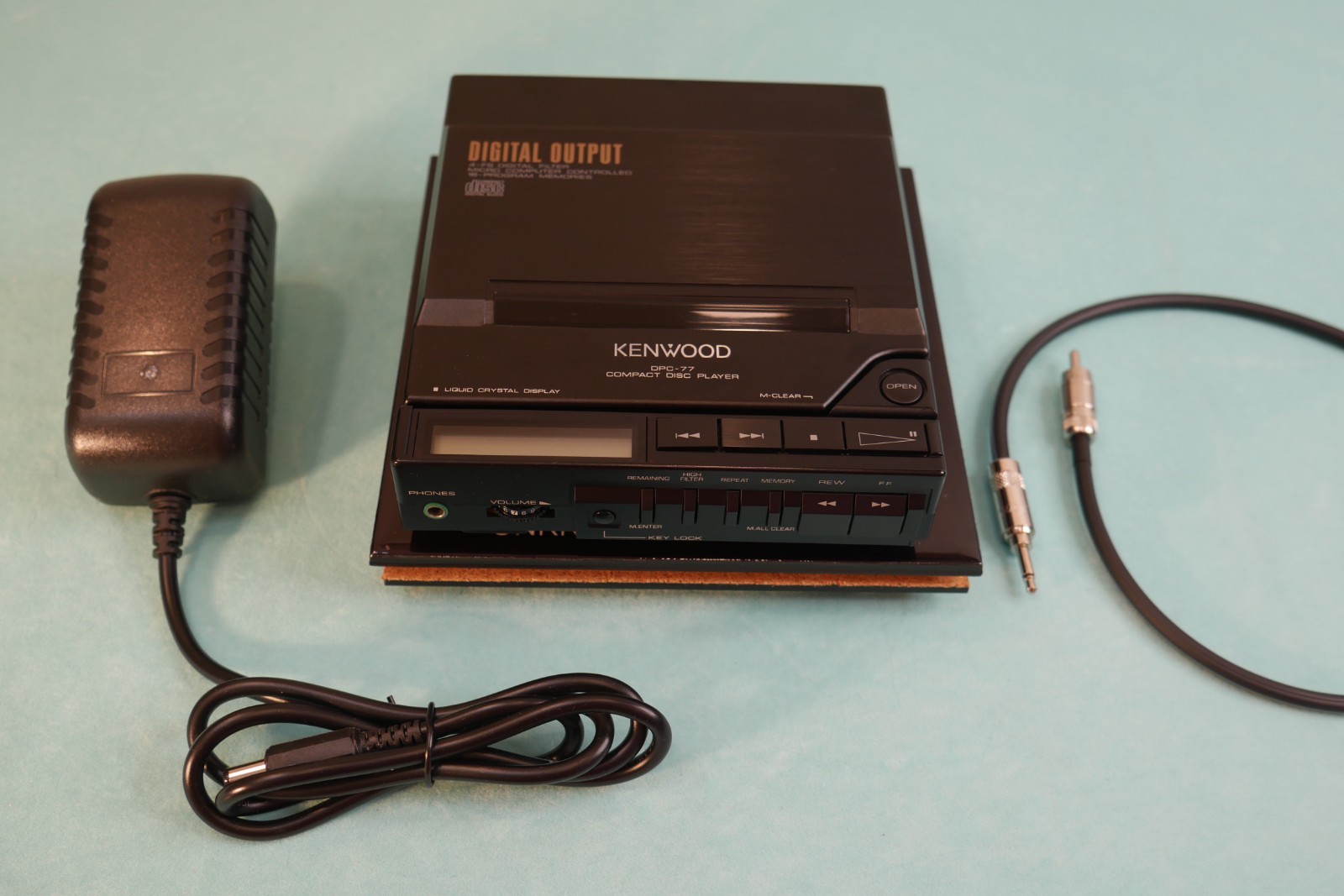
The Kenwood DPC-77 weighs roughly 9.5 ounces without batteries, and it feels heavier than that. It has a slab of aluminum and metal on a plastic body that owners call "chunky," "brutalist," and "industrial." It won't disappear into a jacket pocket. You hold it, open it, and listen to it.
Introduced around 1993-1994 according to Radio Museum records, the DPC-77 was a premium portable, priced somewhere in the $300 - $400 range at launch. That is well above the average walkman-style CD player of the mid-1990s. Kenwood skipped the anti-skip gimmicks and the shrinking footprints. It built a top-loader with a single-disc mechanism, direct drive motor, and both headphone and line outputs. You lift the lid, drop in the disc, and press play.
In 2026 the DPC-77 is interesting for its build quality, which owners consistently praise, and for its digital optical output. Multiple AudioKarma threads document users feeding the digital out into external DACs and receivers, using the DPC-77 as a transport rather than a standalone player. That is an unusual feature on an early '90s portable. It is a big reason the model has a cult following among digital audio enthusiasts who like a well-built CD transport they can hold in one hand.
Key Features
Top-Loader Mechanism
The DPC-77's defining physical trait is its top-loading design. Most portable CD players from the period used slide-in or flip-up mechanisms. The DPC-77 opens like a miniature component deck. Lift the metal lid, seat the disc on the spindle, close, and play. The design favors mechanical simplicity and disc stability over pocketability, and it is one reason the player has aged well. Fewer moving parts in the loading path means fewer things to break, and the direct drive motor referenced in repair discussions suggests a transport built for longevity rather than cost-cutting.
Aluminum/Metal Top with Plastic Body
Owners and eBay listings alike emphasize the construction: a metal lid atop a plastic chassis, with a "substantial build" that reads as premium even by modern standards. The DPC-77 doesn't flex or creak when handled. The metal top is part of what gives it that substantial build.
Digital Optical Output
The digital optical output is the feature that moves the DPC-77 from "nice vintage portable" to "genuinely useful vintage component." Multiple AudioKarma threads confirm it on the rear of the unit, alongside the standard 3.5mm headphone jack and line out. Owners report using the DPC-77 as a transport into external DACs - "I used mine as a transport into my DAC" is a recurring refrain - so this early-'90s portable can serve as a high-quality CD source in a modern digital system. It also plays CD-Rs, as documented in AudioKarma threads, which helps now that original pressings are increasingly expensive.
Controls and Playback
The control layout is straightforward: play/pause, stop, skip forward/back, volume, and a hold switch. There is no elaborate programming interface, just the essentials, arranged for one-handed operation. The DPC-77 plays single CDs only, with no MP3 support, which fits its 1993-1994 vintage. Audio (December 1988, p.34) noted the period's focus on cartridge design. It runs on 2 AA batteries, with a DC input option noted in some listings for those who'd rather plug in than chew through alkaline cells. Given the owner reports about battery life, that AC adapter is worth having.
Historical Context
The early 1990s were the peak of the portable CD player market. Sony had established the category, and by 1993-1994 the field was crowded with inexpensive, feature-laden players aimed at commuters and students. The DPC-77 went the other way. Priced at roughly $300 - $400 at launch, a significant premium over mainstream portables, it was aimed at listeners who wanted reference-grade playback in a portable format and were willing to trade anti-skip convenience for mechanical integrity and sound quality.
That trade-off is central to the DPC-77. It was never really a "walkman" in the mainstream sense. It was a portable transport for people who cared about the music, and who understood that a top-loader with a metal lid and direct drive motor would track a disc more accurately than a featherweight plastic unit with a spinning mirror. The digital optical output, rare in portables of this era, confirms that Kenwood was thinking of the DPC-77 as a source component, not just a personal stereo.
Collectibility & Value
Current market pricing for working DPC-77 units sits roughly in the $99 - $200 range based on observed eBay listings. A tested unit with some scratches was listed at $149.99 Buy It Now. A cleaner example with case and tested functionality was $199.99. An auction starting at $99.99 drew a bid of $102.50 during research. Condition matters significantly, as does whether the unit includes its case and whether the battery door is intact.
That last point matters because the battery door is the DPC-77's most common failure point. Multiple eBay listings and AudioKarma threads document cracked battery doors, broken belt clips, and missing battery covers. The lid hinge is another weak spot - the hinge pin breaks after years of use, a wear pattern consistent with the top-loader design. And like many portables of this age, the DPC-77 suffers from capacitor failure. One AudioKarma repair thread specifically cites "leaky capacitors around the power supply, common for their age and portable."
Skipping is the other recurring complaint. Owners report that the DPC-77 skips when moved or bumped. One thread describes the anti-skip as "basically useless" and notes the player is "really meant for stationary use." This isn't a defect so much as a design choice: the DPC-77 prioritizes accurate tracking over shock resistance. It is not a jogging player. On a desk it is excellent.
Repair is possible but takes patience. The standard skipping fix is to clean the laser lens with isopropyl alcohol on a cotton swab and lubricate the sled rail with white lithium grease. Capacitor replacement with high-temp/low-ESR parts is recommended for the power supply. Parts availability is poor. Genuine Kenwood spares are essentially unavailable, and owners are left to source donor units or improvise aftermarket fixes. As one AudioKarma contributor put it, "you're mostly on your own."
The DPC-77's reputation among owners remains strong. The recurring verdict, across multiple threads, is that "the sound quality is top-notch - it's up there with the best portable CD players I own." Budget for the battery door.
eBay Listings
As an eBay Partner, we earn from qualifying purchases. This helps support our independent vintage technology research.