JBL 3678 Stage Monitor
Stadium-grade wedges that survived the 1993 U2 Zoo TV tour and still command $2,499 to $2,799 on the used market.
Overview
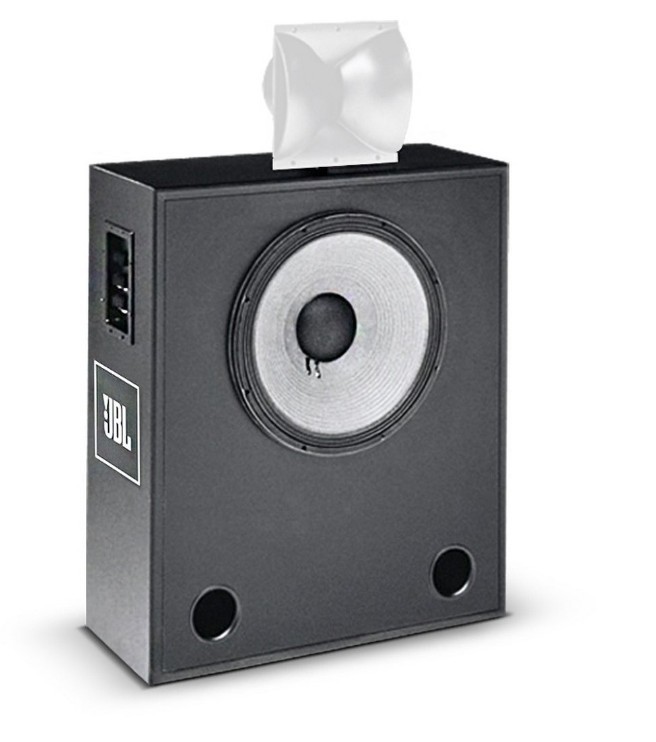
The JBL 3678 is not a studio monitor. It's a stage wedge built to take a beating and keep projecting. It's rated for 250 W continuous sine wave, 500 W continuous program, and 1000 W peaks. Owners call them "stadium-grade wedges," and the construction backs that up: the trapezoidal enclosure is heavy and built like a tank.
JBL positioned the 3678 as a direct replacement for the 4670D, the 12-inch wedge that, along with its predecessor the 4670, had been the industry standard stage monitor for nearly two decades. The advertising tagline for the 3678 was simply "The New Standard." That's a bold claim for a speaker stepping into some very well-worn shoes.
These are two-way, high-power stage monitors designed for bi-amped operation. The LF and HF sections are separate, each with its own 16-ohm impedance, and the system is wired to be driven actively. You can't just hook it up to any amplifier channel. It wants an electronic crossover and dedicated power amps for the low and high sections. For the sound companies and touring rigs it was aimed at, that was standard practice. For a home user, it's a commitment.
The sensitivity rating is 99 dB SPL (1 W @ 1 m). These things get loud, and they don't need massive amounts of amplifier power to do it. Owners report they're very efficient, which makes them forgiving of modest amplification while still leaving headroom to fill a venue when the power is there. The frequency response spans 55 Hz to 18 kHz (±3 dB). That isn't about deep bass extension. It's about getting vocals and guitars across a noisy room.
Key Features
2206H 12" LF Transducer
The low end is handled by a single 2206H 12-inch cone transducer in the 16-ohm configuration. It's a driver built to sustain high output levels for extended periods without thermal compression or mechanical failure. The 2206H is a workhorse in JBL's professional lineup, known for taking punishment and still performing. In the 3678, it's paired with the horn section. Some forum posts describe the 3678 as having two 12-inch woofers, but the manufacturer's specification clearly lists a single 2206H. The confusion likely comes from the visual bulk of the enclosure.
2446J Compression Driver
On the high end sits the 2446J, a 1-inch exit compression driver with a 2-inch voice coil. This is the component that gives the 3678 its vocal projection and clarity. Owners specifically note that the high end is laid back and not at all harsh, which counts when a monitor sits directly in front of a performer's ears for hours. The 2-inch voice coil provides the thermal capacity to sustain high-frequency output in a monitor that might run at full tilt for an entire set.
Bi-Amp Configuration with NL4 Speakon Connectors
The 3678 is a two-way system with separate LF and HF sections, each presenting a 16-ohm load. Two NL4 Speakon connectors are wired for bi-amp operation, so the crossover is external. You're expected to use an electronic crossover and dedicated amplifiers for each section. The passive crossover in the system is specified at 1.2 kHz with a 12 dB/octave slope, but the design intent is clearly active operation. It assumes the user has the processing and amplification a touring sound company would carry. It also means the speaker can be optimized for specific venues and systems.
Trapezoidal Enclosure with 90° × 50° Coverage
The trapezoidal shape reduces internal standing waves and provides the correct geometric angle for stage monitoring. The coverage pattern is 90° horizontal by 50° vertical, which gives the performer a broad sweet spot on stage while keeping the sound focused. Owners describe the enclosure as heavy and built like a tank. It weighs 17.0 kg (37.5 lb) and measures 481 mm × 521 mm × 362 mm. That mass helps its stability and its ability to resist unwanted vibration.
Historical Context
The JBL 3678 was introduced as the successor to the 4670D, a wedge that had dominated the stage monitor market for nearly 20 years alongside its predecessor, the 4670. With "The New Standard," JBL explicitly positioned the 3678 to take over from a design that had become ubiquitous in professional audio.
The speaker's best-known claim is its use on the 1993 U2 Zoo TV tour. That tour was a massive, multimedia spectacle that pushed sound systems hard, and the 3678s were the actual monitors used on stage. Units have surfaced at storage unit auctions in good condition. The Zoo TV connection has become a point of interest for collectors. A related model, the JBL 3677 Screen Channel System, was aimed at small and mid-sized theaters and priced at $640 (Mix Magazine, June 1996, p.124).
eBay Listings

As an eBay Partner, we earn from qualifying purchases. This helps support our independent vintage technology research.
Related Models
- JBL 075
- JBL 077
- JBL 120Ti
- JBL 124A
- JBL 124H
- Braun AUDIO-1 (1965)
- Braun AUDIO-250 (1965)
- Magnavox Component Systems (1972)
- Acoustic Research AR (1967-1976)
- Acoustic Research 11