JBL 2403 (1975–1978)
A 60mm ring-radiator UHF transducer that cost $126 each in 1977 and carried the top octave for some of JBL's most revered studio monitors.
Overview
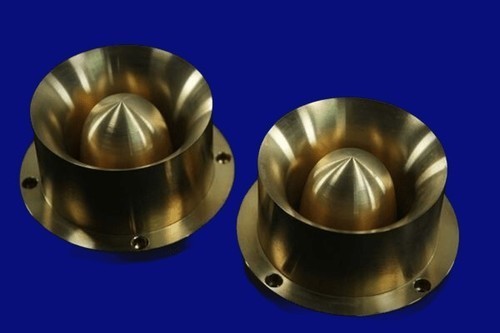
The JBL 2403 is a horn-loaded, ring-radiator ultra-high-frequency transducer built for two-channel stereo reproducing systems. It weighs 1.8 kg and measures 105 x 165 x 100 mm, small enough to sit atop a main speaker cabinet. Its job is to extend response beyond what a conventional tweeter can deliver, adding air and presence to the top octave of a two-way system.
JBL sold the 2403 as a supplementary UHF unit, not a standalone speaker. It was never meant to carry the full range, only what sits above the crossover point. The driver is a direct-radiator type, horn loaded, with the ring diaphragm concentric with a short single-cell horn. That gives it a controlled dispersion pattern and lets it keep up with the dynamic capabilities of the larger woofers and midranges it was designed to accompany.
At $126.00 each in 1977, the 2403 wasn't an impulse buy. It was an upgrade for owners of serious systems who felt their main speakers rolled off too early up top. For those who bought into JBL's professional monitor line, it was simply part of the package.
Key Features
60mm Ring Radiator with Annular Diaphragm
The 2403 uses a 60mm (2.4 in) annular diaphragm, a ring-shaped radiating surface that sits concentric with a short horn. It is not a dome tweeter with a dust cap. The entire ring moves, pushing air through the horn throat with excellent efficiency. The voice coil is 20mm aluminum, paired with a 20mm magnet structure. It responds quickly to transients and reproduces the upper harmonics of cymbals, strings, and brass without the metallic sheen that plagued many dome tweeters of the era.
The 2403's nominal impedance is 16Ω, which makes it easy to integrate into systems using multiple drivers per channel. Power handling is where the documentation gets interesting: the manual lists a 50W power capacity, while other sources cite 15W continuous. The discrepancy likely reflects the difference between peak program material and steady-state sine wave testing — a UHF driver rarely sees sustained full-power signals in normal use, but it can be damaged if driven carelessly above the crossover frequency. Owners report that diaphragms can burn out when the driver is pushed too hard, which leads us to the maintenance realities covered later.
N/S Rear Switch: Flat or Boosted Response
A rear-mounted switch sets the 2403 to either "N" (normal) for flat response or "S" (super) for a +3 dB boost above 8,000 Hz. In a heavily damped room, or with speakers placed far from walls, the "S" position restores some of the air that gets absorbed. In a live room, "N" keeps things honest. The switch is mechanical and can be set incorrectly on used units, so check it first when you buy a pair.
The unit ships with a flush-mount grille kit, so it can be mounted into a baffle or cabinet. That mattered to owners adding the 2403 to existing systems, since it didn't have to sit on top of the speaker. It could be built in.
Closed Enclosure Design
The 2403 uses a closed (sealed) enclosure type. There's no port tuning and no bass reflex to deal with, just a damped cavity behind the diaphragm that prevents back-wave interference. That keeps the upper-frequency response clean and predictable, which suits a driver that only reproduces 7 kHz and up.
Historical Context
The 2403 was originally the UHF section of the JBL L300 (or 4333) system, and in part the 4331A or 4333A. In home systems, it was an add-on to the L200 or L300. So it was the top end of some of JBL's most respected studio monitors of the 1970s. Collectors rate the L300 especially highly, and the 2403 was responsible for that speaker's extended top end.
As a standalone transducer, the 2403 was intended as a supplementary UHF unit in existing systems, not as a standalone speaker. JBL positioned it as an upgrade path for owners of two-way systems who wanted to extend response beyond what their main tweeter could deliver. The recommended high-pass frequency is 7 kHz, which is where most dome tweeters start to beam or roll off.
Production ran from 1975 to 1978, a relatively short window. The design continued in the 2403H, which is the cabinet version of the same transducer. The 2403 itself was sold as a component for system builders.
Collectibility & Value
The 2403 has a dedicated following among JBL collectors, and prices reflect that. Sold listings show pairs moving between $300 and $500 in the US, with European auction prices ranging from €420 to €800 for pairs. Single units have sold for €180 to €625, depending on condition and whether the original horns are included. The spread is wide, which suggests condition and diaphragm health are the main price drivers. DB-Magazine (July 1983, p.35)
The critical issue with the 2403 is the diaphragm. Original JBL diaphragms are no longer available from the factory, only from specialized dealers. Aftermarket replacements exist, but factory originals are scarce. Diaphragms can burn out if the driver is fed too much power above the crossover frequency. A 2403 with a damaged diaphragm is a paperweight unless you can source a replacement, and the aftermarket options may not match the original's sonic character.
When buying used, check the rear N/S switch for proper function, since it may be set incorrectly. If you plan to run these hard, respect the crossover frequency and high-pass filtering. The 2403 is built for the top octave, not full range, and it will punish you if you treat it like a full-range driver.
eBay Listings


As an eBay Partner, we earn from qualifying purchases. This helps support our independent vintage technology research.
Related Models
- JBL 075
- JBL 077
- JBL 120Ti
- JBL 124A
- JBL 124H
- Braun AUDIO-1 (1965)
- Braun AUDIO-250 (1965)
- Magnavox Component Systems (1972)
- Acoustic Research AR (1967-1976)
- Acoustic Research 11