JBL 2240H
An 18-inch die-cast driver rated at 600 watts continuous program. It went into subwoofer cabinets and mostly stayed there.
Overview
The 2240H is the low-frequency driver JBL built for the working side of the business - sound reinforcement, not the living room. JBL's own announcement copy described it as an 18-inch loudspeaker that shares the company's then-recently-developed Symmetrical Field Geometry flux-stabilized magnet structure, high-temperature adhesives, and composite voice coil formers with its sibling, the 2245H. Both were rated at 600 watts continuous program. That's the manufacturer's number, and it's the one to trust. A lot of secondary listings have spent decades repeating a 400-watt figure that appears to have drifted in from somewhere else.
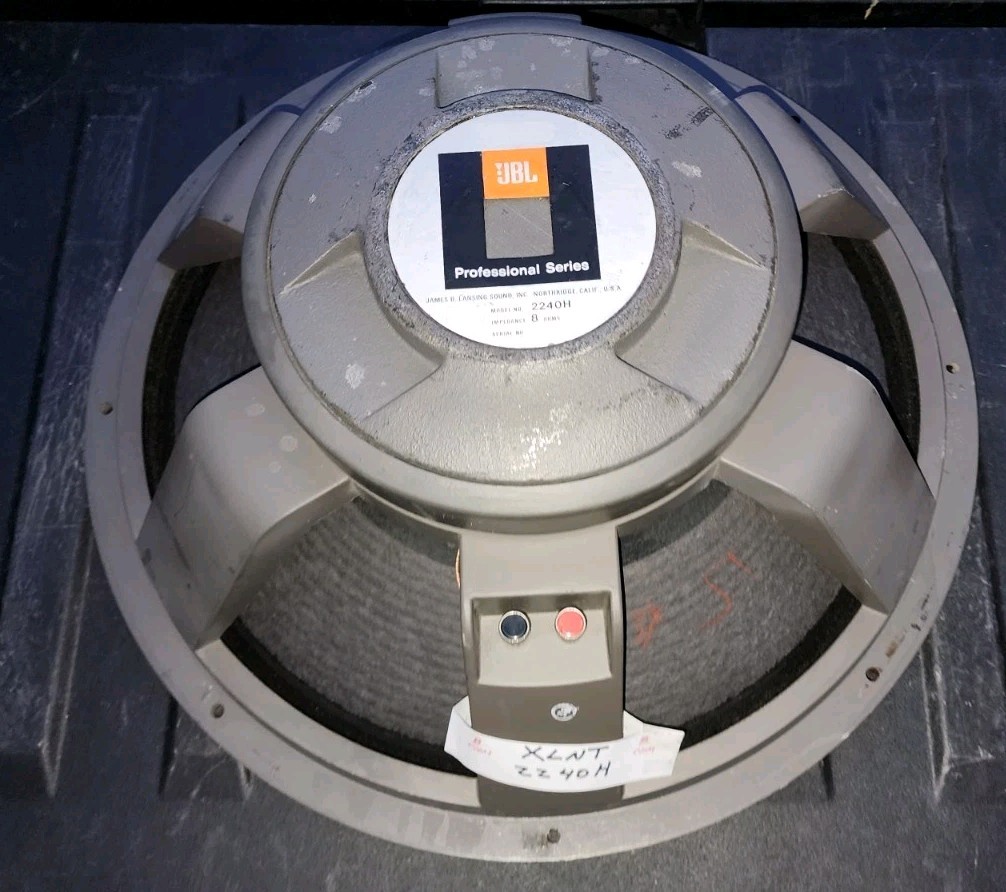
The 2240H isn't exotic engineering. It's a design brief: JBL built it to survive. The cone is integrally stiffened and carries a cloth surround, mounted in a die-cast aluminum frame. The company's literature promised high power handling, minimum distortion, and what it called optimum low-frequency linearity. Sensitivity through the midrange was deliberately controlled so the driver would stay balanced between efficiency and bass output. That's why the 2240H turns up in ported boxes and as a horn driver, rather than being locked into one loading scheme.
The quoted frequency range is 30 Hz to 2 kHz. Read that carefully. This is not a subwoofer in the modern home-theater sense. It's a woofer that reaches 30 Hz and keeps going well into the midbass, which is what a sound-reinforcement low-frequency section needs when it's crossed to a horn or a midrange compression driver. Contemporary Japanese documentation listed a recommended crossover of 800 Hz or below, an SPL figure of 98 dB/W/m, and a 10 cm voice coil wound from edge-wound copper ribbon. The magnet circuit's flux density was given as 12,200 gauss.
Diameter is a persistent point of confusion. Some listings and at least one secondary source describe it as a 15-inch unit. The manufacturer's announcement and the bulk of the record say 18 inches, and the model's own dimensions - a 464 mm outer diameter - settle it. Any 2240H described as a 15 is either mislabeled or a different driver wearing the wrong badge.
Key Features
Symmetrical Field Geometry Magnet Assembly
SFG was JBL's answer to the nonlinearity that creeps into a driver's motor at high excursion. The flux-stabilized structure is the reason the 2240H could be rated at 600 watts continuous program and still be described in JBL's own material as stable at that input. It keeps distortion down when the driver is pushed hard in a reinforcement rig, which is the only environment it was designed for.
19mm Edge-Wound Copper Ribbon Voice Coil
The coil is 10 cm in diameter with a 19 mm winding length, using edge-wound copper ribbon rather than round wire. Edge-winding packs more conductor into the same gap, which gives high power capacity without a coil that behaves like a space heater. The Thiele-Small table gives Re as 6 ohms, Le as 1.4 mH, and Xmax as 5.5 mm. Some of the same source's prose claims a maximum displacement of 25 mm. Treat that as a documentation slip rather than a spec, since it contradicts the driver's own parameter table.
Integrally Stiffened Cone with Cloth Surround
The cone is stiffened as part of its construction and terminated with a cloth surround rather than foam. Foam surrounds turn to dust after fifteen years in a road case, so this is the most consequential detail on the whole driver. The paper cone uses a fixed-edge structure reinforced with cloth. It is built to be loaded into an enclosure and left alone.
Die-Cast Aluminum Frame
JBL described the frame as large and rugged, and specifically credited it with reducing the effect of vibration. In an 18-inch driver moving that much air, a stamped basket would flex and bleed energy into the baffle.
Loading Flexibility: Bass Reflex or Horn
The 2240H was designed to be mounted in either a bass reflex or a horn-loaded enclosure. JBL's own suggested enclosure volume range is 140 to 340 liters, a wide window that reflects that flexibility. A DIY builder quoted in the available record reported good results in a ported cabinet tuned to 30 Hz, which lines up with the driver's quoted fs of 30 Hz and its Vas of 480 L. The Qts of 0.23 is low, so this driver wants a proper box, not a sealed afterthought.
Historical Context
The 2240H arrived alongside the 2245H, and the trade press treated them as a pair with different jobs. Modern Recording (March 1981, p.25) reported the introduction of both 18-inch low-frequency units, noting that the 2240H was intended for a variety of sound-reinforcement applications while the 2245H was recommended for custom studio monitors. That's why the 2240H's record is so thin on the hi-fi side. It was never aimed there.
Pricing in the Japanese market was listed at ¥110,000 per unit around 1981, rising to ¥135,000 around 1983. No US retail price has surfaced in the available documentation, and no production years are confirmed. What is confirmed is the application: the 2240H served as the low-frequency driver in JBL's 4648A subwoofer cabinet, and an owner who replaced one in a 4648A confirmed it as the correct drop-in. A 1990 JBL brochure for a dual-18 triple-chamber bandpass sub-bass system specified dual 2240H drivers, with the system - not the bare driver - quoted as delivering uniform response and power handling down to 25 Hz.
Collectibility & Value
This is a component, not a trophy. The 2240H trades as a working part. Recent asking prices on eBay have run around $300 for a unit described as a 2245H modified to 2240H spec, and $400 for a clean vintage example. Voice coil assemblies for the 2240H and the related 2204H have shown up as repair parts in the $44-48 range, and a separate listing for an E155-4/2240H 8-ohm coil sat at $48. That suggests re-coning is at least theoretically possible, though the available record documents no repair procedures or parts availability beyond what happens to be listed.
Condition notes from sellers are the usual mix. One Reverb listing admitted to paint wear on the metal surrounding the speaker while calling it a good-sounding unit, and an eBay seller reported testing with a frequency signal generator and finding it working as required. At least one "barn found" example in its original box has circulated. Modified units, meaning 2245H frames rebuilt to 2240H spec, are common enough in the used market that buyers should confirm exactly what they're getting before paying collector money.
No common failure modes, maintenance schedules, or repair guidance are documented in the available record. The cloth surround is the obvious thing to inspect. Beyond that, the literature is silent.
eBay Listings


As an eBay Partner, we earn from qualifying purchases. This helps support our independent vintage technology research.
Related Models
- JBL 075
- JBL 077
- JBL 120Ti
- JBL 124A
- JBL 124H
- Braun AUDIO-1 (1965)
- Braun AUDIO-250 (1965)
- Magnavox Component Systems (1972)
- Acoustic Research AR (1967-1976)
- Acoustic Research 11