Heathkit AR-1515 (1975–1981)
Seventy watts a side, half-inch LED digits behind a smoke-tinted window, and a hundred hours of soldering between you and the finest receiver Heath ever designed.
Overview
The AR-1515 is the receiver Heathkit built to end arguments. It is an all-in-one AM/FM stereo receiver sold in kit form, and it sat at the top of Heath's receiver line. The company billed it as the finest receiver Heath had ever designed, and so did the people who owned one. The pitch was simple and, by most accounts, honest. Pay roughly $600 in kit form, spend the better part of a hundred hours at the bench, and end up with a receiver whose measured performance embarrassed factory-built competition costing considerably more.
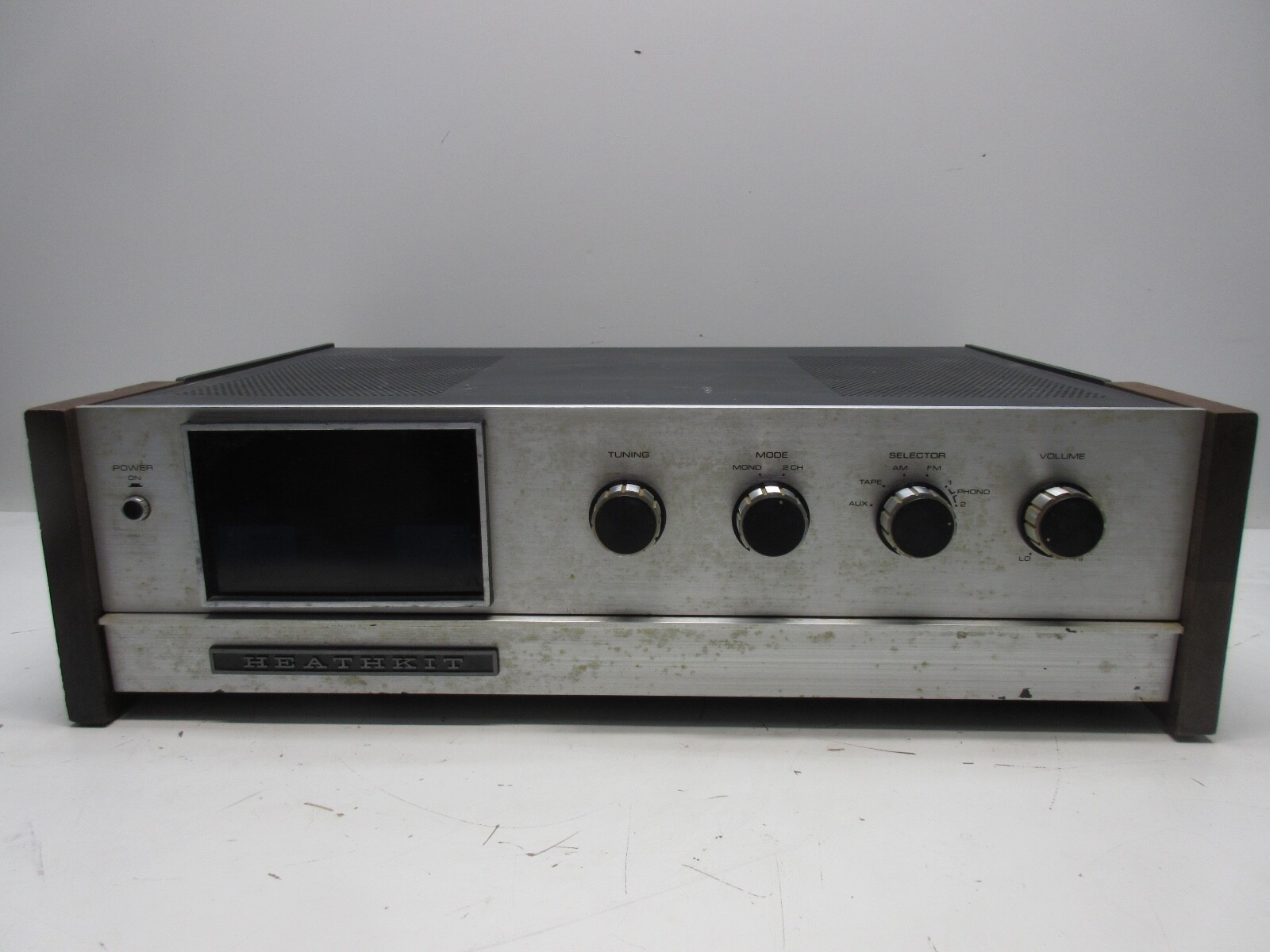
The front end is what made it a flagship rather than just a big kit. The AR-1515 reads out its frequency on half-inch-tall LED digits - a frequency counter driving a digital display, accurate to a tenth of a megahertz. The tuner behind that display is analog. The counter is an overlay, and it does what an overlay should: it removes the guesswork. Owners who lived through the dial-string era describe tuning this thing as a different category of experience. You dial to the number you want, use the signal-strength and center-channel meters to zero in, and stop hunting.
The amplifier is rated at 70 watts per channel, minimum RMS, into 8 ohms. Heathkit's own catalog copy from the period quotes 70 W minimum RMS per channel with less than 0.08% total harmonic distortion from 20 to 20,000 Hz. Frequency response runs +0, -1 dB from 8 Hz to 45 kHz, and extends to +0, -3 dB from 4 Hz to 80 kHz. That is far more bandwidth than the program material of its day demanded, which is the point: headroom, not strain. Intermodulation distortion is quoted at less than 0.08% from 0.25 to 70 watts at full output.
The FM section is where the AR-1515 earned its keep. Usable sensitivity is 1.8 microvolts, capture ratio 1.3 dB, alternate-channel selectivity 100 dB, and FM frequency response 20 to 15,000 Hz ±1 dB. Channel separation holds 40 dB or better at midfrequencies, 35 dB at 100 Hz, and 20 dB at 10 kHz. On the AM side, sensitivity is 5 µV with a 50-ohm direct input. High Fidelity (November 1976, p.47) ran the AR-1515 as "a new standard in stereo receivers," and noted the satin-finished aluminum front panel, the solid walnut end panels, and the subtle red and blue lighting behind the display. That is the same styling story Heathkit told in its own catalog, but this one came from a print magazine rather than a sales brochure.
Key Features
Half-Inch LED Frequency Readout
The digits are the headline. A frequency counter with a digital display reads to a tenth of a megahertz, in half-inch-tall LEDs behind a smoke-tinted window. In 1975 this was not a common sight on a receiver at any price, let alone a kit. In practice you stop tuning by ear and start tuning by number. The signal-strength and center-channel meters flanking the display tell you when you've actually nailed the signal rather than merely found the station. There's also an oscilloscope output for monitoring multipath distortion.
Modular Construction and Color-Coded Harnesses
Heathkit's answer to the objection that a hundred hours of assembly is a lot to ask was architecture. The AR-1515 is built as self-contained modules: preamp, power amp, tuner, and power supply each live on their own board, wired together with color-coded harnesses. Builders report the individual parts packages arrived labeled, and the assembly manual was thorough enough that even a novice could follow it. The modular layout also pays off decades later, when a fault can be isolated to a board and pulled for testing instead of traced through a single monolithic chassis. Budget 80 to 100 hours for the build.
Hinged Control Door and a Clean Front Panel
Only the controls you touch constantly - tuning, mode, input selector, volume - live on the front panel proper. Everything else hides behind a hinged door: balance, bass and treble, the speaker switches, the headphone jack, FM muting and stereo blend, subsonic and high-frequency filters, tone-flat, and the dubbing inputs and outputs. That keeps the panel readable and the secondary controls out of the way until you need them.
Preamp Out / Amp In and Tape Flexibility
The rear panel carries preamp out and amp in jacks, so the AR-1515 can be split. The preamp can feed an external power amp, or an outboard processor can be inserted into the chain. Dedicated tape and dubbing inputs with level matching round out the tape loop. There's also the optional Dolby FM module, a $50 add-on that owners describe as a rare accessory today. It brought the reduced noise and expanded dynamic range of Dolbyized FM broadcasts into the receiver.
10,000 µF Reservoir Capacitors
Two massive 10,000 µF reservoir capacitors anchor the power supply. That's serious storage for a 70-watt-per-channel receiver, and it's the first thing restorers check. If they're leaking, they get replaced. If they're original and unmeasured, they get measured.
Historical Context
The AR-1515 was released in the Christmas 1976 catalog and appears in Heathkit's 1977 Christmas, 1979 Winter, and 1979 Fall catalogs. The fact sheet lists production as running 1975 to 1981. It was sold as a flagship kit for the audiophile who wanted both the performance and the satisfaction of assembly. Heathkit's 1977 Christmas catalog bundled it with two AS-1373 speakers and a Dual CS-721 turntable with base, dustcover, and a Shure V 15 III cartridge - a complete system for the buyer who wanted to build the whole chain. The receiver carried an original kit price of about $600.
Collectibility & Value
The AR-1515 has a cult following, and the market reflects it. Unrestored units needing repair turn up for as little as $50. Working examples typically trade between $250 and $395. A professionally serviced and recapped unit has been listed as high as $1,299.95. Parts and accessories move too. A replacement LED lamp kit runs around $29.50, and a parts receiver with display and meters has sold for $49.95. A restoration kit of filter capacitors and recap components was listed at $185 in 2022.
Know the failure modes before you buy. The original Texas Instruments power transistors are known to overheat, and Heathkit itself advised replacing them with Motorola types like the MJ11016. Muting circuit relays fail and cut the audio out. The counter circuit can malfunction, with the display jumping from 99.9 to 180.1 MHz - a fault usually traced to a faulty IC-406. The two 10,000 µF reservoir capacitors and six electrolytic capacitors per channel in the power amp boards are aging and should be checked. Original dial lamps are difficult to find and replace, and many owners retrofit LEDs. A paid manual is available for $51 from VintageManuals. The service manual that circulates is incomplete, though original assembly manuals with full schematics and reference illustrations do exist. Owner verdicts are warm. One calls it "a master piece to listen to," another reports the sound as "clean and strong," and the restoration community is active.
eBay Listings



As an eBay Partner, we earn from qualifying purchases. This helps support our independent vintage technology research.
Related Models
- Heathkit AA-100 (1960–1964)
- Heathkit AA-121 (1972)
- Heathkit AD-22 (1974)
- Heathkit AJ-13 (1964)
- Heathkit AJ-15 (1968–1974)
- Braun AUDIO-1 (1965)
- Braun AUDIO-250 (1965)
- Magnavox Component Systems (1972)
- Acoustic Research AR (1967-1976)
- Acoustic Research 11