Fisher STATESMAN-II (S-70) (1969)
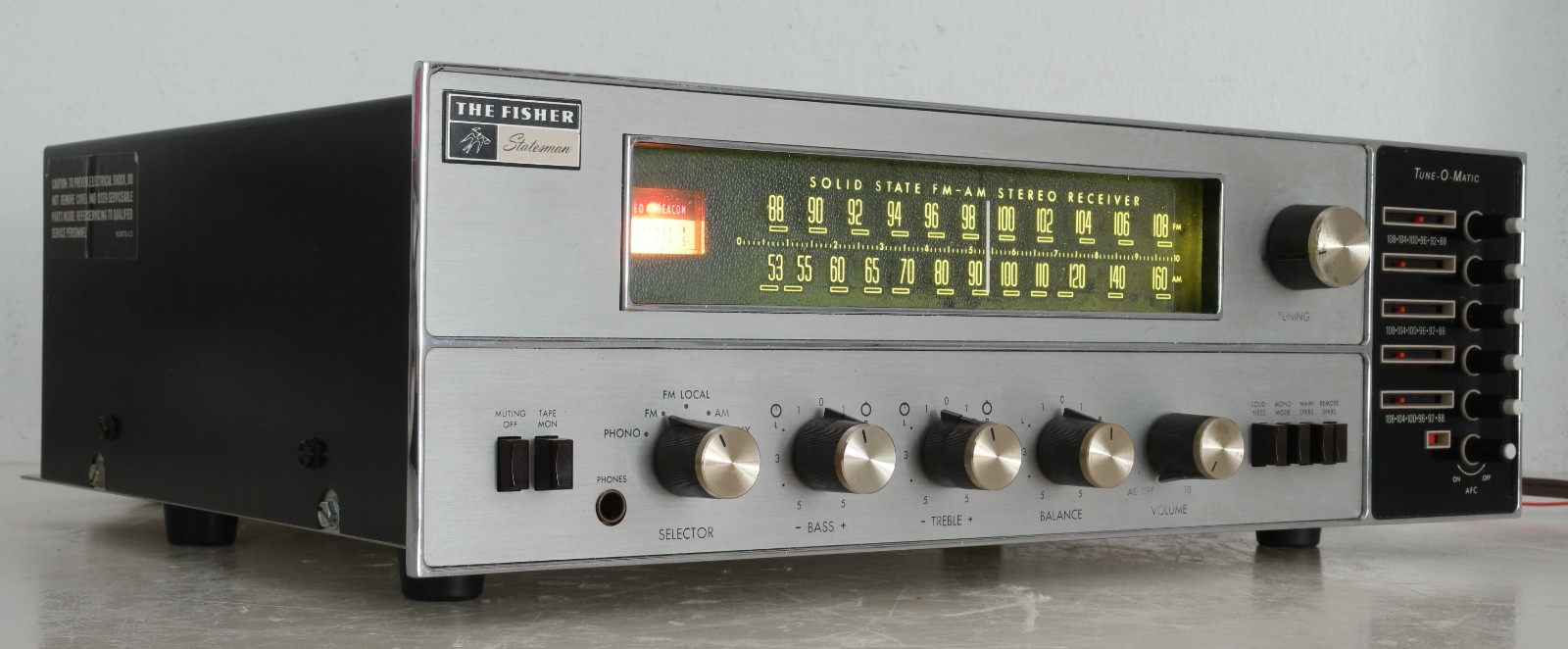
The Fisher STATESMAN-II (S-70) is a classic integrated receiver produced by Fisher Electronics during the late 1960s, representing a high point in American audio engineering. Introduced in 1969, the S-70 was part of Fisher's premium STATESMAN series, which targeted serious audiophiles who valued both performance and craftsmanship. At a time when high-fidelity audio equipment was transitioning from vacuum tubes to solid-state technology, the STATESMAN-II stood out as a bridge between eras—offering the warmth and clarity associated with tube-based designs while embracing the reliability and efficiency of solid-state circuitry.
Design and Build Quality
Fisher was renowned for its meticulous attention to build quality, and the STATESMAN-II (S-70) was no exception. Housed in a sleek, brushed aluminum front panel with a classic black chassis, the receiver exuded a professional, no-nonsense aesthetic. The front panel featured large, clearly labeled knobs for volume, tone controls, balance, and input selection, all of which had a satisfying mechanical feel. The large VU meter in the center was not only functional—providing real-time feedback on output levels—but also added a touch of visual flair, glowing softly in dimly lit listening environments.
The chassis was constructed with heavy-duty materials to minimize vibration and electromagnetic interference, contributing to a cleaner signal path. Internally, the S-70 used discrete transistor circuitry rather than integrated circuits, which was typical of high-end gear at the time. The layout was clean and serviceable, making it a favorite among technicians and hobbyists for restoration and maintenance.
Technical Specifications
The Fisher STATESMAN-II (S-70) delivered 35 watts per channel into 8 ohms, a respectable output for its era. This power rating allowed it to drive a wide range of speakers available in the late 1960s and early 1970s, including popular models from AR, Advent, and KLH. The total harmonic distortion (THD) was rated at less than 0.5%, which was impressive for a solid-state receiver of its time and contributed to its clean, dynamic sound.
Frequency response spanned from 20 Hz to 20 kHz, ±1 dB, ensuring accurate reproduction across the audible spectrum. The signal-to-noise ratio was rated at 70 dB, providing a quiet background that allowed subtle musical details to emerge. Input sensitivity was 2.5 mV for the phono input and 150 mV for line-level sources, making it compatible with both moving magnet cartridges and standard line-level devices such as tuners and tape decks.
The receiver featured both AM and FM tuners, each with their own dedicated section on the front panel. The FM section included a stereo indicator light and a multipath indicator, helping users optimize antenna placement for the clearest reception. The tuner section was praised for its sensitivity and selectivity, capable of pulling in weak stations with minimal noise.
Audio Performance
The STATESMAN-II (S-70) is often described by vintage audio enthusiasts as having a "musical" and "engaging" sound signature. Its solid-state design avoided the harshness sometimes associated with early transistor amplifiers, instead delivering a smooth, warm presentation that many compare favorably to tube equipment. Bass response was tight and well-controlled, while the midrange was clear and detailed—ideal for vocal and acoustic recordings.
One of the standout features was its phono preamp, which was optimized for moving magnet cartridges. In an era when vinyl was the dominant format, a high-quality phono stage was essential, and the S-70 delivered with low noise and excellent channel separation. The tone controls were broad and effective, allowing users to tailor the sound to their room or preferences without introducing noticeable coloration.
The headphone amplifier, located on the front panel, was also well-regarded. It could drive high-impedance headphones of the era with ease, making late-night listening both convenient and enjoyable.
Features and Connectivity
The S-70 offered a comprehensive set of inputs and outputs for its time. On the rear panel, users would find:
- Phono input (MM)
- Two line-level inputs (Aux, Tape)
- Tape monitor loop
- AM and FM antenna terminals
- Speaker binding posts for two sets of speakers (A/B)
- Preamp output and power amp input (for external processor or amplifier integration)
- Headphone jack (¼ inch)
This level of connectivity made the STATESMAN-II a true hub for a complete audio system. The inclusion of a tape monitor loop allowed users to record from any source and monitor playback through the receiver, a feature highly valued before the era of digital recording.
Legacy and Collectibility
Fisher Electronics, founded by Avery Fisher in 1945, was a pioneer in high-fidelity audio and helped define what "hi-fi" meant to a generation of listeners. The STATESMAN-II (S-70) was one of the last receivers produced under the original Fisher brand before the company was acquired by Sanyo in the early 1970s. As such, it holds a special place among vintage audio collectors as a symbol of American engineering excellence.
Today, the S-70 is sought after by collectors and restorers. Units in good working condition can command high prices on the secondhand market, especially when paired with matching Fisher speakers or turntables. Its reliability, when properly maintained, is another reason for its enduring popularity. Many original units still function well after more than 50 years, a testament to the quality of materials and construction.
Restoration projects often involve replacing aging electrolytic capacitors, cleaning potentiometers, and checking solder joints—standard maintenance for vintage gear. Once serviced, the STATESMAN-II can deliver performance that rivals modern entry-level amplifiers, all while offering the charm and character of vintage audio.
Conclusion
The Fisher STATESMAN-II (S-70) is more than just a receiver—it's a piece of audio history. With its elegant design, solid performance, and exceptional build quality, it exemplifies the best of late-1960s American hi-fi. Whether used as the centerpiece of a vintage system or restored as a collector's item, the S-70 continues to impress with its musicality and reliability. For those exploring the world of vintage audio, the Fisher STATESMAN-II is a worthy candidate and a timeless reminder of an era when sound quality was paramount.
eBay Listings
As an eBay Partner, we earn from qualifying purchases. This helps support our independent vintage technology research.
Related Models
- Fisher 800-T (1962)
- Fisher 332
- Fisher 400-R (1963)
- Fisher 400-T (1964)
- Fisher 432
- Pioneer QX-949A (1978)
- Pioneer SX-2000 (1978)
- Pioneer SX-2500 (1978)
- Marantz SR-2000 (1999–2001)
- Onkyo TX-1500MKII (1975)