Fisher FUTURA-(F-591) (1973)
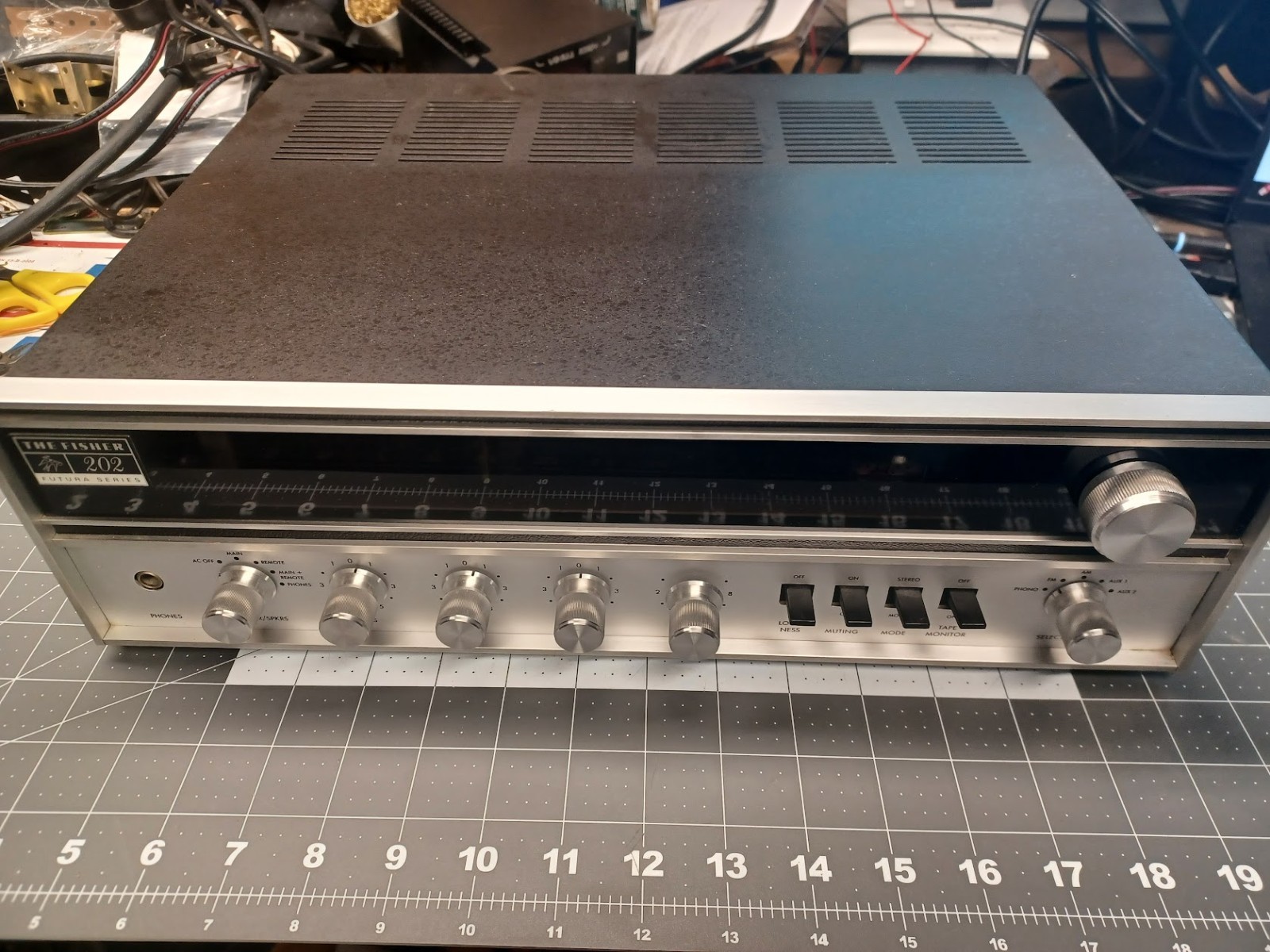
The Fisher FUTURA F-591 is a stereo receiver produced by Fisher Electronics during the early 1970s, representing a transitional period in high-fidelity audio equipment when solid-state circuitry began to replace vacuum tubes in mainstream designs. Though not as widely documented as some of Fisher’s more iconic models like the 500C or 800X, the F-591 holds a quiet distinction among vintage audio enthusiasts for its elegant design, reliable performance, and embodiment of Fisher’s reputation for engineering excellence.
Historical Context and Brand Legacy
Fisher Electronics, founded by Avery Fisher in 1936, built its reputation on high-fidelity audio components that emphasized accuracy, durability, and sonic purity. By the 1960s and 70s, Fisher had become a household name in the American hi-fi market, known for both tube-based amplifiers and early solid-state receivers. The FUTURA series, introduced in the early 1970s, was designed to modernize Fisher’s image with sleek styling, improved circuitry, and integrated functionality.
The F-591 was part of this FUTURA lineup, which included several receivers and amplifiers aimed at the mid-to-high-end consumer market. While exact production years are difficult to pin down due to limited surviving documentation, the F-591 is generally believed to have been released around 1973. It arrived at a time when stereo receivers were becoming the centerpiece of home audio systems, combining AM/FM tuners, preamplifiers, and power amplifiers in a single chassis.
Design and Build Quality
The F-591 features the clean, minimalist front panel typical of early 1970s Fisher design. It includes a large analog VU meter flanked by function switches and tuning knobs, with a brushed aluminum faceplate and black side panels. The meter, a hallmark of Fisher receivers from this era, provides real-time monitoring of output levels and adds a touch of visual drama to the listening experience.
Physically, the unit is substantial, weighing approximately 28 pounds (12.7 kg), a testament to its heavy-duty transformer, robust heat sinks, and high-quality internal components. The chassis is constructed from steel with reinforced mounting points, ensuring durability and resistance to microphonics and vibration.
The rear panel includes four pairs of speaker terminals (two sets of A/B speakers), a range of line-level inputs (including tape in/out), AM and FM antenna connections, and standard RCA jacks for phono and auxiliary sources. The inclusion of both MM (moving magnet) and MC (moving coil) phono inputs was relatively advanced for its time, indicating that the F-591 was intended for serious audiophiles who valued vinyl playback quality.
Technical Specifications
While original datasheets for the F-591 are scarce, surviving units and service manuals confirm the following specifications:
- Rated Output Power: 40 watts per channel into 8 ohms (both channels driven, RMS, 20Hz–20kHz, 0.1% THD)
- Total Harmonic Distortion: Less than 0.1% at rated power
- Frequency Response: 20Hz–20kHz ±1dB (line input), 20Hz–20kHz ±2dB (phono input)
- Signal-to-Noise Ratio: 80dB (phono), 90dB (line)
- Input Sensitivity: 2.5mV (phono), 150mV (line)
- Output Level: 150mV (tape out, preamp out)
- Tuner Section:
- FM Sensitivity: 1.8 µV for 30 dB quieting
- AM Sensitivity: 30 µV for 20 dB S/N
- FM Stereo Separation: >40dB at 1kHz
- Power Supply: Linear transformer-based, dual rail design with regulated preamp section
- Speaker Impedance: 8 ohms nominal (compatible with 4–16 ohm loads)
The amplifier section uses a hybrid design with discrete transistors and minimal feedback, contributing to a warm, musical sound signature that many vintage audio fans describe as “organic” or “analog-rich.” The preamp stage includes tone controls (bass, treble, loudness), balance, and source selection via a precision rotary switch.
Performance and Sound Characteristics
The F-591 delivers a balanced, detailed sound with a slightly forward midrange and smooth high frequencies. Its low distortion and wide dynamic range make it well-suited for a variety of music genres, from classical to rock. The phono stage, particularly when using the MC input, reveals fine detail in vinyl recordings, outperforming many contemporary receivers that offered only MM compatibility.
The FM tuner is also highly regarded, featuring a phase-locked loop (PLL) design in later production runs, which improved stability and reduced drift. Reception is crisp and stereo imaging is precise, especially when paired with a good external FM antenna.
One of the F-591’s strengths is its ability to drive a wide range of speakers efficiently. While rated at 40W per channel, users report that it performs well beyond its paper specifications, delivering clean power even with moderately inefficient speakers. This is due in part to the oversized power transformer and high-capacity filter capacitors.
Serviceability and Restoration
Like most vintage electronics, the F-591 benefits from periodic maintenance. Common issues in units that have been stored or used heavily include degraded electrolytic capacitors, worn potentiometers, and oxidized switch contacts. Replacing the main filter caps and recapping the power supply is strongly recommended before extended use.
The front panel VU meter can also become inaccurate over time and may require recalibration or replacement of the meter movement. The tuning dial and balance controls are prone to crackling if not cleaned, so contact cleaner (non-residue type) should be applied carefully.
Despite its age, the F-591 is relatively easy to service due to its modular design. Circuit boards are minimal; most components are point-to-point wired or mounted directly to the chassis, making troubleshooting straightforward for experienced technicians.
Market and Collectibility
The F-591 is not as collectible as Fisher’s flagship tube models, but it has developed a loyal following among enthusiasts of 1970s solid-state gear. Units in good working condition typically sell for $200–$400 on the secondary market, depending on cosmetic condition and functionality.
Its appeal lies in its combination of build quality, sonic performance, and understated elegance. Unlike some flashier receivers of the era, the F-591 exudes a sense of engineering integrity—everything about it feels purposeful and well-made.
Conclusion
The Fisher FUTURA F-591 may not be the most famous receiver from Fisher’s golden era, but it represents the company’s successful adaptation to the solid-state age. With its robust construction, accurate tuning, and warm, engaging sound, it remains a capable performer more than 50 years after its introduction.
For vintage audio collectors and audiophiles seeking a no-frills, high-quality receiver from the 1970s, the F-591 is a compelling choice. It embodies the transition from tube warmth to transistor precision, offering a listening experience that is both faithful to the source and rich in analog character. Whether used as a daily driver or restored as a period-correct centerpiece, the F-591 stands as a quiet testament to Fisher’s enduring legacy in high-fidelity sound.
eBay Listings



As an eBay Partner, we earn from qualifying purchases. This helps support our independent vintage technology research.
Related Models
- Fisher 800-T (1962)
- Fisher 332
- Fisher 400-R (1963)
- Fisher 400-T (1964)
- Fisher 432
- Pioneer QX-949A (1978)
- Pioneer SX-2000 (1978)
- Pioneer SX-2500 (1978)
- Marantz SR-2000 (1999–2001)
- Onkyo TX-1500MKII (1975)