Fisher 400-T Tube Stereo Receiver (1964)
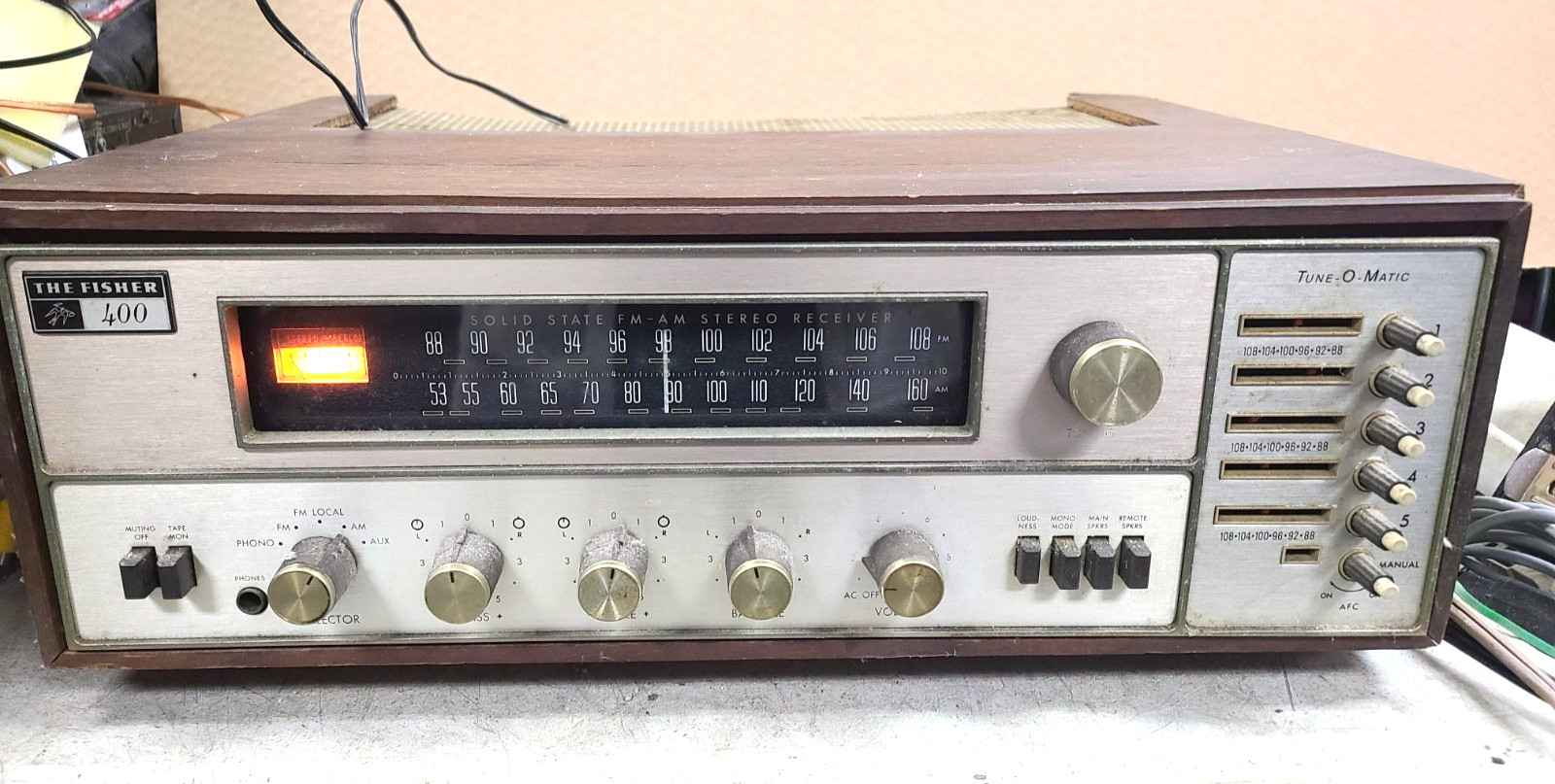
The Fisher 400-T is a classic tube-powered stereo receiver introduced in 1964, representing the pinnacle of analog audio engineering during the mid-1960s. Revered for its robust build quality, elegant design, and rich sonic character, the 400-T remains a sought-after component among vintage audio enthusiasts and collectors. Combining a high-performance amplifier section with a sensitive FM/AM tuner, this receiver delivers a warm, engaging listening experience—particularly well-suited for vinyl playback.
Specifications
| Feature | Specification |
| Model | Fisher 400-T |
| Year of Production | 1964–1968 |
| Type | Tube stereo receiver (amplifier + tuner) |
| Power Output | 40 watts per channel (RMS), 2 channels |
| Output Tubes | 4 × 7189 (equivalent to EL84) |
| Impedance Settings | 4, 8, or 16 ohms (switchable) |
| Frequency Response | 20 Hz – 20 kHz (±1 dB) |
| Tuner Bands | FM, AM (MW) |
| Inputs | Phono (MM), Auxiliary, Tape (via external adapter) |
| Tone Controls | Bass, Treble |
| Front Panel Features | Analog tuning meter, stereo/mono switch, input selector, volume, balance |
| Phono Stage | High-gain, low-noise design optimized for moving magnet cartridges |
| Power Supply | Linear transformer-based |
| Dimensions | 19" W × 6.5" H × 14.5" D |
| Weight | Approx. 42 lbs (19 kg) |
Historical Context
The Fisher 400-T was released during a golden era of high-fidelity audio, when tube technology had matured and manufacturers like Fisher, Marantz, and Scott were pushing the boundaries of performance and reliability. Fisher, founded by Avery Fisher, was known for its commitment to accuracy and engineering excellence. The 400-T exemplified this philosophy, offering audiophiles a fully integrated solution with both amplification and broadcast reception in a single chassis.
As one of Fisher’s most popular tube receivers, the 400-T stood out for its powerful 40-watt-per-channel output—impressive for a tube design of its time—and its precision FM tuner, which featured a calibrated analog meter for accurate station tuning. Its use of high-quality transformers and point-to-point wiring contributed to its reputation for durability and sonic clarity.
The 400-T arrived just before the widespread shift to solid-state electronics in the late 1960s, making it a high-water mark in tube receiver design. It was marketed to serious listeners who valued both performance and craftsmanship, and it remains a benchmark for vintage integrated receivers.
Sound Signature
The Fisher 400-T delivers a classic tube sound: warm, smooth, and musically engaging. Its rich midrange brings vocals and acoustic instruments to life, while the detailed highs remain natural without harshness. The bass is well-controlled and dynamic for a tube amplifier, especially when driving efficient speakers.
Its forgiving nature makes it ideal for older recordings and vinyl sources, where it can soften digital glare or tape saturation. When paired with high-sensitivity speakers (90 dB+), the 400-T performs exceptionally well, revealing its ability to create a spacious soundstage and precise imaging.
Maintenance and Restoration Tips
Like all vintage tube equipment, the Fisher 400-T benefits from proper care and periodic maintenance to ensure safe and optimal operation:
- Capacitor Replacement: The electrolytic and coupling capacitors degrade over time. A full recapping is strongly recommended, especially if the unit has been stored for years.
- Tube Replacement: The 7189 (EL84) output tubes should be checked for wear. Replacing them with matched, high-quality NOS or new-production tubes can restore full power and balance.
- Cleaning: Use contact cleaner on potentiometers, switches, and jacks to eliminate crackling or channel dropouts.
- Bias and Alignment: While the 400-T is cathode-biased (no manual bias adjustment), the FM tuner may require realignment for optimal reception.
- Power-Up Routine: Always power up the unit gradually using a variac or dim-bulb tester if it has been unused for decades.
- Ventilation: Ensure adequate airflow around the chassis, as tube receivers generate significant heat.
Avoid using the receiver without a speaker load connected, as this can damage the output transformers.
Collectibility and Market Value
The Fisher 400-T ranks 8/10 in collectibility due to its reputation, build quality, and historical significance. Fully operational units in original condition command strong prices, especially those with matching serial numbers and unmodified circuitry.
- Market Value: $800 – $1,500
(Higher end for restored, fully functional units; lower for non-working or heavily modified examples)
Original packaging, manuals, and warranty cards can increase value for collectors.
Conclusion
The Fisher 400-T is more than just a vintage receiver—it's a piece of audio history. Combining powerful tube amplification, excellent tuner performance, and a lush, musical sound, it continues to captivate audiophiles over half a century after its introduction. With proper restoration and care, the 400-T can deliver decades more of listening pleasure, serving as both a functional component and a testament to the artistry of analog design.
eBay Listings



As an eBay Partner, we earn from qualifying purchases. This helps support our independent vintage technology research.
Related Models
- Fisher 800-T (1962)
- Fisher 332
- Fisher 400-R (1963)
- Fisher 432
- Fisher 440-t
- Pioneer QX-949A (1978)
- Pioneer SX-2000 (1978)
- Pioneer SX-2500 (1978)
- Marantz SR-2000 (1999–2001)
- Onkyo TX-1500MKII (1975)