Electro-Voice Sx200
A 39-pound box that puts out 126 dB continuous and hangs off a single handle.
Overview
The Sx200 is a two-way, full-range portable speaker system, and it is about the smallest box EV could build that still holds its own on a loud stage. It uses a 12-inch woofer and a DH2010A compression driver with a pure titanium diaphragm. A 65° x 65° constant-directivity horn is molded right into the front baffle. The whole thing weighs 17.7 kg (39 lb) and measures 58.6 cm high by 42.9 cm wide by 31.2 cm deep. One person can carry it, and the integral handle molded into the cabinet makes it a one-trip load-in.
The numbers are good. Electro-Voice rates the Sx200 at 101.5 dB sensitivity, measured at 1 meter with a 1-watt, 300-2,000 Hz pink-noise input in an anechoic environment. That's very efficient, so the speaker gets loud on very little amplifier power. Axial frequency response is specified at 80-25,000 Hz. The low-frequency 3-dB-down point is 80 Hz, and the usable low-frequency limit is 55 Hz when the system is paired with the Xp200A controller. Power handling is rated at 300 watts long-term average per ANSI/EIA RS-426-A 1980, with a short-term peak capacity of 1,200 watts. Nominal impedance is 8 ohms, minimum 6 ohms.
The cabinet is high-impact polypropylene structural foam, a trapezoidal enclosure that is stiff, extremely durable, and light. Molded into the shell are an integral carrying handle, a stand socket for 1⅜-inch stands such as the Electro-Voice model 100BK, and four attachment points (metric M8 x 1.25) for suspension. Rubber feet bolt to the bottom, and mating sockets molded into the top let you stack systems. Two supplied monitor feet insert into holes at the rear so the box can lie horizontally as a stage monitor. The "O" rings on those feet allow repeated removal without wear.
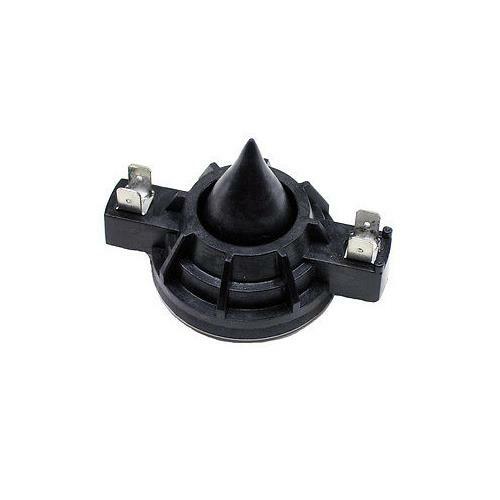
The DH2010A driver uses Electro-Voice's Resonant Drive technology to couple the voice coil to the diaphragm. This smooths the high-frequency response and reduces the internal equalization needed to flatten it. Driver output extends to 25,000 Hz. A self-resetting protection circuit, EV's PRO circuit, watches the driver. If input power exceeds the nominal rating, the circuit engages and cuts power to the driver by 6 dB until the input drops back to a safe level. That's a real reliability feature, not a marketing bullet. The horn's Varipath throat geometry is designed to direct output toward the corners of a room, which the manual notes are points of coverage not described by the usual horizontal and vertical coverage angle specs. Coverage is rated at 65° ±15° both horizontally and vertically, 2,000-20,000 Hz. Directivity factor (Q) is 14.3 (+7.9, −9.3) median from 800 to 16,000 Hz. Directivity index is 11.1 dB (+2.4, −4.1).
Crossover between the woofer and the horn sits at 1,500 Hz, with an 18 dB-per-octave low-pass slope and a 6 dB-per-octave high-pass slope. Box tuning frequency is 65 Hz. Distortion at 0.1 full power input runs 1.2% second harmonic at 100 Hz, 1.4% at 1,000 Hz, and 10% at 10,000 Hz. That last number is high, but it's the kind of thing that shows up on a spec sheet and rarely in a listening room at reasonable levels. Third harmonic at the same input is 0.1% at 100 Hz, 1.4% at 1,000 Hz, and 2.5% at 10,000 Hz. At 0.01 full power, second harmonic drops to 0.2% at 100 Hz and 1,000 Hz, and 1.0% at 10,000 Hz. Third harmonic sits at 0.1%, 0.4%, and 0.2% respectively.
The bass section is a 12-inch Pro-Line woofer with beryllium copper lead wires, a low-mass edge-wound voice coil, and high-temperature materials. The magnetic structure adjacent to the coil is insulated using EV's PROTEF process (U.S. Patent #4,547,632), and the coil is driven by a 16-pound magnet assembly. The woofer is designed using Thiele-Small parameters for efficient performance down to below 80 Hz. Maximum woofer acoustic output is listed at 17.7 watts.
Connections depend on the version. The Sx200 and Sx200W use ¼-inch phone jacks. The Sx200-E and Sx200W-E use Neutrik Speakon NL4MP connectors. Paralleled input and output connectors are on all versions, so you can daisy-chain cabinets. The W variants are white. The manual lists the Sx200, Sx200-E, Sx200W, and Sx200W-E as the four available configurations.
Electro-Voice recommends amplifier power of 600 to 1,200 watts for the Sx200, which is 2.0 to 4.0 times the long-term average noise power rating. The manual is blunt about who should attempt that: skilled experts in sound system installation and operation, or those who can discipline themselves against pushing the system for ever-higher levels and avoid accidents like catastrophic feedback or dropped microphones. For everyone else, a more modest amplifier will still get the box loud, because 101.5 dB sensitivity means it doesn't need much to reach serious SPL.
For more bottom end, EV offered two matching bass modules: the Sb120 (non-powered) and the Sb120a (powered, with a 400-watt amplifier built into the cabinet). Both use similar structural foam enclosures and were designed to complement the Sx200. The Xp200A system controller provides up to 12 dB of additional bass output from the Sx200 itself, with the amount of low-frequency enhancement adjustable to taste. The Xp200A also provides a sub-woofer output that is a crossed-over sum of the left and right channels for feeding the bass modules.
EQ (August 1994, p.71) ran a piece introducing the System 200 modular pro audio line, describing the Sx200 as a 39-lb full-range system putting out more than 126 dB continuous — more than double any comparable speaker. The same piece noted that the Sb120a bass module was a 34-lb box containing a 400-watt amplifier and a 12-inch woofer, and that the Xp200 combined a crossover with electronic enhancement. Sound on Sound (February 1996, p.85) carried a testimonial-style ad from a working band that had switched to the System 200, praising the Sx200's clean, up-front power and the Sb120's punchy bass from an "unbelievably compact" cabinet. That's advertising copy, not independent measurement, but it captures why the line sold: bands wanted a system they could load into a small van and still be heard in a noisy room.
The Sx200's five-year warranty against defects in materials and workmanship was standard for EV speakers of the period. Active electronics in the line carried a three-year term. The warranty explicitly excluded burned voice coils and cone or coil damage from improperly designed enclosures.
Collectors and working musicians still seek these out for the reasons they were bought new: high efficiency, a durable foam cabinet that survives being thrown in and out of vans, and stand mounting, arraying, and monitor use from one box. The Speakon-equipped Sx200-E and Sx200W-E versions are generally more desirable for modern use, since Speakon connectors are more secure than ¼-inch jacks for high-current applications. Replacement drivers and diaphragms are the usual wear items. The Sx200 is part of a broader EV portable line, and owners often pair it with the Sb120 or Sb120a for full-range work.
eBay Listings


As an eBay Partner, we earn from qualifying purchases. This helps support our independent vintage technology research.