Electro-Voice SP-12 (c. 1954–mid-1960s)
A coaxial speaker that spent more than a decade in Electro-Voice's catalog and left almost no paper trail. The SP-12 is known mostly through the ads that sold it.
Overview
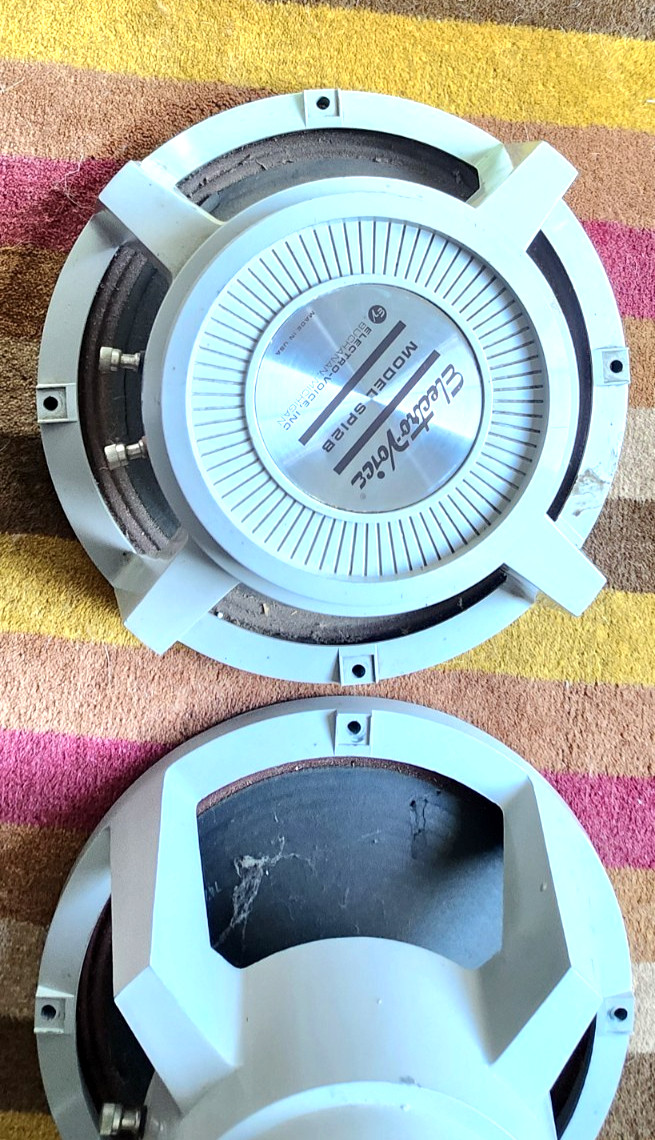
The SP-12 is a mid-century Electro-Voice driver that turns up in old system ads and garage-sale cabinets far more often than in any surviving spec sheet. Little is documented. Most of what exists comes from Electro-Voice's own advertising, which ran from at least 1954 into the mid-1960s. The name is slippery. Sources use "SP-12," "SP-12-B," and "SP12B," and the available material says only that these names were used at different points. Whether that means revisions, cosmetic changes, or sloppy typesetting in the ads is not established anywhere in the record.
The documentation does confirm the basic architecture. It's a coaxial loudspeaker. That's the whole design story as far as the archive can verify it. No frequency response, power handling figure, crossover details, driver complement beyond the coaxial description, or exact production dates appear in the available sources. Anyone quoting a rated response or sensitivity for the SP-12 is working from something other than the surviving record.
The most concrete early trace is a 1954 system advertisement, Hi-Fi Music at Home (March 1954, p.4). It bundled the SP-12-B into a package called "Music System #101" with a Pilotone amplifier, a Garrard record changer, and a G.E. magnetic cartridge, priced at $159.50 for the complete system. That tells you how Electro-Voice expected the driver to sell, as the speaker end of a complete hi-fi package and not as a standalone component. By the mid-1960s the picture had shifted.
The $37.00 figure is a single-source number tied to a specific year. The archive flags it as lower-confidence because it appears in a metadata field and not in the main body of the source material. Treat it as a reported price, not a verified MSRP. The same caution applies to the $159.50 system bundle. It's the figure the 1954 advertisement carried, but it prices the whole package, not the speaker alone.
Key Features
Coaxial Driver Architecture
The surviving documentation describes the SP-12 as a coaxial loudspeaker. In period terms that meant a single chassis carrying both low- and high-frequency reproduction, instead of separate woofer and tweeter units. Mid-century manufacturers used the coaxial approach to get a point-source presentation from one mounting hole. It suited cabinets where a separate tweeter cutout wasn't practical, and buyers who wanted full-range sound from a single driver. Beyond that description, the archive has no circuit topology, crossover, or construction detail. The internal layout of the SP-12 remains undocumented in the sources reviewed.
Whizzer Cone Design (SP12B)
The SP12B variant, the name that shows up most often in surviving listings and period advertising, is described in multiple sources as a whizzer-cone full-range design. A whizzer cone is a small secondary cone attached to the voice coil. It radiates high frequencies mechanically, with no separate tweeter or electrical crossover. It's an old approach, and it's why the SP12B could be sold as a "full range" driver when many competing 12-inch speakers needed a helper tweeter. Two independent listings describe the design this way, which makes it one of the better-corroborated facts about the line.
Alnico Magnet
SP12B listings describe the magnet as Alnico, and one seller calls the housing a "coffee can" style, the cylindrical alnico magnet assembly common to drivers of the period. This is seller-stated and not manufacturer-confirmed, but it fits the era and the physical form shown in the listings. Alnico is one reason these drivers still draw interest from collectors building period-correct systems.
Use as a Low-Frequency Driver in Multi-Way Systems
One period source, a stereonomono reference that appears to contain a typo rendering "SP12B" as "SPB12," states that the SP12 and SP12B may be used as low-frequency drivers in expanded separate two- and three-way systems. In that application, it says, their operation is comparable to the Electro-Voice Models 12 W and 12BW low-frequency drivers. That's a single-source claim and should be treated as one. It does show the driver was understood as more than a full-range coaxial. It could be drafted into a larger multi-way build when the owner wanted more bottom-end authority than a single coaxial could provide.
Impedance and Diameter — Seller-Stated Only
The archive has no manufacturer impedance figure for the SP-12. Seller listings reference a 12-inch diameter and, on the SP-12BW variant, a 16-ohm impedance. Those numbers come from eBay listing titles, not from any confirmed spec source, so read them as seller claims and not factory ratings. One owner on a collector forum reports that SP12B units measure in the 11-ohm area on a DC resistance check. That's a useful data point for buyers testing a driver, since DCR readings don't map directly to rated impedance and a nominal 16-ohm driver will typically read lower on a meter.
Historical Context
The SP-12's documented life runs from at least 1954 into the mid-1960s, with the SP-12B variant dated by one source to circa 1965-1966. A separate listing dates an SP12B to the 1950s, which conflicts with the 1965-1966 date. The two may refer to different production runs of a long-lived model, or one may simply be wrong. The archive doesn't resolve the conflict.
What is clear is that the SP-12 was a catalog fixture for over a decade, sold under multiple name variants and appearing in both complete-system advertising and standalone component listings. Electro-Voice's own mid-1960s advertising pitched the SP12B and the related 12TRXB as long-time "best buys," claiming that listeners and laboratories had favored them for over a decade. That's a marketing claim, not an independent verdict, but it confirms the driver's longevity in the company's own telling.
A note for anyone searching: "SP-12" was also the model name of an unrelated E-mu drum machine from the 1980s. This page is about the Electro-Voice speaker. The two products share only a name, and search results for one will often surface the other.
The record also hints that the SP12 saw use in larger Electro-Voice systems. One eBay listing title references it in connection with a Patrician 700, and other listings describe SP12B units pulled from Allied Knight 2350A and 2350B cabinets. Those are seller claims from listing titles, not confirmed system-integration data, and the archive treats them as low-confidence. They suggest the driver was used across a range of applications, but they don't establish any official pairing.
Collectibility & Value
The SP-12 market is a driver market, not a collector-object market. Asking prices on eBay at the time of research ranged from $45.00 for a pair of SP-12B woofers dated circa 1965 up to $98.00 for a pair of SP-12BW drivers pulled from Allied Knight cabinets, with singles in the $49.00 to $74.95 range. On the SP12B side, listings ran $44.95 for a single 16-ohm unit with a noted whizzer-cone flaw and small hole, up to $80.00 for a tested 8-ohm full-range unit. These are seller-asked prices, not confirmed sales. As usual with vintage drivers, condition, impedance variant, and whether the cone and voice coil are original all move the number more than the model name does.
The whizzer cone is the SP12B's signature feature and also its most vulnerable point. One tested listing specifically flags a flaw and small hole in the whizzer. Buyers should inspect that secondary cone carefully, along with the voice coil former and the alnico magnet assembly. The DCR reading in the 11-ohm area reported by one owner works as a sanity check. A driver reading far off that figure is either a different impedance variant or has a damaged coil. The archive has no documented common-failure or maintenance procedures for the SP-12, so buyers are largely on their own when assessing a used unit.
Seller sound impressions in the surviving listings are positive - "rich, full sound with excellent clarity" and "sounds great" - but these are seller descriptions, not independent reviews. The archive found no period magazine test report for the SP-12.
eBay Listings


As an eBay Partner, we earn from qualifying purchases. This helps support our independent vintage technology research.