Electro-Voice Sentry 500
A studio monitor that hits 96 dB at one meter on a single watt — and dares you to feed it 400 on peaks.
Overview
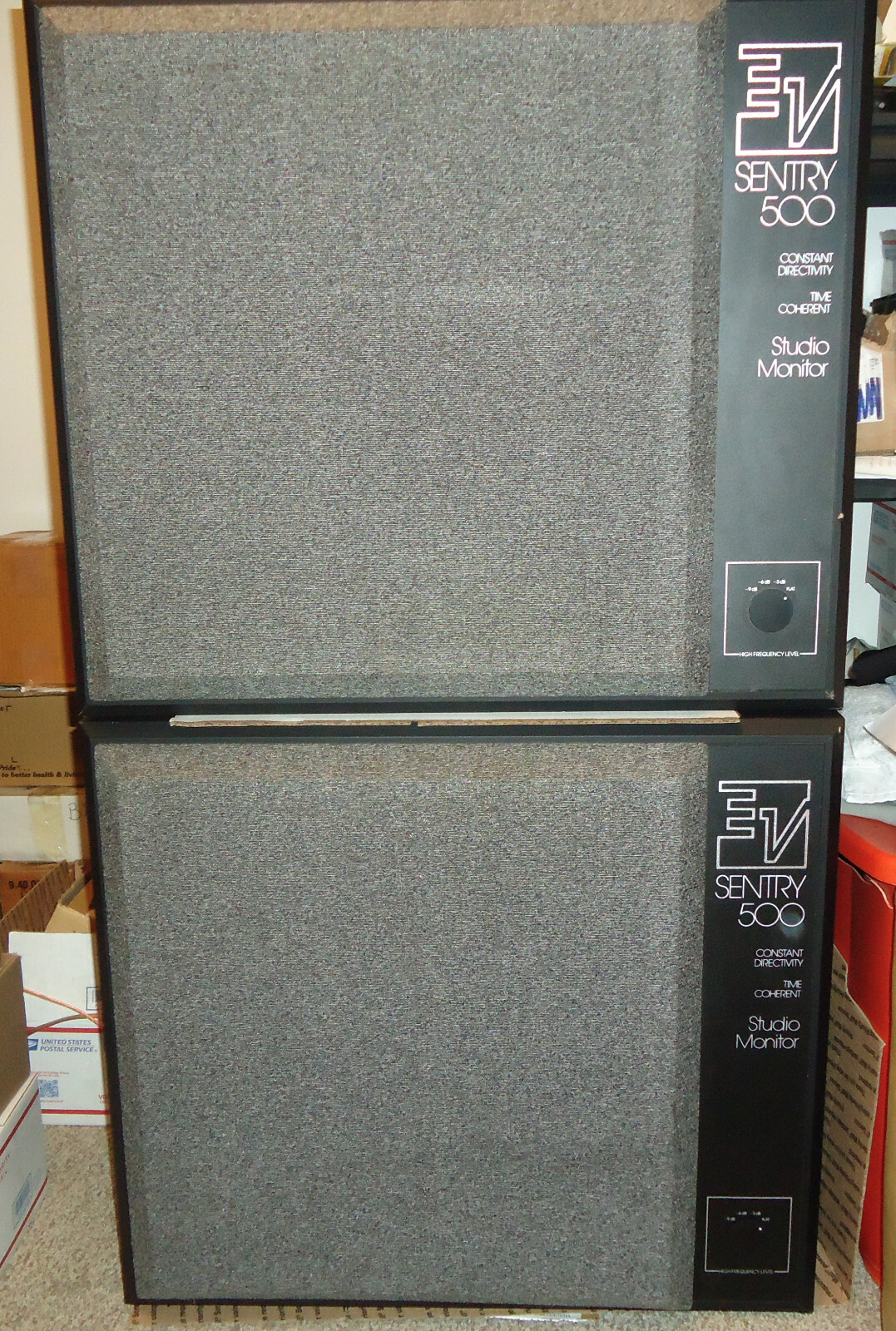
The Sentry 500 arrived as Electro-Voice's bid for the broadcast and recording studio market, and the company's own literature makes the pitch plain: this is a monitor built to be a test instrument, not a piece of furniture. E-V's Greg Silsby, writing in the promotional material that ran across the trade press, argued that too many boxes get a "studio monitor" label without the precision engineering behind it — cosmetic appeal and a particular popular sound traded in for real accuracy. Whether or not one buys the sales framing, the Sentry 500's spec sheet backs up the intent. The system delivers 96 dB at one meter from a single watt, a sensitivity figure that speaks to the high-efficiency, optimally tuned Thiele-aligned cabinet E-V paired with its Sentry components. That efficiency is matched to serious power capacity: 100 watts continuous program material with 6 dB of headroom, which works out to 400 watts on peaks. For a studio asked to reproduce the wide dynamic range of contemporary music and digital recording, that combination is the whole point.
Frequency response is quoted at 40–18,000 Hz, ±3 dB — a linearity claim E-V was keen to connect to the smaller Sentry 100A, noting that because the two systems share it, program material could be mixed on one and sweetened on the other with confidence in the match. The company also stressed acoustic time coherence, the synchronous arrival of wavefronts from the high- and low-frequency drivers, achieved through crossover design and driver positioning.
The most distinctive engineering story here is the constant-directivity behavior. The Sentry 500 uses an E-V-exclusive high-frequency "Director" to hold essentially uniform coverage across a wide angle from 250 Hz up to 10 kHz, then 60° dispersion from 10 kHz out to 18,000 Hz — and it does so on both the vertical and horizontal axes. E-V's own copy makes the practical case: the "sweet spot" that used to fit one set of ears now lets the engineer, producer, and talent all monitor the same accurate sound at once. The coverage angle is where the documentation gets slippery — the manual text states 110° while a distributor listing quotes 100° for the same 250 Hz–10 kHz band, so treat the exact figure as approximate. The trade press took notice of the model's introduction; Mix (1983, p.15) and Recording-Engineer (August 1983, p.75) both carried E-V's "a monitor by design" campaign, and DB-Magazine (December 1982, p.15) ran the same pitch to the studio crowd, which places the Sentry 500's push into the professional market in the early 1980s. A contemporary show report in the same period noted the Sentry 500's adaptable wall-mounting bracket alongside the response and power figures — a reminder that these were meant to be installed in real rooms, not just auditioned on a pedestal.
The tweeter deserves its own paragraph, because E-V clearly enjoyed bragging about it. The Super-Dome/Director combination handles a full 25 watts of program power — roughly five times the capacity of most "high powered" tweeters, per the company's own comparison. Silsby's line about tweeters converting electrical energy to acoustical energy "not to smoke and fire" is marketing, but the underlying durability claim is the kind of thing studio engineers care about when someone rewinds a tape at full volume. The same protection theme shows up in E-V's copy for the smaller Sentry 100, where the 25-watt tweeter rating is pitched as insurance against exactly that scenario.
Pricing put it firmly in professional-but-credible territory: manufacturer's list is quoted at $499.00 in distributor literature, with at least one dealer advertising a discounted BSW price. That positioning — serious monitor performance without flagship-studio pricing — is consistent with how E-V framed the whole Sentry line.
For collectors and studio owners today, the Sentry 500 is a period-correct way to hear what early-1980s monitoring sounded like: high efficiency, wide dispersion, and power handling that flatters the dynamics of the source rather than compressing them. Buyers should note that the coverage-angle discrepancy between sources means the exact dispersion spec is best confirmed against the specific unit's engineering data sheet, and that the model is documented primarily through E-V's own promotional and manual material rather than independent lab measurement — so the numbers above are the manufacturer's claims, not third-party verified figures.
eBay Listings


As an eBay Partner, we earn from qualifying purchases. This helps support our independent vintage technology research.