Electro-Voice S-200
A two-channel active equalizer made as the companion piece to the S-200 Stage Speaker system. It is the reason that system reaches an octave lower than it otherwise would.
Overview
The Electro-Voice S-200 is not a standalone product in the usual sense. It is a two-channel active equalizer built specifically to be used with the Model S-200 Stage Speaker system as an option — and when it is switched into the circuit, it changes what those speakers can do. According to the owner's manual, the equalizer allows the speakers to be switched into their equalized (step-down) mode of operation, extending the low-frequency response limit by almost one octave, from 90 Hz to 50 Hz. It also provides four decibels of increased efficiency in that mode. That is not a subtle tweak. An octave of low-end extension plus a 4 dB efficiency bump is the kind of change that turns a portable stage speaker into something that can actually carry a bass line.
The equalizer is deliberately conservative at the top end. Some competitive systems provide up to 18 dB of electrical boost at high frequencies. The S-200 equalizer is essentially flat above 1000 Hz, with a gain spec of 0 dB there. This substantially reduces the amount of high-frequency energy the power amplifier has to deliver. The amplifier isn't asked to pump out treble boost that gets thrown away as heat or distortion, and its headroom is kept for the low end.
Below 50 Hz, a sharp cutoff filter attenuates sub-sonic signals and noise that lie below the useful response range of the speakers. It is not a gentle roll-off. It eliminates energy-robbing signals from the power amplifiers and significantly reduces speaker cone excursion. So the woofer doesn't pump in and out on inaudible rumble, and the amplifier doesn't work on content neither it nor the speaker can reproduce.
The input and output connections are standard ¼-inch phone jacks. The equalizer is designed to drive two high-impedance, unbalanced loads, as provided by typical power amplifiers. Up to five such amplifiers may be driven in parallel without appreciable degradation of specifications, and up to ten, with only a reduction in output level. The input impedance is 500 k ohm, unbalanced, and the output is also unbalanced. The equalizer can deliver over 8 volts RMS output into a high-impedance load, much more than is required to drive most power amplifiers to full output. A number of amplifiers may be driven in parallel so long as their combined impedance does not fall appreciably below 1000 ohms.
The circuitry uses what the manual describes as the latest BI-FET operational amplifier technology, employed to assure very fast slew-rate capability and clean sound. The parts list confirms TL072 integrated circuits. The TL072 is a dual low-noise JFET-input op-amp, a serious choice for audio at the time, and still respected for its low distortion and high input impedance. The inputs are very high impedance and protected against incidental DC leakage voltages up to 50 V. The manual notes that although it is unlikely the equalizer could be overloaded at its input under any normal conditions, the maximum permissible input level versus frequency represents a substantially greater level than that of competitive units at high and low-frequency extremes.
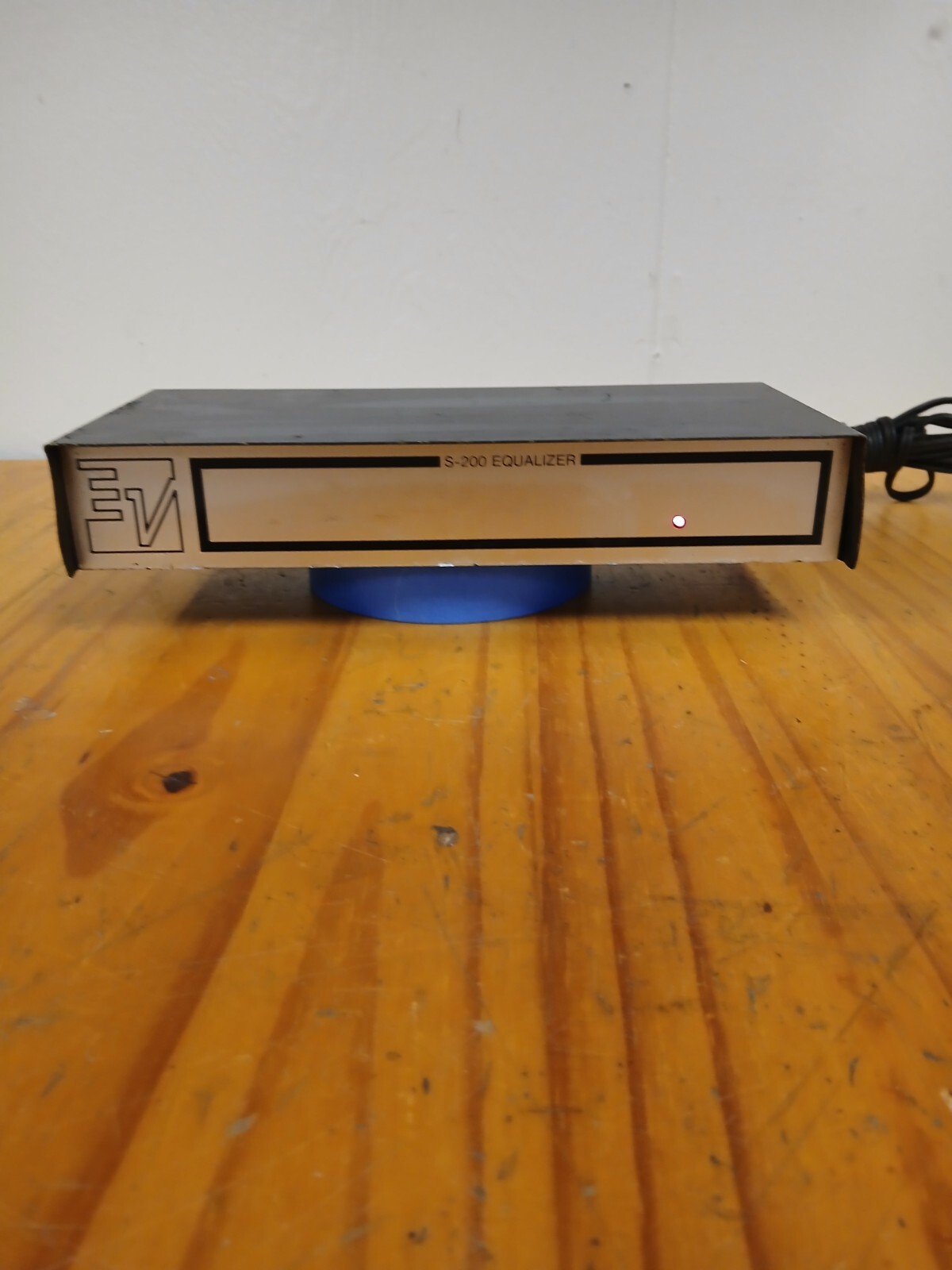
Power draw is modest: less than 2½ watts. The domestic model runs on 100-130 V, 60 Hz, and the export model on 200-260 V, 50/60 Hz, both at 2.5 W maximum. Because the drain is so low, the manual suggests the equalizer may be left energized between uses if desired. A red LED on the front panel indicates power. The chassis measures 4.2 cm (1.67 in.) in height, 24.3 cm (9.58 in.) in width, and 11.1 cm (4.35 in.) in depth. An adapter panel is provided for mounting in a standard 19-inch rack. The input and output circuit grounds are isolated from the chassis by an internal 10-ohm resistance, which reduces the likelihood of a ground loop when the unit is mounted in an equipment rack.
The S-200 equalizer connects between the mixer (or preamplifier) and the power amplifier. The output of the mixer goes to the input of the equalizer, and the output of the equalizer goes to the input of the power amplifier, using shielded cable for both connections. The line cord goes to AC power. The equalizer shapes the signal before it reaches the amplifier, which is how it extends the speaker's low-frequency limit without asking the amplifier for more power at those frequencies.
Period coverage of the S-200 Stage Speaker system shows what this equalizer was supporting. Recording-Engineer (August 1983, p.108) described the portable stage speaker system as employing a high-output version of EV's Super-Dome tweeter, coupled to a high-frequency Direktor molded as an integral part of the cabinet. That coupling of a direct radiator to a directivity-controlling device duplicates the performance of an EV constant directivity horn. The same piece noted the system was housed in a black plastic cabinet with a gray grille, weighing 36 pounds and displacing 1.8 cubic feet. Modern-Recording (October 1983, p.56) reported that the computer-designed woofer and optimally-vented enclosure benefited from new heat-resistant voice coil materials and proprietary manufacturing techniques, with a power rating that met the standard RS-426 specification.
Ten years later, EQ-Magazine (August 1994, p.71) looked back and noted that the Electro-Voice S-200 speaker system had set the standard for portable, lightweight speaker systems a decade earlier, and had been unrivaled in performance until the introduction of System 200 Modular Pro Audio. The equalizer was not a cosmetic accessory. It unlocked the speaker system's extended low-frequency mode, and without it owners were leaving an octave of response and 4 dB of efficiency unused.
Today the S-200 equalizer is a niche piece. It is only useful with the S-200 Stage Speaker system, or if you have some other use for a two-channel active equalizer with a sharp sub-50 Hz filter and flat response above 1 kHz. The TL072 op-amps are still available and inexpensive, the ¼-inch jacks are standard, and the power supply is simple. The manual includes a full parts list with six-digit part numbers, and service parts were available from the Redmond, Washington factory. The warranty was one year from date of original purchase against malfunction due to defects in workmanship and materials. Units were repaired or replaced at Electro-Voice's option, without charge for materials or labor, if delivered prepaid to the proper service facility. The warranty did not extend to finish, appearance items, or malfunction due to abuse or operation under other than specified conditions, and repair by anyone other than Electro-Voice or its authorized service agencies voided the guarantee.
The S-200 equalizer is a black box with ¼-inch jacks, a red LED, and one specific job. It extends the low-frequency response of the S-200 speaker system by almost an octave, adds 4 dB of efficiency, filters out sub-sonic noise, and draws less than 2½ watts while doing it.
eBay Listings
As an eBay Partner, we earn from qualifying purchases. This helps support our independent vintage technology research.